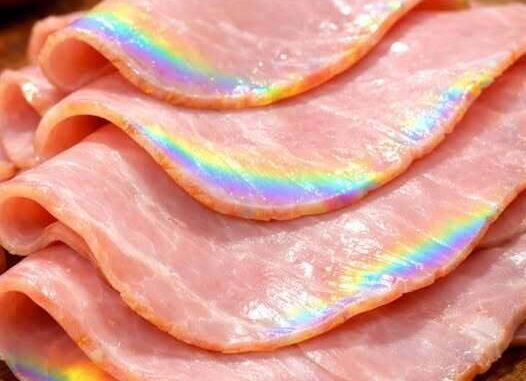
Understanding this phenomenon also helps explain why similar effects appear in other everyday foods. Thinly sliced turkey, roast beef, and even some types of cured salami can show faint color shifts under the right conditions. In each case, the underlying cause remains the same: highly ordered muscle fibers interacting with light in a structured way.
This is not unique to food either. In nature, similar optical patterns appear on butterfly wings, fish scales, and certain bird feathers. These are known as structural colors, where the appearance of color is created not by pigment, but by microscopic physical structures that bend and scatter light. Deli ham simply happens to be an unexpected place where a simplified version of this effect can be seen.
Another interesting detail is how slicing direction influences the appearance. When meat is cut against the grain, the exposed muscle fibers are more uniform and tightly packed on the surface. This increases the likelihood of light interference, making the rainbow sheen more visible. If the slice is thicker or cut differently, the effect may be much weaker or not noticeable at all.
Packaging also plays a role in how strong the effect appears when first opening a sealed pack. Vacuum-sealed deli meat often retains a thin layer of moisture on its surface. This moisture acts like a reflective film, enhancing the way light interacts with the meat. As the surface dries out after being exposed to air, the iridescent effect may fade or disappear entirely.
Temperature can also subtly influence the visual outcome. Cold meat tends to have a firmer surface structure, which can reflect light more evenly in some cases. As it warms slightly at room temperature, the surface properties change, which may alter how strong or visible the rainbow effect becomes.
From a food science perspective, this phenomenon is actually useful in teaching how physical structure influences perception. It demonstrates that color is not always a fixed property of an object, but often depends on context, angle, and environment. Two people looking at the same slice of ham from different positions may see entirely different color patterns.
Despite how unusual it looks, iridescence in deli meat has no connection to additives or artificial coloring. No chemical reaction is occurring in the moment you see it. The pigments already present in the meat remain unchanged. What changes is only the path of light as it reflects and interferes across microscopic surfaces.
This is why food safety agencies consistently reassure consumers that rainbow-colored ham is not a sign of contamination. Bacteria and spoilage processes do not create shifting rainbow patterns. Instead, spoilage produces more consistent and structural changes such as odor, texture breakdown, and persistent discoloration that does not vary with light angle.
Still, it is understandable that people feel uncertain when they first see it. Humans are naturally cautious about unusual changes in food appearance, and that instinct has historically helped with survival. The key is learning to separate visual novelty from actual warning signs.
Once that distinction is clear, the phenomenon becomes less about concern and more about curiosity. It offers a small window into how complex and beautiful even processed foods can be when viewed through the lens of physics.
In everyday life, this also encourages more mindful observation. Many people go through daily routines without considering the science behind ordinary experiences. Something as simple as opening a packet of deli meat can become an opportunity to notice how light, structure, and material interact in subtle ways.
It also highlights how modern food production unintentionally creates these visual effects. Industrial slicing machines are designed for consistency, not aesthetics, yet that very precision is what makes iridescence more visible. The smoother and more uniform the surface, the more predictable the interaction with light becomes.
Over time, as people become more aware of this effect, it may even change how they interpret food appearance in general. Instead of reacting immediately with concern, they may pause and consider whether what they are seeing is actually a physical phenomenon rather than a sign of spoilage.
In the broader sense, this is a reminder that science is constantly present in everyday life, even in places where it is not immediately obvious. From the way food is processed to the way our eyes interpret light, countless small interactions shape how we perceive the world.
So the next time a slice of deli ham shimmers with unexpected colors, it is not a warning sign or a defect. It is a quiet demonstration of optics at work—light bending, scattering, and reflecting in ways that reveal the hidden structure of something as ordinary as lunch meat.
What looks strange at first is actually just the surface of a much deeper explanation, one that connects kitchen science to physics, biology, and human perception in a surprisingly elegant way.
Leave a Reply