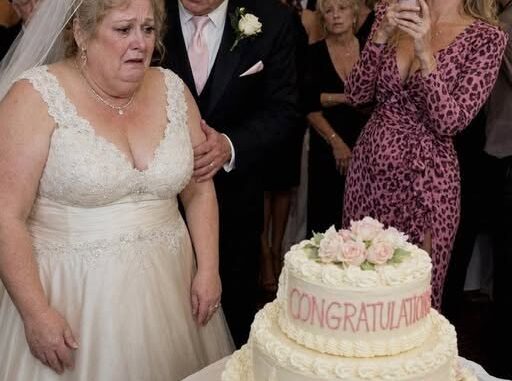
At 56, I thought finally finding love was the surprise of my life. Then my younger sister sent a wedding cake no bride should ever see, with pink words across the frosting meant to shame me in front of all the guests. What my husband did next left her speechless.
The library smelled of old paper and lemon polish, just as it had for 34 years. I shelved a worn copy of Bridge Design Principles and listened to the radiator hum—the only company most evenings asked of me.
At 56, I had made peace with quiet. Peace with the worn cardigan, the single mug, and the cat that wasn’t mine but visited anyway.
My twenties, thirties, and most of my forties had belonged to my parents after their car crash: wheelchairs, prescriptions, sponge baths. Love, the romantic kind, had knocked on other doors.
Then came Daniel.
He visited every Thursday at four, looking for books, but stayed until closing, his calloused hands and quiet eyes catching me off guard the first time he laughed.
“Margaret,” he murmured one Thursday, sliding a book across the counter, “do you ever read these, or just judge the men who do?”
“I judge,” I tapped the spine. “Silently. It’s a librarian’s privilege.”
Daniel grinned. “What’s the verdict on me?”
“Still pending.”
Over weeks, that pending verdict turned into coffee, then dinner, then him fixing the squeaky hinge on my back door without being asked. One evening on my porch, he held my hand silently. That was Daniel—a whole sentence in a single gesture.
“I lost someone this spring,” he said. His voice caught. I didn’t press; I only rested my hand over his.
Then he did something I hadn’t expected: he asked me to marry him. Not kneeling, not dramatic—just holding a small ring and saying, “I’m 58! We’re right on time, Margie.”
I laughed and cried. “Yes!” I said.
When I called my sister Diane to share the engagement news, she was cruel. “You’re settling because you’re scared to die alone,” she sneered. Her sharp, loud laugh cut through the phone.
My other relatives chimed in, wrapped in concern, repeating her words. Every conversation chipped away at me. Daniel, patient and steady, reminded me to trust him.
“They won’t be. I have something planned. A surprise,” he said.
Two days before the wedding, Diane’s husband Roger approached me. He apologized for letting Diane mistreat me for years. That small acknowledgment was a quiet support I hadn’t expected.
On the wedding day, I stood in my bridal suite. Daniel, waiting at the altar, was nervous. Just as the ceremony began, a delivery man wheeled in a three-tier cake I hadn’t ordered. Across the front, in cruel pink cursive, it read:
“CONGRATULATIONS GRANDMA BRIDE.”
The room went silent. Diane stood near the back, phone raised, recording. My face burned. I wanted to run.
Daniel gently tapped his glass, drawing everyone’s attention. Calm, collected, he explained the situation. The cake wasn’t ours. Someone went to a lot of trouble to send it. But then, with a quiet smile, he revealed the surprise.
He cut into the cake and pulled out a wooden box, polished smooth. Inside gleamed two Paris honeymoon tickets.
The champagne glass slipped from Diane’s hands, shattering. Roger confirmed the plan: he had paid the baker to hide the box, turning Diane’s cruel joke into a gift.
Daniel then added a final touch: the granddaughter of his late best friend would join us after our honeymoon. That was the “grandma bride” truth Diane had tried to mock.
Tears streamed down my face. For the first time in 56 years, I knew love had found me. The music began, Daniel guided me to the dance floor, and our eighty guests rose to their feet.
I rested my head against his chest. Love hadn’t skipped my address—it had simply taken the long way home, bringing a whole new family with it.
Leave a Reply