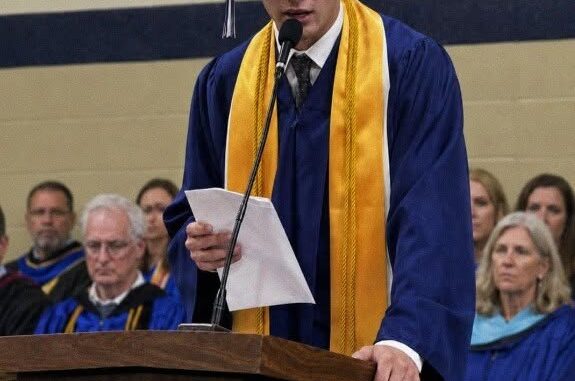
The night of my son Caleb’s valedictorian speech, I expected pride, applause, and maybe a few shaky jokes. What I didn’t expect was for him to pause mid-sentence, lock eyes with my husband, and expose a secret that had quietly controlled our household.
Caleb had worked for years to reach that stage—not because I pushed him, but because he was driven and capable. After his father passed away when Caleb was eleven, school became a place he could manage, a realm of order amid the chaos of grief. While I juggled double shifts at the pharmacy, Caleb packed his own lunches, helped his younger sister with homework, and excelled academically, quietly shouldering responsibilities beyond his age.
When I married Patrick, I thought I was offering my children stability. Patrick was organized, calm, and efficient, handling things I hadn’t noticed were broken. But beneath that polished exterior, he did not like Caleb speaking about his late father.
At first, Caleb tried to maintain peace. He was respectful, polite, and never caused the typical teenage friction. But during his senior year, subtle changes appeared—hesitations, avoidance, and the slow disappearance of college letters from the fridge. Conversations about graduation plans became curt replies: “I’m handling it.”
One day, I stumbled upon a torn envelope Caleb had hidden in the garage. When I asked about it, he dismissed it quickly. I believed it was stress. I should have pressed further, but I didn’t.
Graduation night arrived, the gym sweltering and packed with proud families. When Caleb’s name was called, my daughter gripped my hand tightly, a reminder of the anticipation in the room. Caleb walked onto the stage, his posture and expression so much like his father’s that I felt my breath catch.
He began his speech gracefully, thanking teachers, classmates, and me. My emotions spilled over as he praised the lessons I had taught him about perseverance. Then, suddenly, he stopped. Not a stumble, not hesitation—just a sudden pause.
Caleb reached into his gown and produced a sealed envelope, locking eyes with Patrick. “I can’t pretend nothing happened,” he said. His hand trembled as he revealed an old photograph: Caleb as a young boy, sitting on his father’s shoulders, smiling at the camera, and behind him, his grandmother. I hadn’t seen her in years.
“I spent most of this year believing my dad’s family had stopped caring,” Caleb said, his voice steady but heavy with emotion. “I was told to move on, to stop trying to reach out.”
He explained that Patrick had intercepted letters, checks, and invitations meant for him, hiding them in drawers and envelopes. Caleb had discovered the truth through careful searching, realizing he wasn’t abandoned—he had just been blocked. The gym was silent, the weight of the revelation settling over everyone.
Caleb’s determination to reach his grandmother led him to call her from a borrowed phone. “She cried so hard I could barely understand her,” he said. And then, the moment of joy: she appeared at the gym doors, tearful and relieved, reuniting with her grandson.
Patrick tried to justify his actions as protection for our family, but Caleb confronted him with clarity: he had been controlling relationships, not safeguarding anyone. With courage beyond his years, Caleb brought his grandmother into our lives and began rebuilding connections that had been deliberately hidden.
In the weeks that followed, Caleb helped organize documents, restore contact with family, and ensure his younger sister had access to her extended family. Patrick tried to frame Caleb as destructive, but it was clear that Caleb was simply seeking honesty and love.
Eventually, we visited the lake from the photograph—a place of childhood memories and family bonds. Caleb stood on the dock, and we recreated the photo, this time as a symbol of reclamation, connection, and truth. He looked out over the water and said, “He tried to make me feel like I had no one.” I replied, “Then you went and found everyone.”
For the first time in years, Caleb seemed fully himself—strong, visible, and embraced by the people who truly loved him. What began as a valedictorian speech had transformed into a moment of revelation and restoration. In facing the truth, he reclaimed his family, his voice, and his place in the world.
Leave a Reply