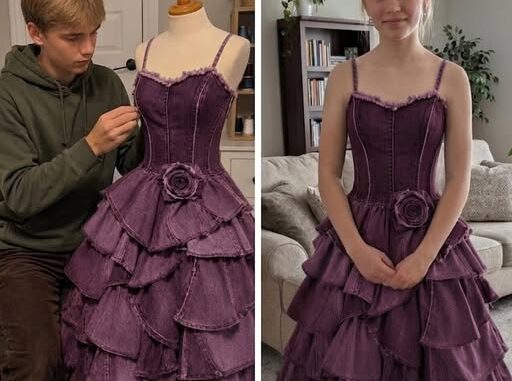
When our father passed away, our home didn’t just lose a parent—it lost its moral center. Carla, our stepmother, quickly took control of every cent, including the savings our mother had painstakingly set aside for our future milestones. She became the authority, dictating how money was spent and who deserved it.
So when I asked her for money for a prom dress, I was met with laughter instead of support. She mocked my request, calling it a ridiculous waste of money, all while clutching her designer handbag as if to emphasize her own wealth. I remember the sting of her words and the way her eyes seemed to say that nothing I wanted or needed mattered.
But what Carla didn’t realize was that my fifteen-year-old brother, Noah, had heard every word. He was quiet, the kind of boy who faded into the background, often overlooked. But what the world didn’t see was his steel-like determination beneath that quiet exterior. For the past year, he had been secretly learning to sew, practicing every evening, even while classmates laughed at him for playing with “girly” hobbies.
That night, Noah knocked on my bedroom door with a stack of our late mother’s old jeans. He looked at me with a serious expression. “Do you trust me?” he asked. I didn’t hesitate. Every worn piece of denim carried the memory of our mother—her laughter, her warmth, and the countless small lessons she had taught us. I trusted him completely.
For two weeks, our kitchen transformed into a workshop. Fabric scraps covered the countertops, scissors and needles littered the table, and Noah worked with a focus that was mesmerizing. Every stitch felt like a tribute to our mother, turning faded jeans into a gown that was equal parts delicate and bold. It was more than a dress—it was a story of resilience, a symbol of love stitched into every seam.
When the dress was finally finished, Carla saw it and laughed—sharp, cold, and cruel. She called it a “patchwork mess” and predicted that everyone at the prom would ridicule me. She even announced her intention to attend, phone in hand, eager to capture what she assumed would be my public humiliation. I felt a pang of fear, but I also felt something else—a quiet confidence that this moment didn’t belong to her.
The night of the prom arrived, and I remember stepping into the ballroom with a mix of nerves and anticipation. The room was filled with laughter, music, and the glow of string lights reflecting off polished floors. But as I walked in, the chatter slowed. People turned, some looking confused, others simply stunned.
The principal, who had known our mother well, took the microphone. But instead of commenting on the decorations or the dance, he spoke about character. Slowly, deliberately, he exposed the truth about Carla’s control over our inheritance, her dismissive cruelty, and the way she had tried to dominate the lives of two grieving children. The audience listened, many with mouths open in shock.
Then a lawyer, who had been blocked by Carla for months, stepped forward. He confirmed that legal steps were finally being taken to restore what was rightfully ours. Carla’s smug expression disappeared instantly. The power she thought she held dissolved in the face of truth, and the room was no longer filled with whispers about a prom dress—it was filled with recognition of justice.
I stepped onto the stage, wearing Noah’s creation with pride. The dress, made from our mother’s jeans, was both elegant and unique. Every stitch told a story, every panel a memory. The crowd didn’t laugh—they were silent, captivated. I realized then that the dress had become more than just a gown; it had become a testament to perseverance, creativity, and family.
Noah stood by my side throughout the evening, his quiet smile telling me everything I needed to know. He had taken something ordinary—old jeans—and turned it into something extraordinary, proving that talent, love, and determination can outshine cruelty.
By the end of the night, Carla’s presence felt hollow. She had tried to assert power over our lives, but the truth had a weight she couldn’t overcome. Our community rallied around us, providing support and encouragement that reminded me how resilient human connection can be. For the first time in years, I felt safe and validated—not because of wealth or recognition, but because we had stood firm and remained true to ourselves.
The dress now hangs in my closet as a daily reminder. It represents more than a prom night; it represents courage, resourcefulness, and the unwavering bond between siblings. People may try to mock you, take your resources, or diminish your worth—but they can’t undo the love and effort that stitches your life back together.
Looking back, I realize that Carla’s cruelty, as painful as it was, forced us to discover strengths we might never have known. Noah’s dedication to creating that dress was more than craftsmanship—it was a declaration that kindness, skill, and courage will always prevail over cruelty and greed.
That prom night wasn’t just a dance. It was a turning point, a moment when the past’s pain met the present’s courage, and justice, in its own quiet way, was served. Every stitch in that dress, every look from the crowd, and every proud glance from Noah told a story of triumph, not over others, but over the limitations that had been unfairly imposed on us.
The experience taught me an invaluable lesson: life will not always be fair, and some people will try to undermine your spirit. But when you hold onto your creativity, your integrity, and your loved ones, you can transform even the smallest scraps into something magnificent. Just as Noah turned our mother’s jeans into a work of art, we too can turn moments of hardship into milestones of strength and pride.
That prom dress is more than fabric. It’s a symbol of victory over unfairness, proof that compassion, resilience, and ingenuity will always outshine cruelty. And every time I see it, I remember that no matter how dark the situation may seem, love—especially the love stitched into family—can rebuild everything that was threatened.
Leave a Reply