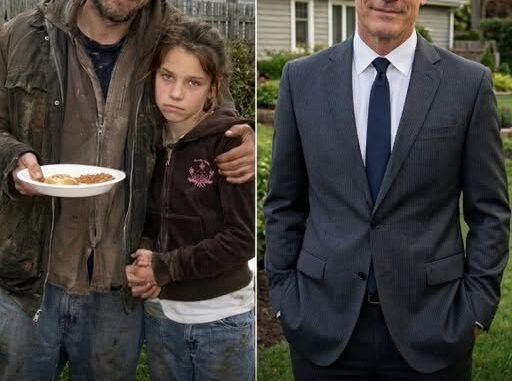
The day after my mother’s funeral, the homeless man who had lived behind our house disappeared.
For most of my childhood, I believed he was just that—a man who didn’t belong anywhere except the scrap of land behind our fence, built from tarps, wood pallets, and whatever he could salvage. His name was Victor. At least, that’s what my mother called him.
Every single day of my life growing up, she cooked for him.
Not occasionally. Not when she had extra.
Every. Single. Day.
And every single day, I watched her do it while telling myself something must be wrong with her.
A Childhood I Didn’t Understand
Our house was never wealthy. The paint peeled in thin strips along the window frames. The heater worked only when it felt like cooperating. I learned early how to stretch meals, how to wear shoes a size too small, how to pretend I wasn’t hungry.
And yet my mother—Stephanie—always made three portions.
Two stayed inside the house.
One went into a plastic container she washed and reused every day for Victor.
I hated it.
I was eleven when I finally snapped.
“He eats better than I do,” I said one evening, watching her carefully ladle soup into a container while my own bowl sat half full.
My mother didn’t even look up.
“Fiona, don’t start.”
“Mom, the lights got shut off twice this winter. Twice. And he gets meals like he’s family.”
The spoon clattered into the sink.
“Don’t you ever talk about him like that.”
I froze.
“Why? He’s just some man behind our house.”
That was when she turned.
And for the first time in my life, I saw fear in her face.
“No,” she said quietly. “He isn’t just some man.”
“Then who is he?”
Her hands trembled slightly as she pushed the container into mine.
“Take him his food.”
That was the end of the conversation.
But not the end of my resentment.
The Man Behind the Fence
Victor never came closer than the fence line.
He sat there in the cold, sometimes repairing broken wood, sometimes simply watching the sky like he was waiting for something that never arrived.
When I brought him food, he always smiled like it mattered more than it should have.
“Your mom make soup today?” he once asked.
“Yes,” I said flatly. “Chicken.”
“That’s her best one,” he said softly.
“You don’t even know her.”
His smile faded.
“I know her soup.”
That should have meant nothing.
But somehow, it stayed with me.
Years passed like that—quiet, unresolved, uncomfortable.
Victor never left.
And my mother never stopped feeding him.
Things That Didn’t Add Up
Sometimes I noticed strange things.
A pair of boots appearing outside my door in winter.
Firewood stacked neatly after storms.
A repaired porch step that I never saw anyone fix.
When I asked my mother, she always answered too quickly.
“Church donation.”
“Someone must have helped.”
But every time I looked out the window, Victor was there.
Silent. Present. Unchanging.
And still, never fully explained.
The Promise in the Hospital Room
Everything changed the day cancer finally took my mother.
Two weeks before she died, she gripped my wrist in a hospital bed that smelled like disinfectant and endings.
“Fiona,” she whispered.
“Mom, rest.”
“No.” Her voice sharpened. “You have to promise me something.”
I leaned closer.
“Anything.”
“Victor.”
My stomach tightened.
“Not this again.”
“Promise me you’ll feed him.”
“Why him?” I whispered. “Why always him?”
Tears slid down her face.
“I never put him before you.”
It didn’t feel true.
She knew it.
“I know,” she said. “And I’m sorry.”
Then she added something strange.
“If Mark comes around after I’m gone, don’t let him touch the blue box.”
I frowned.
“Uncle Mark?”
“Promise me.”
I didn’t understand.
But I nodded.
And that was the last real conversation we ever had.
After the Funeral
The house filled with relatives, food trays, soft condolences, and quiet rearrangements of a life that wasn’t theirs.
Uncle Mark moved through the house like he already owned it.
He opened drawers.
Sorted papers.
Made comments about “clutter.”
I didn’t like the way he looked toward the back window where Victor’s shelter still stood.
When I confronted him, he smiled.
“You’re grieving, Fiona. Don’t make emotional decisions.”
That sentence alone made my skin crawl.
Something about him felt… rehearsed.
Controlled.
Like he was always managing a story.
The Day Victor Disappeared
The next morning, Victor was gone.
No shelter.
No belongings.
No trace except neatly stacked firewood.
I found him standing beside a black SUV near the edge of the property.
Clean coat. Shaved face. Exhausted eyes.
And something in his hand.
My mother’s silver locket.
My breath stopped.
“That’s hers,” I said.
“No,” he replied softly. “She gave it to me.”
“That was lost.”
“She told you that because she had to.”
My chest tightened.
“Why would she give you that?”
Victor looked at me for a long time.
“Because I gave her mine first.”
Then he opened the locket.
Inside was a faded photograph.
Two children sitting on porch steps.
His arm around her shoulders.
On the back, written in childlike handwriting:
My safe place.
The Truth My Mother Hid
Everything collapsed after that.
Victor wasn’t a stranger.
He was her brother.
My mother had grown up poor—too poor, too visible, too vulnerable.
And Victor had been her only protection.
But family cruelty had rewritten their story.
A theft. A misunderstanding. A bracelet sold for survival during a frozen winter.
Mark had turned that into a weapon.
“Victor steals,” he told everyone.
Even when Victor later tried to survive the only ways he knew how, the label stuck.
My mother had believed she was protecting me.
So she hid him in plain sight.
Behind the house.
Behind the story.
Behind twenty years of meals I thought were betrayal.
The Blue Box
Back at the house, I found it exactly where she said it would be.
A blue box with my name on it.
Inside were letters, photos, and truths she never said out loud.
One letter began:
Fiona, if you are reading this, I was never brave enough to tell you.
She explained everything.
How Victor wasn’t dangerous.
How Mark had used fear and shame to erase him.
How she chose secrecy over losing both her brother and her child.
And how Victor never stopped being part of our lives—even when hidden.
I sat on the floor and cried until I couldn’t breathe properly.
The Final Confrontation
When Mark returned for the box, everything broke open.
He insisted Victor was gone for a reason.
That he was dangerous.
That I didn’t understand.
But I did.
For the first time, I understood everything.
“You didn’t protect us,” I said. “You erased him.”
Victor stood beside me, quiet but steady.
“I chose your mother,” he said. “You chose fear.”
Mark left that night.
No victory.
No explanation.
Just silence where control used to be.
The First Family Meal
That evening, I did something I hadn’t done in years.
I cooked soup.
Victor stood awkwardly by the doorway.
“I can eat outside,” he said.
“No,” I replied. “You don’t eat outside anymore.”
I placed the bowl in front of him at the kitchen table.
For the first time in twenty years, Victor didn’t sit behind a fence.
He sat at the table.
Where he had always belonged.
And where my mother, in her own impossible way, had always tried to keep him—just close enough not to lose him completely.
What I Learned
Grief doesn’t just take people.
It rewrites stories.
It hides truths in plain sight.
And sometimes, love doesn’t look like fairness or explanation.
Sometimes it looks like a woman quietly feeding her brother for twenty years while the world believes she is doing something else entirely.
I used to think my mother chose him over me.
Now I understand something far more complicated:
She never chose between us.
She was trying—imperfectly, desperately—to hold both of us in a world that gave her no safe way to do it.
And when Victor finally sat at our table, I realized something else too.
Some people are not strangers at all.
They are just family we were never allowed to understand.
Leave a Reply