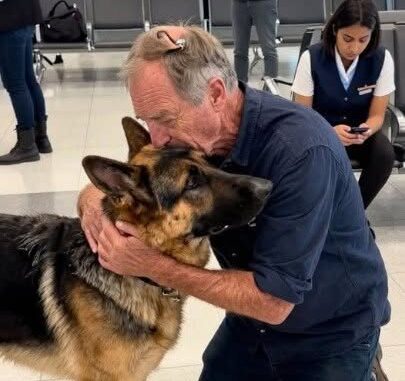
The gate agent called my boarding group.
For a few seconds, nobody moved.
People around me stood, gathered their bags, and shuffled toward the line. The ordinary rhythm of airport travel continued as if my world hadn’t just been turned upside down.
I looked at the boarding pass in my hand.
Then I looked at Ranger.
Six years.
Six years believing he was gone.
Six years carrying grief that now felt strangely unfinished.
“What happens if I don’t get on that plane?” I asked.
Deb smiled for the first time since we’d met.
“Then I think we’ll figure things out.”
I stared at the departure board.
That flight represented everything I thought my future would be—a quiet apartment, unfamiliar streets, and a life built around the assumption that all my important chapters were already behind me.
But the truth was standing beside me with a gray muzzle and a crooked ear.
For the first time in a long while, I wasn’t walking toward loneliness.
I tore the boarding pass in half.
Ranger immediately stood up.
Not because I’d given a command.
Because somehow he knew.
Dogs always know.
The next several hours passed in a blur of paperwork, signatures, phone calls, and explanations. The rescue director approved an emergency adoption review after hearing the entire story. Apparently even Pat Sloan, famous for saying no to everyone, cried when Deb explained what had happened.
By sunset, Ranger was sitting in the passenger seat of a rental car.
Home.
Or at least heading there.
He spent most of the drive with his head resting against the center console, occasionally glancing over to make sure I was still there.
Every time I stopped at a red light, I reached over and scratched behind his ears.
Neither of us seemed willing to risk losing sight of the other again.
That night I checked into a small motel near the airport.
The room wasn’t fancy.
One bed.
A television that barely worked.
A humming air conditioner.
The kind of place most people forget five minutes after leaving.
But as I sat on the edge of the mattress, Ranger curled up on the carpet beside me exactly the way he used to after long shifts.
For the first time since Carol died, the silence didn’t feel quite so heavy.
The following week brought difficult conversations.
I contacted former colleagues.
Internal affairs reopened old records.
Investigators reviewed reports connected to the kennel fire and the fraudulent notification.
Dennis eventually met me in person.
He looked older than I remembered.
Smaller somehow.
Age and guilt had done their work.
We sat on a park bench for nearly two hours.
At first neither of us said much.
Finally, he apologized.
Not the kind of apology people give when they want forgiveness.
The kind people offer when they know forgiveness may never come.
He admitted that not a single year had passed without thinking about what he’d done.
He talked about Gary’s illness.
About fear.
About convincing himself he was protecting the dog.
About how one lie became impossible to undo.
I listened.
Then I told him something I’d learned during three decades as a police officer.
The truth doesn’t disappear.
It waits.
Sometimes for months.
Sometimes for years.
Sometimes for six long years beside an airport gate.
When we stood to leave, I shook his hand.
Not because everything was forgiven.
Not because the damage was erased.
But because carrying anger forever seemed like handing him another piece of my life.
I had already lost enough years.
I wasn’t giving away any more.
Several months later, Ranger and I moved into a small house instead of the apartment I’d planned to rent.
The second bedroom stayed empty.
At first.
Then I filled it with old photographs.
Carol’s sewing machine.
Ranger’s awards.
Boxes of memories I’d been avoiding.
Some mornings I sit on the porch with coffee while Ranger sleeps beside my chair.
He’s slower now.
So am I.
Sometimes his legs shake when he stands.
Sometimes my knees complain when I bend down.
We’re both showing our age.
But that’s alright.
Because neither of us expected this chapter.
At sixty-eight, I thought life had finished surprising me.
I thought the future would simply be smaller versions of the days that came before.
Then a dog started barking at Gate B14.
And suddenly the arithmetic changed.
The empty space beside me wasn’t empty anymore.
The years ahead didn’t feel quite as lonely.
And every morning when Ranger lifts his head and looks at me as if no time has passed at all, I’m reminded that sometimes life returns what you thought was gone forever.
Not often.
Not fairly.
Not logically.
But sometimes.
And sometimes is enough.
Leave a Reply