My daughter will never remember that night, but I will carry it with me for the rest of my life.
It should have been a simple first birthday celebration—soft music, a cake with uneven frosting, relatives gathered in a warm living room taking photos of a baby who was more interested in the wrapping paper than the gifts. Instead, it became something else entirely. Something sharper. Something that exposed more than anyone in that room was prepared to face.
I remember the exact moment the atmosphere changed. My daughter was in my arms, her small fingers sticky with frosting, her blue eyes bright under the glow of the living room lights. Someone—my mother-in-law, Helen—made a comment that landed differently than the rest of the birthday chatter.
“Those eyes,” she said slowly, narrowing hers. “I don’t see that in our family.”
It wasn’t loud. It didn’t need to be. The room went quiet in a way that felt practiced, like everyone was waiting for a performance they had already decided the ending to. I could feel twenty-five pairs of eyes shift toward me, not curious, but expectant.
They weren’t just looking at my daughter.
They were looking at me.
For months, I had lived with whispers disguised as concern. Comments about resemblance. Jokes that weren’t really jokes. Questions that always seemed innocent on the surface but carried something heavier underneath. That night, they finally stopped pretending.
My husband sat near the head of the table, silent in a way that hurt more than anything anyone else could say. Not defending me. Not interrupting. Just watching.
I could feel my daughter’s small body growing tense in my arms, reacting to emotions she was far too young to understand but old enough to feel. Her fingers tightened around my collar. She pressed her face into my shoulder, seeking safety she didn’t know how to name.
That was the moment something inside me shifted—not into anger, not into panic, but into clarity.
They thought I was cornered.
They were wrong.
I stood up carefully, adjusting my daughter on my hip as the room watched. No one spoke. No one moved. The silence wasn’t empty—it was loaded, like everyone had rehearsed how this would go and was waiting for me to follow the script.
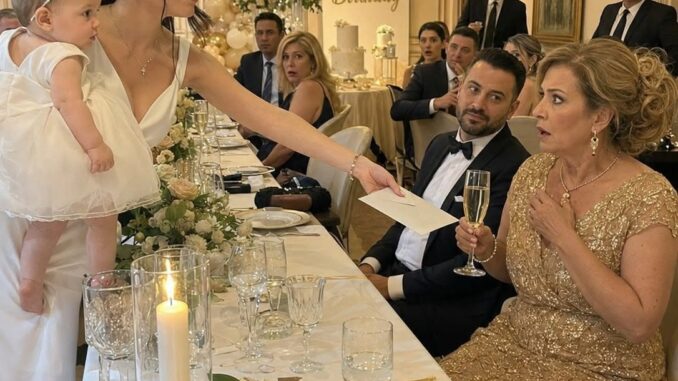
I walked to the dining table and placed three envelopes in front of my mother-in-law.
One by one.
No drama. No shaking hands. No raised voice.
Just paper hitting wood.
The sound was small, but it changed everything.
“What is this?” she asked, her tone already defensive.
“Open them,” I said.
She hesitated, then picked up the first envelope. Inside was the paternity test. Not a rumor. Not a suspicion. A clinical, undeniable result confirming what I had already known: my daughter was my husband’s child.
A few people leaned in to see. The confidence in the room wavered, but it didn’t disappear yet. They were still waiting for the second act.
The second envelope was heavier. Inside were bank records—transactions, transfers, and financial patterns that didn’t belong to me or my husband. They belonged to someone else entirely. Someone who had been quietly influencing conversations, planting doubts, and fueling suspicions behind closed doors.
My mother-in-law’s expression tightened as she read. Her lips pressed into a thin line.
The third envelope was the one that made the air feel different.
It contained everything I had not said for months. Messages. Dates. Conversations I had kept track of not because I wanted revenge, but because I needed to understand the shape of what was happening to me before it consumed me completely.
By the time she finished reading, no one in the room was speaking.
Not because everything was resolved.
Because everything had been exposed.
I didn’t raise my voice. I didn’t need to.
“I didn’t come here to argue,” I said quietly. “I came here to make sure that what you’ve been saying about me stops tonight.”
My husband finally stood up, but he didn’t come toward me. He looked between me and the papers on the table like he was seeing both of us clearly for the first time and didn’t like what that clarity demanded of him.
I didn’t wait for him to choose a side.
I turned away from the table and walked back to my daughter.
She had stopped crying. She was watching me with wide, curious eyes, her tiny hand reaching for my hair as if nothing in the room had changed for her at all.
And maybe, in the only way that mattered, nothing had.
I stepped away from the table and moved toward the window, rocking her gently as the noise behind me began—voices rising, chairs shifting, papers being picked up and put down again. The beginning of arguments that had been waiting months to surface.
But I didn’t turn around.
Because for the first time in a long time, I didn’t need to convince anyone of anything.
That night wasn’t about winning an argument or proving a point.
It was about ending a story that was never mine to carry.
Later, when the house was finally quiet and the guests were gone, I looked at the small framed photograph I had taken that night.
Just my daughter and me. One candle still burning. Her blue eyes reflecting soft light. My face calm, steady—not because everything was perfect, but because I had finally stopped trying to survive inside someone else’s version of my life.
That photograph still sits on my wall.
Not as evidence of what I destroyed.
But as proof of what I refused to let destroy me.
Leave a Reply