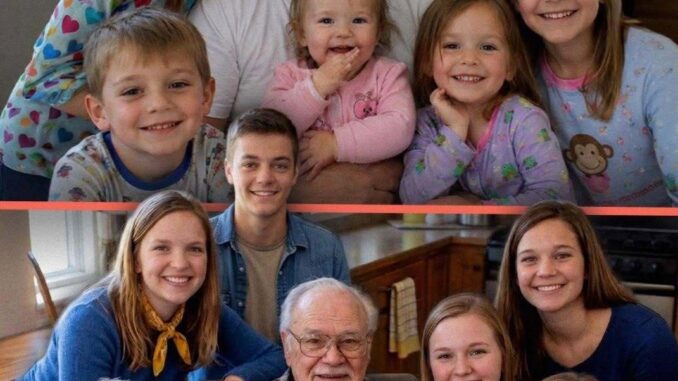
The chapel was heavy with the scent of lilies and the kind of silence that only follows a lifetime coming to an end. Standing beside Grandpa Harold’s casket, I felt grief pulling me backward through the years. At thirty-two, I worked as a paralegal and spent my days examining details and searching for truth, but in that moment, I was simply the oldest child again—the frightened teenager who had lost her parents in a devastating fire and never truly understood why.
For as long as I could remember, I had believed that my grandfather was our hero. After the fire that took my mother and father, he stepped in and raised all six of us. He cooked our meals, sewed our clothes, helped with homework, and sat awake through our nightmares. To us, he was the man who saved our family when everything else had fallen apart.
Throughout my childhood, I asked countless questions about the day of the fire. Every time, Harold would avoid the details. He would stare off into the distance and quietly say, “Some memories burn a man twice, Elena. Let me carry that burden.”
I never pushed further.
Now, standing over his casket, I suddenly wished I had.
As the final mourners drifted away and the chapel emptied, I remained behind. Colored light filtered through the stained-glass windows, casting long shadows across the floor. That was when I felt it—the strange sensation that someone was watching me.
I turned around.
An elderly woman stood near the back pew. She wore a faded headscarf and a heavy coat, her expression impossible to read. Without introducing herself or offering condolences, she walked directly toward me.
When she reached me, she pressed a folded note into my hand.
“If you want to know the truth about your parents,” she whispered, “read this. Read it alone. Don’t tell your brothers and sisters yet.”
Before I could ask who she was or what she meant, she turned and disappeared out the chapel doors.
I waited until I returned to Harold’s house before opening the note.
Sitting at the kitchen table where he had spent years caring for us, I unfolded the paper with trembling fingers.
The message was brief:
“Your grandfather was at the summer house that morning. There are documents hidden in this house. Look in the one place he never allowed you to go.”
My stomach dropped.
Harold had always insisted he was in the city when the fire happened.
If that was a lie, what else had he hidden from us?
The answer came immediately.
The basement.
Growing up, we were forbidden from going down there. Harold always claimed the stairs were unsafe and the room was filled with junk, rust, and mice.
The next morning, after finding a brass key hidden behind his desk, I unlocked the basement door.
What I discovered was nothing like the abandoned storage room he had described.
The stairs were sturdy.
The floor was spotless.
Everything appeared carefully maintained.
At the far end of the room stood a large wooden cabinet.
I recognized it instantly.
It had belonged to our old family home before the fire.
I thought it had been destroyed years ago.
Inside the cabinet were stacks of letters, photographs, insurance documents, and personal records.
The photographs were the hardest to look at.
They showed my parents standing outside the summer house, locked in a fierce argument. Their faces were twisted with anger. Between them stood Harold, trying desperately to calm the situation.
I moved on to the letters.
What I found revealed a side of my family’s history I had never known.
For years, Harold had been trying to help my father escape severe financial trouble. He had paid debts, offered loans, and repeatedly begged him to accept assistance.
The replies were cold and hostile.
One letter from my father simply read:
“Stay out of it. The house is mine. I’ll handle it myself.”
Then I found the document that changed everything.
It was a handwritten confession from Harold.
The paper was worn from years of being unfolded and read.
It said:
“I went to the summer house that morning. There was an argument in the kitchen. Then the explosion happened. I survived. They did not.”
I read the sentence over and over.
The room seemed to tilt around me.
Harold hadn’t been miles away when the fire started.
He had been there.
Inside the house.
Present when everything happened.
Desperate for answers, I tracked down the woman who had given me the note.
Her name was Margaret.
She had lived next door to the summer property for more than forty years.
When I called her, she spoke calmly.
“I came outside right after the explosion,” she explained. “Your grandfather was already on the lawn. He was on his knees, staring at the house. He looked completely shattered.”
I asked why she had waited seventeen years to tell anyone.
Her answer surprised me.
“Because I watched him raise six children who weren’t his responsibility,” she said. “I watched him work himself to exhaustion. I watched him sacrifice everything for you. It seemed like he was punishing himself every day. I didn’t think exposing the truth would help anyone.”
After hanging up, I sat alone in the dark kitchen.
The confession rested in my lap.
At first, I felt angry.
Then betrayed.
Then heartbroken.
The more I thought about it, the more I realized Harold hadn’t spent years hiding a crime.
He had spent years hiding his guilt.
That evening, I gathered my brothers and sisters around the same kitchen table where we had grown up.
With tears in my eyes, I read every word of Harold’s confession.
The room fell silent.
Then the crying began.
For the first time, we learned the full story.
We discovered that Harold had mortgaged his own home to ensure we would have money after our parents died.
We learned that our father’s financial problems were far worse than anyone had known.
We learned that insurance policies had lapsed because of debt, and that Harold had desperately tried to fix the situation before it was too late.
Most importantly, we learned that he had carried the weight of that morning for the rest of his life.
He believed that if he hadn’t gone to the house, if he hadn’t argued with my father, maybe things would have turned out differently.
For seventeen years, he lived with that possibility.
He was terrified that if we ever learned the truth, we would blame him for everything.
But as I looked around the table at my brothers and sisters, I realized something Harold never fully understood.
He wasn’t the reason our family survived the tragedy.
He was the reason we survived at all.
The truth changed our understanding of the past, but it didn’t change the man he had been.
He wasn’t a saint.
He wasn’t a villain.
He was a broken man carrying an impossible burden.
And despite his mistakes, despite his secrets, despite the guilt that haunted him every day of his life, he gave everything he had to six children who needed someone to love them.
In the end, that was the truth that mattered most.
Leave a Reply