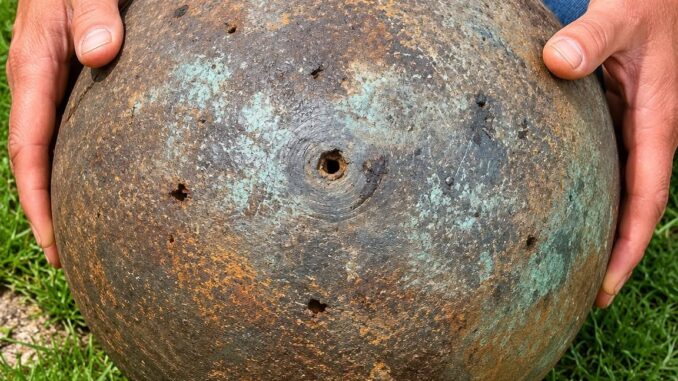
A surprising discovery at a local creek has captured the attention of history enthusiasts, engineers, and curious observers alike. Partially embedded in the landscape was an enormous steel sphere, an object whose size and appearance immediately sparked questions about its origins and purpose.
While it may appear unusual in a natural setting, experts believe the sphere is a relic from an important chapter in industrial history. Once a crucial component in large-scale mining and manufacturing operations, steel grinding balls like this played a significant role in helping industries process raw materials that fueled economic growth and technological advancement.
The find serves as more than just an interesting artifact. It provides a tangible connection to an era when engineering innovation transformed the way resources were extracted, refined, and utilized across expanding industrial economies.
An Unexpected Discovery
Creeks and riverbanks often reveal traces of the past, especially after years of erosion expose objects that have long been hidden beneath soil and sediment. In this case, what initially appeared to be an unusually large metal object turned out to be something far more significant.
The massive steel sphere stood out because of its remarkable size and durability. Despite years of exposure to the elements, the object remained largely intact, demonstrating the strength and quality of the materials used during its manufacture.
Observers were immediately intrigued by how such a large industrial component could have ended up in a remote natural environment. Questions quickly emerged about its history, age, and original purpose.
As researchers examined the object more closely, its likely connection to historical mining and milling operations became increasingly apparent.
The Role of Steel Spheres in Industry
During the height of industrial expansion, steel grinding balls were essential tools in many manufacturing and mining processes.
These heavy spheres were commonly used inside large machines known as ball mills. Ball mills are rotating cylinders designed to break down raw materials into much smaller particles. As the machine rotates, the steel balls repeatedly strike and crush materials placed inside the chamber.
The process allows large rocks, ores, and minerals to be reduced into fine powders or smaller fragments suitable for further processing.
This technology played a vital role in numerous industries, including mining, cement production, metallurgy, and construction materials manufacturing.
Without equipment like ball mills, many of the industrial processes that supported economic development would have been far less efficient.
How Ball Mills Worked
The concept behind a ball mill is relatively straightforward, yet highly effective.
Raw materials are loaded into a rotating drum along with numerous steel balls. As the cylinder turns, gravity causes the balls to rise and then fall repeatedly. The impact generated by these constant collisions gradually breaks down the material.
Over time, large chunks of ore or rock are transformed into finely ground material that can be used for refining, manufacturing, or construction purposes.
The steel balls themselves must be exceptionally durable because they endure constant impact and friction throughout the grinding process.
This requirement led manufacturers to develop specially hardened steel spheres capable of withstanding years of demanding use.
The sphere discovered at the creek is believed to be one such example.
A Symbol of Engineering Innovation
Although the steel sphere’s original purpose was purely practical, it also represents a broader story of human innovation and industrial progress.
Throughout the nineteenth and twentieth centuries, engineers continually developed new technologies to improve productivity and resource utilization. Equipment such as ball mills allowed industries to process larger volumes of material more efficiently than ever before.
These advancements contributed significantly to the growth of infrastructure, manufacturing, transportation networks, and urban development.
Every road, bridge, building, and factory required raw materials that often passed through industrial machinery similar to the equipment that once housed steel grinding balls.
In this sense, the sphere serves as a reminder of the countless engineering solutions that helped shape the modern world.
Why the Discovery Matters
Historical artifacts often provide valuable insights into the technologies and industries of previous generations.
While documents and photographs can tell part of the story, physical objects offer a direct connection to the past. They allow researchers to study manufacturing methods, material quality, and engineering techniques in ways that written records alone cannot provide.
The steel sphere discovered at the creek offers an opportunity to better understand the equipment and processes that supported industrial production during a transformative period of history.
Its survival also highlights the remarkable durability of industrial materials. Designed to endure extreme conditions inside grinding mills, the sphere has remained recognizable despite years of environmental exposure.
For historians and preservationists, finds like this help bring industrial history to life.
The Connection Between Industry and Natural Landscapes
One of the most intriguing aspects of the discovery is its location.
Finding a massive industrial component in a quiet creek setting creates a striking contrast between nature and human engineering.
The object likely arrived there through circumstances connected to nearby industrial activity, transportation routes, or historical land use. Over time, changing landscapes and natural processes may have concealed the sphere until erosion eventually revealed it once again.
Such discoveries remind us that traces of industrial history can often be found in unexpected places.
Many regions that appear entirely natural today once played important roles in mining, manufacturing, transportation, or resource extraction. Artifacts hidden beneath the surface continue to tell stories about those forgotten connections.
Industrial Relics as Educational Tools
Objects like this steel sphere have value beyond their historical significance.
They also serve as educational resources that help people understand the technologies that powered earlier generations.
Students, engineers, and history enthusiasts can learn a great deal by examining industrial artifacts firsthand. These objects illustrate concepts related to mechanics, metallurgy, manufacturing, and economic development.
They also provide context for understanding how industries evolved over time.
Many modern technologies trace their origins to innovations developed during earlier industrial periods. Studying historical machinery and components helps reveal the progression of engineering ideas that continue to influence production methods today.
Preserving Pieces of the Past
As industrial sites disappear or undergo redevelopment, preserving artifacts becomes increasingly important.
Objects such as grinding balls, machinery components, tools, and equipment remnants help document a period of history that transformed societies around the world.
Whether displayed in museums, incorporated into educational exhibits, or studied by researchers, these artifacts provide lasting value for future generations.
The creek discovery demonstrates how even a single object can spark interest in broader historical themes and encourage further exploration of local industrial heritage.
A Lasting Reminder of Industrial Achievement
The massive steel sphere discovered at the creek is more than just an unusual object. It represents a connection to an era defined by innovation, hard work, and technological advancement.
Once an active participant in the grinding and processing of raw materials, the sphere contributed to industrial operations that helped supply factories, construction projects, and growing communities.
Today, its role has changed.
Instead of serving inside a machine, it serves as a historical artifact—a physical reminder of the engineering achievements that helped build modern society.
As researchers continue to study relics like this, they gain valuable insights into the tools, technologies, and creative problem-solving that characterized earlier industrial generations.
What may appear at first glance to be a simple steel ball is actually a symbol of an important chapter in human history, one that continues to influence the world we live in today.
Leave a Reply