Old barns and storage sheds often act as time capsules. Tucked away behind stacked crates, rusted machinery, and weathered wooden beams, they preserve remnants of earlier generations—tools and objects that once played an essential role in everyday rural life. To someone discovering them today, these items can appear strange, mysterious, or even unrelated to anything familiar. Yet each one usually carries a very practical purpose tied to a way of life that has largely disappeared from modern memory.
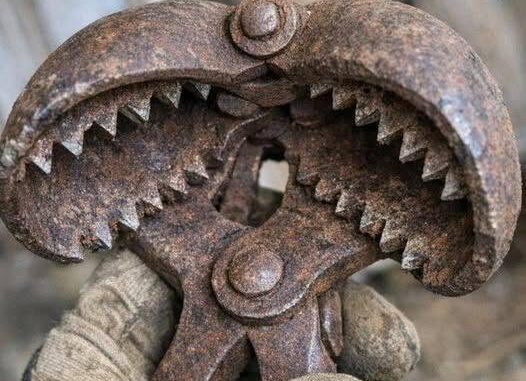
When exploring or cleaning out an old barn, it is not unusual to come across objects that are heavy, worn, and built with a level of durability that immediately stands out. One such example is a solid iron tool with a hinged center and curved jaws lined with sharp, evenly spaced teeth. At first glance, it might resemble something industrial or even vaguely mechanical in a modern sense, but its design quickly suggests that it was made for manual labor rather than factory use.
The tool’s construction is simple but purposeful. The hinged mechanism allows it to open and close like a pair of pliers, while the serrated inner edges indicate that it was meant to grip, hold, and pull rather than slice cleanly. The teeth are not random or decorative—they are carefully shaped to create friction and control, especially when working with firm, round objects that require force to process.
Without context, such a tool can be difficult to identify. It does not resemble most modern kitchen or gardening equipment, and its appearance alone does not immediately reveal its function. However, the key to understanding it lies in those jagged inner teeth and the motion of the hinge. These features point toward a very specific type of traditional agricultural implement: a handheld corn sheller.
A Tool From a Different Agricultural Era
Before the widespread use of modern agricultural machinery, farming relied heavily on manual tools designed for efficiency and durability. Corn, being one of the most widely cultivated crops, required significant labor during harvest season. Once dried, corn needed to be processed to separate the kernels from the cob so they could be stored, sold, or used as livestock feed.
This is where tools like the handheld corn sheller became essential.
Rather than relying on large mechanical systems, farmers used compact iron devices that could be operated by hand. These tools were built to withstand repeated pressure and constant use, often in harsh outdoor or barn environments. Their simplicity was part of their strength—fewer moving parts meant fewer breakdowns, and their solid construction ensured they could last for decades.
How the Corn Sheller Worked
The function of the tool becomes clearer when observing its structure more closely. A dried corn cob would be placed between the two curved jaws of the device. When the handles were squeezed together, the serrated teeth would grip the surface of the cob.
Instead of cutting into it, the tool worked by scraping and stripping the kernels away through pressure and motion. Farmers would often rotate the cob as they applied force, allowing the teeth to remove kernels in sections. This repetitive process continued until the cob was fully stripped.
It was not a delicate process, but it was effective. In an era before electric machinery, efficiency depended on tools that could perform consistent work with minimal complexity. The corn sheller was one of those solutions—small enough to carry, strong enough to endure, and simple enough to be used by almost anyone on the farm.
Life on the Farm and the Role of Simple Tools
Tools like this represent more than just agricultural function—they reflect a way of life built around manual effort, seasonal cycles, and shared labor. On traditional farms, tasks like shelling corn were not isolated activities. They were often part of larger communal efforts, where families or neighbors worked together to process harvests.
A tool like the corn sheller might have been passed between hands countless times during a single harvest season. It would have been stored in barns, carried into fields, and used repeatedly until the work was done. Over time, it would develop wear patterns—slight rusting, smoothed handles, or worn-down teeth—all signs of years of practical use.
When such an object is found today in a barn, it often carries that quiet evidence of history. It is not just a piece of metal; it is a remnant of labor, routine, and survival from a period when food production required direct physical involvement at every stage.
Why These Tools Look Unfamiliar Today
Modern agriculture has largely replaced hand tools like this with mechanized systems capable of processing large quantities of crops in far less time. Shelling corn is now typically done using machines that separate kernels quickly and efficiently, reducing the need for manual labor.
Because of this shift, tools that were once common have become unfamiliar. Many people today have never seen a corn sheller in operation, which is why encountering one in an old barn can feel puzzling or even mysterious. Without context, its shape and texture do not immediately connect to any modern equivalent.
This disconnect is what often makes old farm tools so intriguing. They sit betwee
Leave a Reply