Last weekend, I decided to take a walk around a small artificial lake near my village. It was one of those peaceful afternoons where everything seemed calm. The water was perfectly still, the trees reflected off the surface, and there wasn’t another person around.
As I walked along the shoreline, something unusual caught my attention.
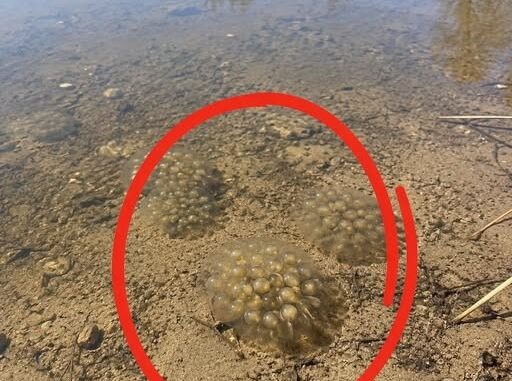
Near the edge of the water, I noticed several clusters of small round objects resting on the sandy bottom. At first glance, they looked like eggs. There were dozens of them grouped together in what appeared to be shallow crater-like depressions.
I stopped immediately.
The more I looked, the stranger it seemed.
The clusters were scattered around the shoreline, each one containing dozens of perfectly round spheres. Some appeared slightly transparent, while others looked cloudy. From where I stood, it almost looked as if some animal had carefully placed them there.
Naturally, my curiosity took over.
I spent several minutes just staring at them, trying to figure out what I was looking at. Were they fish eggs? Frog eggs? Some kind of underwater plant? I honestly had no idea.
The strange thing was that I had visited this lake many times before and had never noticed anything like it.
I took a few photos and continued walking, but I couldn’t stop thinking about what I had seen. Later that evening, I showed the pictures to a few friends.
The guesses started immediately.
One person thought they belonged to fish.
Another suggested they might be some kind of aquatic insect.
Someone else jokingly claimed they looked like alien eggs.
The truth turned out to be much more interesting.
After doing some research, I discovered that these clusters were most likely amphibian eggs, commonly laid by frogs or toads during their breeding season.
Many species deposit their eggs in shallow water where sunlight can help warm the developing embryos. The jelly-like substance surrounding the eggs protects them while allowing oxygen and nutrients to pass through.
What looked like mysterious craters were actually natural depressions in the lake bed where the eggs had settled.
Once I knew the answer, everything made sense.
The transparent jelly surrounding the eggs.
The way they were grouped together.
The shallow location near the shoreline.
Over the following days, I became fascinated by the process. Tiny embryos develop inside the eggs, eventually hatching into tadpoles. Those tadpoles then spend weeks or months growing before transforming into young frogs or toads.
It’s remarkable to think that an entire life cycle begins with something that many people would simply walk past without noticing.
What amazed me most was how ordinary the scene became once I understood it.
At first, it looked mysterious.
Then it looked strange.
Finally, it became something beautiful.
Nature has a way of hiding incredible stories in plain sight. A cluster of tiny eggs sitting quietly beneath the water may not seem important at first glance, but it represents the beginning of dozens of new lives.
The next time you find something unusual outdoors, take a closer look before dismissing it.
Sometimes the most ordinary explanations are also the most fascinating.
And sometimes, a simple walk around a lake can turn into an unexpected lesson about the natural world.
What started as a mystery ended up becoming one of the most interesting things I’ve learned this year.
So if you ever spot strange jelly-like clusters in shallow water, don’t be alarmed.
You may just be witnessing one of nature’s oldest and most remarkable life cycles beginning right before your eyes.
Leave a Reply