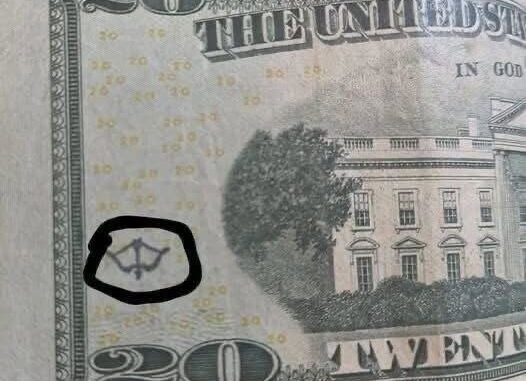
Most people handle cash without giving it much thought. We glance at the denomination, complete a transaction, and move on with our day. Yet every once in a while, someone notices something unusual on a bill—a small stamp, symbol, or mark that seems out of place.
At first glance, these markings can look mysterious. Some people assume they are signs of damage, random ink stains, or even evidence that a bill may not be genuine. In reality, many of these markings have a fascinating connection to international trade and a centuries-old tradition known as chop marking.
While not commonly seen in everyday circulation in the United States, chop marks occasionally appear on U.S. currency that has traveled through international markets. These small symbols tell a story about commerce, trust, and the movement of money across different countries and cultures.
What Are Chop Marks?
A chop mark is a small stamp, symbol, or identifying mark placed on currency after someone has examined and accepted it as authentic.
Historically, merchants, money changers, and traders used these marks as a simple way to indicate that they had inspected a coin or bill and considered it trustworthy. Rather than relying solely on government guarantees, individuals involved in trade often created their own systems of verification.
The result was a network of trusted markings that helped facilitate commerce long before modern banking systems became widespread.
Although chop marks can look unusual to people unfamiliar with them, they generally represent a practical tradition rather than anything secretive or suspicious.
A Practice With Ancient Origins
The history of chop marking stretches back many centuries, particularly in parts of Asia where merchants regularly handled precious metals such as silver and gold.
Before modern financial institutions existed, verifying the authenticity of coins was an important part of doing business. Traders needed confidence that the coins they accepted contained the proper amount of precious metal and had not been altered.
To solve this problem, merchants often applied their own identifying marks after inspecting a coin.
Each mark acted as a personal endorsement. When multiple respected traders accepted the same coin, it could accumulate several marks over time.
Rather than reducing confidence, these additional marks often increased it. A coin that had been examined and accepted by several merchants was generally viewed as more reliable than one that had never been checked.
This system helped create trust in marketplaces where official verification methods were limited or unavailable.
How Chop Marks Moved to Paper Currency
As paper money became more common, the practice evolved.
Unlike metal coins, paper bills could not easily be stamped with deep impressions. Instead, merchants and money changers began using inked marks, stamps, or small symbols to indicate that they had inspected a particular note.
These markings served a similar purpose: they provided reassurance that someone had already examined the bill and accepted it in trade.
During the nineteenth and twentieth centuries, international commerce expanded dramatically. Goods, services, and currencies moved between countries at an unprecedented rate.
As U.S. dollars became widely used around the world, they often passed through regions where chop-marking traditions were already established.
As a result, some American banknotes acquired stamps and symbols from merchants operating thousands of miles away from where the bills were originally issued.
Why U.S. Currency Is Sometimes Marked
The U.S. dollar has long been one of the most widely recognized and accepted currencies in the world.
Because of its international use, dollar bills frequently circulate beyond U.S. borders. In some regions, traders and money changers developed habits of marking bills after verifying their authenticity.
These marks served as a quick visual reference for future transactions.
Instead of performing lengthy inspections every time a bill changed hands, merchants could often recognize familiar marks and proceed with greater confidence.
Over time, a single bill might accumulate several markings from different locations and different individuals.
Each symbol represented a small chapter in that bill’s journey through various marketplaces and communities.
The Meaning Behind the Symbols
One of the most common misconceptions is that chop marks contain hidden messages or secret codes.
In reality, most marks are simply identifiers.
They may represent a business, an individual trader, a money exchange service, or a local merchant. Some take the form of initials, while others use geometric shapes, numbers, characters, or simple logos.
A symbol that resembles a bow and arrow, star, circle, or abstract design typically serves the same purpose: identifying someone who verified or handled the currency.
The specific meaning often depends on the person or organization that applied it.
Rather than conveying secret information, these marks usually function as practical records of commercial activity.
Do Chop Marks Affect a Bill’s Value?
For everyday spending, chop-marked currency generally retains its face value.
Banks and financial institutions typically continue to accept bills that contain minor stamps or markings, provided the note remains identifiable and meets standard currency requirements.
The marks themselves do not automatically reduce the purchasing power of the bill.
However, some collectors find chop-marked currency especially interesting.
Because each mark reflects part of the bill’s circulation history, these notes can provide insights into trade routes, cultural practices, and economic activity in different parts of the world.
For numismatists—the people who study and collect currency—such bills can be valuable historical artifacts.
A Window Into Global Commerce
One reason chop marks continue to fascinate collectors and historians is that they offer a glimpse into the movement of money across international borders.
A single banknote may have traveled through multiple countries, passed through countless hands, and participated in numerous transactions before eventually returning to circulation elsewhere.
The marks left behind act as a visual record of that journey.
While modern banking systems rely heavily on electronic records and digital verification, chop marks represent an earlier era when trust was built through personal relationships and direct inspection.
They remind us that commerce has always depended on confidence and credibility.
Why the Tradition Still Matters
Today’s financial world is dominated by digital payments, online banking, and advanced anti-counterfeiting technology.
Yet chop marks remain a fascinating reminder of how people solved problems before these systems existed.
Merchants developed practical methods to establish trust without centralized databases, electronic scanners, or instant communication.
Their solutions were simple, effective, and widely understood within their communities.
Even now, occasionally encountering a marked bill serves as a reminder that money has a history beyond its printed design.
Every note passes through countless hands, businesses, and transactions during its lifetime.
Final Thoughts
The next time you notice an unusual symbol or stamp on a dollar bill, take a closer look before dismissing it as random ink.
In some cases, that small mark may be part of a long-standing tradition that stretches back centuries. What appears to be a simple symbol could represent a merchant’s approval, a trader’s verification, or a record of the bill’s travels through international markets.
Far from being evidence of damage or mystery, chop marks highlight the human side of commerce. They tell stories of trust, trade, and connection between people separated by distance, language, and culture.
In an age where so many transactions happen invisibly through screens and digital networks, these tiny marks offer a tangible reminder that every piece of currency has its own unique journey—and sometimes, that journey is far more interesting than we might imagine.
Leave a Reply