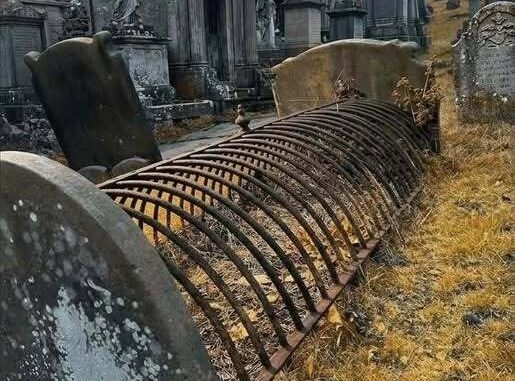
Walking through an old cemetery in parts of Scotland, England, or other regions of Europe, you may occasionally notice something that feels out of place among the weathered headstones and leaning stone crosses.
Instead of simple graves resting quietly beneath the soil, you might see something heavier, more industrial—iron frames resting over burial plots like cages frozen in time.
At first glance, they can feel unsettling. Almost as if they were built to contain something rather than protect it.
But these structures were never meant to frighten visitors.
They were called mortsafes, and they exist because of a period in history when even the dead were not always safe from disturbance.
A Time When Graves Were Not Left Alone
To understand mortsafes, it helps to understand the world that created them.
In the 18th and 19th centuries across parts of Europe, particularly in areas like Scotland, cemeteries were not always peaceful places after burial. While families believed they were laying loved ones to rest permanently, a hidden and deeply troubling reality existed beneath the surface.
Medical science was advancing rapidly during this period, especially in universities and teaching hospitals. Anatomists needed cadavers for dissection and study, but legal access to bodies was extremely limited. Executed criminals were one of the only official sources, and they were far too few to meet demand.
This imbalance created a grim underground trade.
Grave robbing became a profitable but illegal activity. Recently buried bodies—especially those not yet fully decomposed—were at risk of being stolen and sold to medical schools for anatomical research.
For grieving families, this possibility was horrifying. A burial was supposed to represent final rest. Instead, it could become a temporary stop before a second violation.
The Birth of the Mortsafe
Out of this fear came a uniquely practical solution: the mortsafe.
A mortsafe was a heavy iron structure placed directly over a grave immediately after burial. Built from thick iron bars and reinforced frames, it functioned as a physical barrier designed to prevent access to the coffin below.
Unlike permanent monuments, mortsafes were often temporary. Families would install them for a limited time—usually several weeks—until the body had decomposed enough that it was no longer of interest to grave robbers.
In some communities, these devices were shared. Rather than each family owning one, they were rented or rotated between graves in a cemetery. The goal was simple: protect the newly buried during the highest-risk period.
Community Vigilance and Cemetery Guards
Mortsafes were only one part of a broader system of protection.
In many towns, communities took security seriously. Families sometimes organized night watches in cemeteries. In other cases, paid guards were employed to patrol burial grounds after dark.
The fear of grave robbing was strong enough that entire social practices formed around it. Cemeteries, which we now associate with silence and reflection, once had an undercurrent of vigilance and concern.
The dead were meant to rest in peace—but peace had to be enforced.
Why Grave Robbing Happened
The existence of mortsafes is tied directly to the growth of medical education.
During this era, universities were expanding their understanding of human anatomy. Students needed real bodies to study muscles, organs, and skeletal structures. Books and illustrations were not enough.
But legal supply was extremely limited. As a result, a black market emerged, driven by individuals known as “resurrectionists,” who exhumed fresh graves and sold bodies illegally.
It was not driven by superstition or ritual, but by demand from institutions that desperately needed material for learning.
This uncomfortable reality forced ordinary families to confront a difficult truth: burial alone was not enough protection.
The Design and Function of Mortsafes
Mortsafes were not delicate structures. They were intentionally heavy, rigid, and difficult to remove without tools or multiple people.
Most consisted of iron grids placed over the grave, sometimes locked or bolted into position. Their weight alone often made removal impractical without drawing attention.
Some versions were reusable. Once a body had sufficiently decomposed, the mortsafe could be lifted and moved to another grave.
Others were permanent fixtures, left behind long after their protective purpose had ended.
Today, the few surviving examples in old cemeteries stand as rusted reminders of this unusual period in burial history.
The Legal Turning Point
The decline of mortsafes came with changes in law and medical ethics.
By the mid-19th century, governments began introducing regulations that provided legal access to bodies for medical study. Over time, systems of anatomical donation were established, allowing individuals to consent to posthumous donation.
In the United Kingdom, reforms such as the Anatomy Act of 1832 helped reduce the demand for illegally obtained cadavers.
As legal supply increased and enforcement improved, grave robbing declined sharply. With it, the need for physical grave protection disappeared.
Mortsafes were no longer necessary.
What Remains Today
Most mortsafes were eventually dismantled, scrapped for metal, or left to decay. Iron was valuable, and once their purpose ended, many were recycled.
A small number survived, especially in rural or historically preserved cemeteries. In places like Edinburgh and surrounding regions, visitors can still encounter them—silent, rusted frames resting over old burial sites.
To modern eyes, they may appear eerie or symbolic of darker beliefs. But their true meaning is far more grounded in practicality than superstition.
They represent a society trying to solve a very real problem with the tools it had available.
More Than Iron: A Reflection of Human Concern
Although mortsafes may look harsh, they were not acts of cruelty. They were expressions of care.
Families were not trying to imprison the dead. They were trying to protect them.
In an era when law, medicine, and ethics were still evolving, people created physical solutions to safeguard dignity after death. The mortsafe was one of those solutions—imperfect, heavy, and inconvenient, but deeply intentional.
It reflects a time when trust in institutions was fragile, and communities relied on themselves to ensure peace for their loved ones.
Why Mortsafes Still Matter Today
Today, mortsafes are no longer functional tools. But they remain important historical artifacts.
They remind us of a time when scientific progress and moral uncertainty existed side by side. They also highlight how far society has come in balancing medical advancement with ethical responsibility.
Modern anatomy programs no longer rely on grave disturbance. Donation systems and strict regulations ensure that learning happens with consent and dignity.
Standing in front of a mortsafe today, one can see more than iron.
You see a story about fear, adaptation, and eventual reform.
You see how communities respond when something they value is threatened.
And most of all, you see how even the most unusual objects in old cemeteries often carry a very human history beneath their surface.
Final Thought
Mortsafes are not symbols of darkness.
They are symbols of transition.
From fear to regulation. From uncertainty to structure. From vulnerability to protection.
And in their rusted silence, they still tell a story worth remembering: even in death, people have always sought ways to protect what they love.
Leave a Reply