Grief is a ghost that refuses to be evicted. In our house, it didn’t just haunt the hallways; it lived in the threads of a dozen hand-knit sweaters left behind by my daughter-in-law, Emily. When she passed away from cancer two years ago, she left a void that no amount of time could fill. My grandson, Liam, who is only nine years old, went quiet in a way that breaks a grandmother’s heart. He stopped running, he stopped laughing, and he began to exist in a world of muted colors. The only tether he had left to his mother was a cedar box filled with the sweaters she had knit for him. They were soft, colorful, and still carried the faint, comforting scent of lavender detergent.
When my son, Daniel, remarried a year later, I wanted to believe in new beginnings. I wanted to welcome Claire into our home with an open heart. But Claire didn’t want to be part of our history; she wanted to erase it. She viewed Emily’s memory as a rival and those sweaters as “clutter” that didn’t fit her vision of a modern home. Daniel, desperate for a peaceful life, brushed off her coldness as “adjustment issues.” He didn’t see the storm brewing until Liam decided to turn his grief into a mission of mercy.
With Easter approaching, Liam came to me with a crooked, lopsided knitted bunny. He had unraveled one of his mother’s sweaters, turning her handiwork into something new. “I want to make these for the kids in the hospital,” he told me, his voice small but steady. “So they don’t feel lonely. Mom used to call me her bunny.” I felt a lump in my throat that I couldn’t swallow. Over the next few weeks, that one bunny turned into a hundred. Liam worked tirelessly, his small fingers flying as he re-knit his mother’s love into tiny creatures with mismatched eyes and uneven ears. Each one carried a tag: “You are brave,” or “Keep fighting.” For the first time in two years, I saw a flicker of pride in my grandson’s eyes. He wasn’t just a boy who had lost his mother; he was a boy who was helping others survive their own darkness.
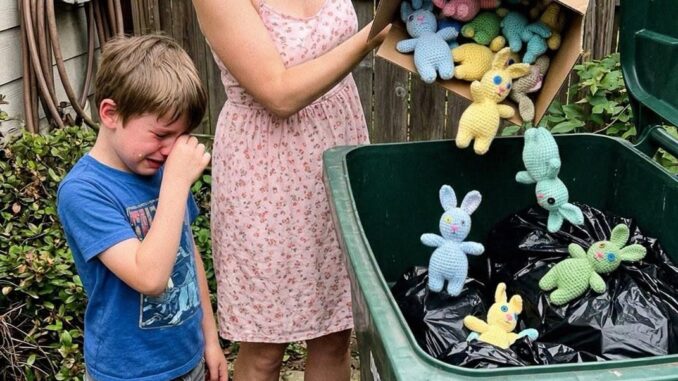
The afternoon of the delivery started with a sense of triumph. We had the bunnies packed into pristine boxes, ready for the children’s cancer ward. But then Claire walked in. Her face twisted into a mask of disgust as she looked at the boxes. “What is all this trash?” she demanded. I tried to explain the beauty of the gesture, but Claire wasn’t listening. In a fit of unexplained rage—or perhaps a deep-seated jealousy she could no longer contain—she grabbed the boxes and marched outside. Before I could reach the door, she had dumped them all into the communal dumpster.
Liam didn’t scream. He didn’t even move. He just stood there as his entire world, unraveled and re-knit with his own hands, was treated like refuse. When the tears finally came, they were silent, which was a thousand times worse than a tantrum. It was the sound of a child giving up.
But Daniel had come home early. He stood in the hallway, taking in the scene: his sobbing son, his defiant wife, and the empty space where Liam’s hard work had been. For months, Daniel had chosen “peace” over confrontation, but something in him finally snapped. He didn’t yell. He didn’t even look at Claire at first. He simply told Liam to wait and walked into the back of the house. When he returned, he was holding a small, weathered wooden box with a dark stain—a box I had never seen before.
Leave a Reply