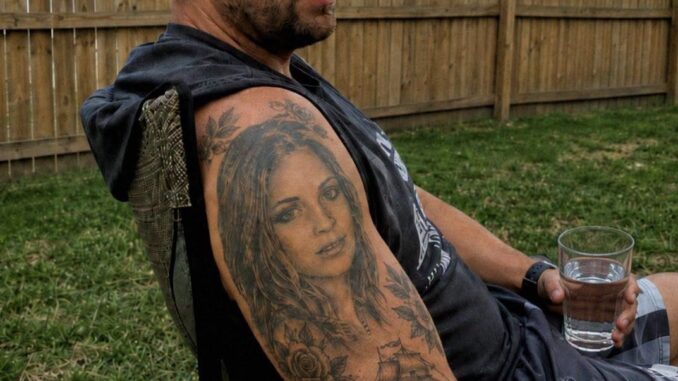
For twelve long years, I lived in the shadow of a ghost inked permanently onto my husband’s skin. Every morning, I woke up to the haunting, sad eyes of a woman I didn’t know, watching me from Ryan’s shoulder. He called it a random design, a practice piece, a mistake from his youth. I wanted to believe him. I needed to believe him. But the truth wasn’t buried in ink—it was buried in a past so toxic it nearly destroyed two lives. When I finally met her by accident in a bakery, the look of pure, unadulterated terror on her face shattered my reality.
When I first met Ryan, the tattoo was just a curiosity. It was a full portrait of a young woman in her early twenties with dark, thick hair and a melancholic expression that seemed to follow me across the room. I was young and head-over-heels in love, so I pushed down the creeping insecurity. I didn’t want to be the “jealous girlfriend.” But as our relationship deepened into marriage, the tattoo became a third person in our bed. Whether we were at the beach or just lounging at home, her eyes were always watching.
I asked about her constantly. At first, Ryan was dismissive. Later, he became defensive. He claimed a friend was learning to tattoo and needed a canvas, grabbing a random photo off the internet. It sounded like a hollow excuse, the kind that rings in your ears like a lie you’re expected to swallow. I eventually stopped asking, not because I was satisfied, but because I was exhausted. I tried to force him to cover it—to trade her for a mountain or a dragon—but there was always a delay. Money was tight, his artist moved away, work was too busy. The excuses piled up until I just gave up.
Then came the bakery. I was standing in line when a woman turned around. My breath caught in my throat. I knew those eyes. I knew that exact beauty mark near her jaw. It was her—the woman from Ryan’s shoulder, only older, hardened by time, and looking weary. My hands began to shake as I approached her.
“Excuse me,” I whispered, my heart slamming against my ribs. “Do you know someone named Ryan?”
The color drained from her face so fast I thought she might faint. She stepped back, her gaze darting toward the exit like a trapped animal. “Ryan?” she breathed. Her voice was thin, laced with a fear that made my skin crawl. When I told her about the tattoo, her knees seemed to give way. She sat down, looking at me with a mix of pity and profound sorrow. “If Ryan still hates me,” she said, “I understand.”
I drove home in a daze, my mind racing through every possible scenario, yet none of them hit the mark. When I arrived, Ryan was on the porch. I didn’t wait. I told him I’d met her. The reaction wasn’t anger or defensiveness; it was pure, cold dread. He looked like a man watching his own execution.
“Her name is Sloane,” he finally whispered. “And I am the person who hurt her more than anyone else in this world.”
We moved to the kitchen, and for the first time in twelve years, the walls between us fell. Ryan’s father, the man the whole town remembered as a saintly coach and volunteer, had been a monster. When Sloane was a teenager, she had the courage to speak up about what he had done to her. She told the truth. And in return, the entire town, including Ryan and his mother, turned on her. They called her a liar, a manipulator, and worse. They systematically dismantled her life, forcing her to flee.
“I wasn’t just a bystander,” Ryan confessed, his voice thick with shame. “I was an accomplice. I believed the lie because the truth was too painful to accept. I helped destroy her.”
I looked at him, stunned. The tattoo wasn’t a tribute to an old flame or a secret romance. It was a penance. He had gotten the portrait done after the truth finally surfaced years later—when it was already too late to save Sloane’s reputation. He chose her face because he never wanted to forget the girl he had helped ruin. He wanted to be forced to look at the consequences of his own cowardice every single time he caught his reflection.
The next day, I didn’t ask for permission. I found Sloane again, and this time, I facilitated the apology that had been rotting in Ryan’s chest for two decades. I sat in the car, watching from a distance as he walked up to her door. When he returned hours later, his eyes were bloodshot, but the heavy, dark shroud he’d been wearing for years seemed to have finally lifted. He told me she had forgiven him, not for his sake, but to free herself from the weight of his past actions.
Ryan eventually made an appointment to cover the tattoo, but as the date approached, he realized he didn’t need to hide it anymore. He didn’t keep it out of obsession; he kept it because he finally owned his story. A month later, Sloane sent us a photo of a youth resource center she had opened, a place where vulnerable kids could finally find the safety she had been denied.
The tattoo is still there, resting on his skin, but it no longer feels like an intruder in our marriage. It’s a testament to the fact that truth, no matter how long it’s buried, has a way of coming to the surface. We learned that forgiveness isn’t about forgetting the past—it’s about changing how we carry it into the future. The woman with the sad eyes isn’t a ghost anymore; she’s a reminder that it’s never too late to stop being a coward and start being a human being.
Leave a Reply