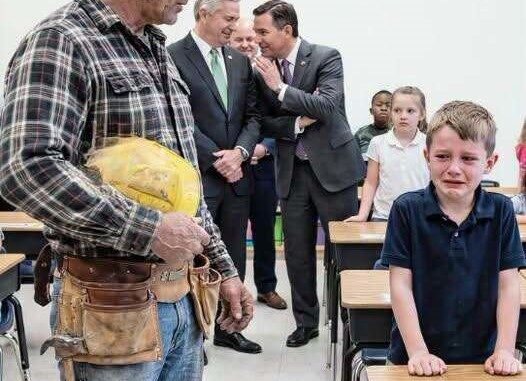
They were already judging me before I even reached the front of the room.
Not openly.
Not loudly.
Just the subtle looks and quiet smiles people exchange when they think they’ve figured someone out at first glance.
As I stepped through the classroom door, I caught a whisper from the back row.
“Is he here to fix something?” a woman murmured behind her coffee cup.
The man sitting beside her didn’t answer. He simply smiled awkwardly and looked away.
I heard every word.
After more than forty years working outdoors through storms, freezing temperatures, and dangerous conditions, you develop an ear for things people think go unnoticed.
I didn’t respond.
People rarely change their minds because you argue with them. They change their minds when reality forces them to.
So I walked to the teacher’s desk and carefully placed my old yellow hard hat on top.
The helmet was scratched and faded from decades spent beneath sun, rain, ice, and wind.
Next came my tool belt.
The leather was worn smooth from years of use. I set it beside the helmet and removed a few of the tools attached to it.
Wire cutters.
Insulated pliers.
A voltage tester.
A heavy wrench whose handle had molded itself to my grip after thousands of hours of work.
The belt left a thin layer of dust on the polished surface.
A few students stared curiously.
Several adults looked less impressed.
It was Career Day at my grandson Caleb’s school.
The school sat in one of the wealthiest neighborhoods in the county. The kind of place where every lawn looked professionally maintained and luxury SUVs lined the pickup area each afternoon.
Across the room, Caleb sat near the windows.
These days he insisted on being called Caleb instead of Cal. He said it sounded more grown-up.
I could tell he was nervous.
Not embarrassed exactly.
Just worried.
Worried that his grandfather might not fit in among the other speakers whose careers sounded more impressive on paper.
Earlier that morning, the students had listened to presentations from successful professionals.
There had been an attorney.
A financial consultant.
A software executive.
Each came prepared with polished presentations, colorful charts, and carefully rehearsed success stories.
The audience applauded politely after each one.
Everything looked clean, professional, and impressive.
Then there was me.
An old flannel shirt.
Work boots carrying traces of dried mud.
Hands covered with scars earned from decades of dangerous work.
When the teacher introduced me, she hesitated briefly.
“Our next speaker works in… electrical infrastructure.”
The pause was small.
But I noticed it.
I stood and looked around the room.
No slideshow.
No fancy graphics.
Just experience.
“I never attended a traditional university,” I began.
Several parents immediately returned their attention to their phones.
Apparently that was all they needed to hear.
“I went to trade school instead,” I continued. “While some of my classmates were decorating dorm rooms, I was already earning a paycheck.”
A few students looked up.
Unlike adults, teenagers sometimes recognize authenticity faster than credentials.
I rested one hand on the desk.
“When a winter storm knocks out power across an entire county,” I said, “and temperatures drop below freezing inside people’s homes…”
The room grew quieter.
“When families are sitting in the dark wrapped in blankets, hoping the heat comes back before morning…”
I paused.
“You don’t call an investment banker.”
A few students laughed.
“You don’t call a corporate executive.”
The laughter grew slightly louder.
“You call the men and women who climb power poles in the middle of the storm everyone else is trying to escape.”
Now nobody was looking at their phones.
They were listening.
Not because they suddenly admired me.
Because they finally understood.
“Last winter,” I continued, “our crew spent thirty-six straight hours restoring power after a major substation failure. Snow reached our knees. Ice covered every surface. One mistake at that height and you might never come home.”
The room had become completely silent.
I looked around at the students.
“Most people only think about electricity when it stops working,” I said. “But every light switch, every phone charger, every heater, every computer depends on someone being willing to do dangerous work long before anyone notices.”
For the first time all morning, nobody seemed concerned about my clothes.
Nobody cared about the dirt on my boots.
And over by the window, I noticed something even more important.
Caleb had stopped worrying.
He was smiling.
Leave a Reply