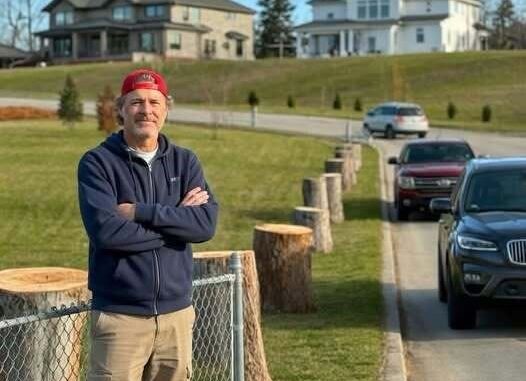
The first tree didn’t fall with enough noise to warn me. There was no dramatic crack that carried across the yard, no moment of warning that something permanent was being undone. Only silence, and then absence. I didn’t even know it had happened until I came home that afternoon and noticed the gap—too clean, too intentional, too final.
Where there had once been a continuous line of tall, mature trees—planted decades ago by my father—there were now six raw stumps. Fresh wood was exposed in pale circles against the darker soil, like wounds that hadn’t yet understood they were supposed to heal. The wind moved differently through the yard that evening. It felt less like air passing through a familiar space and more like something had been opened up and left unprotected.
At first, I thought there had to be some mistake. Trees don’t just disappear from your property without notice. But as I walked closer, the truth became harder to ignore. The cut marks were deliberate, professional. Whoever did it knew exactly what they were doing. And they hadn’t done it for safety, or necessity, or maintenance.
They had done it for a view.
The explanation came later, almost casually, from one of the workers at the nearby development. The new houses behind ours were being marketed as luxury properties with “enhanced sightlines.” The trees, apparently, interfered with that plan. So they were removed to open up the landscape, to make the homes feel larger, brighter, more connected to the surroundings.
To them, it was improvement. To me, it was erasure.
Those trees had never been decorative. They weren’t planted for resale value or aesthetics. My father planted them one by one over the course of years, starting when I was still a child. I remember watching him dig each hole with slow patience, packing the soil down with his boots afterward. He said they would “grow into a boundary that didn’t need a fence.”
And they did.
Over time, they became something more than a line of vegetation. They marked seasons. They held snow in winter like sculpture. They blocked harsh summer winds. They carried the sound of birds that always seemed to return at the same time each year. They were part of the rhythm of the place in a way that didn’t need to be explained to anyone who had lived with them long enough.
Their removal didn’t just change the yard. It changed the feeling of the entire property.
The house suddenly felt exposed. Windows that once looked out into dense green now faced direct sightlines to newly built structures. What had once been private became visible. It was a subtle shift, but one that registered immediately in the body before it could be rationalized in the mind. I found myself closing curtains earlier. Standing in rooms differently. Listening for sounds I had never needed to pay attention to before.
For a few days, I didn’t act. I just tried to understand what had actually happened. There is a strange mental delay that occurs when something crosses from “unthinkable” into “already done.” You find yourself replaying the same thought: how could this be allowed to happen? But that question rarely leads anywhere useful unless you eventually replace it with something else.
What actually happened here? And what can be done now?
That shift sent me back through old documents—property records, easements, boundary maps stored in a box that hadn’t been opened in years. Most of it was routine paperwork, faded ink and legal language that normally sits untouched for decades. But eventually I found what I was looking for.
A recorded easement tied to the only access road leading into the new development.
It was small, almost overlooked. But it mattered.
The next morning, I walked down to that road and placed a heavy chain across it. It wasn’t done in anger, at least not in the immediate sense. It was more like setting something back into balance after it had been quietly disturbed. The chain wasn’t decorative or symbolic. It was practical. A physical statement that access was not unconditional.
At first, the response was dismissive. A few cars turned around. Some drivers assumed it was temporary construction. But as the day went on and deliveries were delayed, contractors redirected, and residents began having to take longer routes, the inconvenience became harder to ignore.
People began asking questions.
Then came phone calls. Then complaints. Then legal attention.
That was when the situation shifted again—from inconvenience to conflict.
The developers insisted the trees were on a shared buffer zone. I presented the property lines. They argued intent. I presented the easement. They shifted to interpretation. But paper has a way of being stubborn. When the records were laid out clearly, there wasn’t much room left for narrative.
The trees had been entirely on my land. Their removal had not been approved. And their justification—however commercially convenient—did not override ownership.
What followed wasn’t dramatic in the way people often imagine disputes to be. There were no shouting matches or confrontations in the yard. Instead, there were meetings, emails, and long pauses between responses. A slow recognition that what had been treated as landscaping was, in fact, something legally and personally significant.
Eventually, an agreement was reached.
Restoration would begin.
It didn’t undo what had happened, but it acknowledged it.
A few weeks later, new trees were planted along the same line. Younger this time. Smaller. Not replacements, because you cannot replace forty years of growth with a single afternoon of planting. But they were beginnings. Symbols of continuity rather than repair.
I watched them being set into the ground one by one. The same process my father had once done, except now I understood it differently. Not as a single act, but as a long-term commitment to time itself.
When the work was finished, I removed the chain from the road.
No announcement. No final statement. Just the absence of a barrier that no longer needed to be there.
Life slowly returned to its usual shape after that. Cars passed again. Deliveries resumed. The neighborhood settled back into its normal rhythm. But something fundamental had changed in how I understood the space I lived in.
The land was no longer just background. It was no longer something that could be adjusted for convenience or reshaped for aesthetics without consequence. It was understood now—clearly, formally, permanently.
And as the new trees begin their slow work of growing into the space left behind, they carry a different meaning than the ones that came before them.
Not just memory.
But awareness.
That some boundaries don’t need to be loud to matter.
Leave a Reply