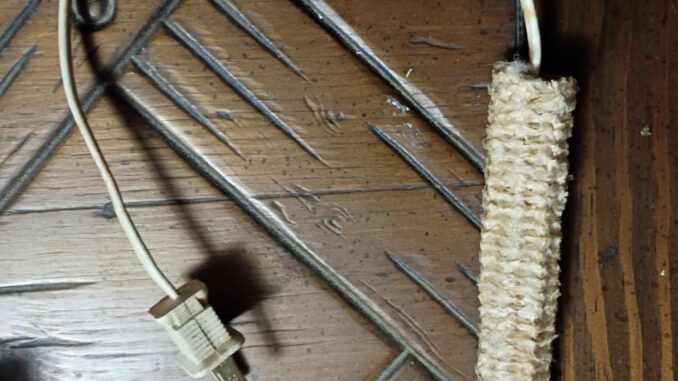
Old houses have a way of turning into museums of accidental memory. You open a basement box expecting tax papers or tangled holiday lights, and instead you find something that makes everyone in the room stop and stare. That’s exactly what happened when a family came across a dried corn cob with an electrical cord attached—an object so absurd it seemed almost fictional at first glance. Only later did they learn it was a real novelty item known as the “Electric Toilet Tissue” gag gift, a piece of mid-century humor that makes more sense the less seriously you take it.
The item itself is as simple as it is baffling. A corn cob, dried and lacquered, fitted with a plug and cord. Sometimes it came mounted in a small box, sometimes wrapped in plastic, and sometimes just loose, as if the joke itself refused to be contained. The packaging, when it survived, usually bore bold lettering reading “Electric Toilet Tissue” and often included cartoonish outhouse illustrations alongside slogans like “Live Better Electrically.” It was not subtle. It was not elegant. And that was precisely the point.
The Electric Toilet Tissue gag gift belongs to a very specific era of American humor—the mid-1960s through the 1970s—when novelty items thrived on exaggeration and contradiction. Electricity was rapidly transforming everyday life. Households were filling with electric appliances: electric razors, electric can openers, electric blankets, even electric carving knives. The cultural joke practically wrote itself: if everything could be electrified, why not the most ridiculous possible thing?
That absurd leap is where the corn cob came in.
Historically, corn cobs were once associated with rural improvisation. In some older American farm communities, before commercial toilet paper became universal, corn cobs were sometimes used in outhouses. Whether people find that amusing, unsettling, or both depends on distance from that history. The gag gift took that old reality and collided it with modern appliance obsession. The result was a fake product that pretended to “modernize” something that absolutely should not be modernized.
The humor worked because it played on expectation. The box suggested a serious household innovation. The phrase “Electric Toilet Tissue” sounded like it might sit on a store shelf next to electric shavers or bathroom heaters. For just a split second, the brain tries to reconcile it as plausible. Then the image lands: a corn cob with a plug. The joke resolves itself in that instant of contradiction, where expectation collapses into absurdity.
This kind of humor was especially popular in a time when novelty stores and mail-order catalogs thrived. Gag gifts were a social currency. People brought them to office parties, holiday exchanges, and birthdays not because they were useful, but because they were designed to produce a reaction—usually laughter, groans, or both. The Electric Toilet Tissue gift fit perfectly into that tradition. It was cheap, strange, and memorable enough that no one forgot it after seeing it once.
Over time, these objects stopped circulating and started accumulating in attics, garages, and basement corners. That’s why discoveries like the corn cob surprise still happen today. A family cleaning out an old home might not immediately recognize what they’re holding. It doesn’t look like modern memorabilia or even a coherent object at all. Without context, it becomes something between junk and mystery artifact.
But context changes everything. Once identified, the corn cob stops being unsettling and becomes oddly charming. It transforms from “What is this?” into “Someone thought this was funny enough to buy.” And that realization is often more interesting than the object itself. The gag gift becomes less about its physical form and more about the personality behind it.
Why would someone keep it for decades? The answer is almost always the same: because it meant something at the time. Not emotionally profound, but socially meaningful. It might have been a joke from a coworker, a white elephant exchange, or a novelty shop impulse buy. It may have been passed down without explanation, surviving simply because no one had a reason to throw it away. In that sense, the object outlives its humor not because it remains funny, but because it once was.
The packaging, when preserved, amplifies that effect. Vintage novelty boxes often used deadpan marketing language, presenting absurd products as if they were revolutionary inventions. That contrast—serious presentation paired with ridiculous content—was a key part of the comedy. The box didn’t wink at you; it trusted you to get the joke. That restraint is part of why these items still feel oddly effective today.
Of course, there is one modern reality that cannot be ignored: it should never be plugged in. Even if the cord appears intact, these items were never functional appliances. They were not designed to operate safely or at all. The wiring, if present, is purely theatrical, and decades of storage can make it unsafe. The humor ends where electricity begins.
Still, there is something undeniably enduring about the Electric Toilet Tissue gag gift. It represents a style of humor that didn’t rely on irony or complexity. It was immediate, physical, and a little ridiculous on purpose. It also captures a moment in cultural history when “electrifying everything” felt like progress worth joking about.
Today, it survives mostly as a curiosity, a talking point, and occasionally a viral discovery when someone posts a photo online asking what they’ve found. And each time, the reaction is the same: confusion, laughter, and disbelief that such a thing ever existed.
A corn cob with a cord doesn’t need to be useful to be memorable. It just needs to make people pause, stare, and ask the simplest possible question.
Why does this exist?
And sometimes, that question is the entire joke.
Leave a Reply