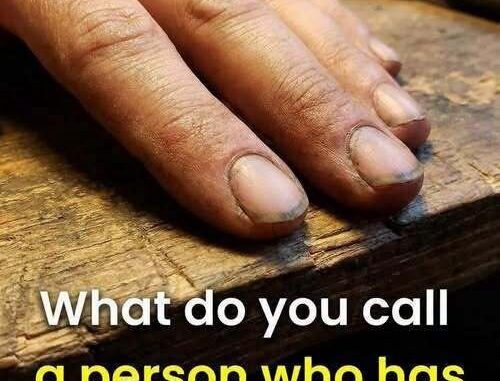
Easier still to judge them.
A glance at darkened nails or soil-stained fingertips can trigger an immediate reaction—discomfort in some, assumptions in others, and in professional or public settings, a quiet decision about what kind of person is standing in front of you.
Because hands feel personal in a way few other details do. They’re what we extend in greeting, what we see when someone gestures, what we notice when money is exchanged or food is served. Cleanliness in that space has become shorthand for order, discipline, even trustworthiness.
But that shorthand is incomplete.
And often, unfair.
There are cases where dirty or unkempt nails do reflect neglect. Situations where hygiene is easily accessible but ignored, where carelessness becomes a habit rather than an exception. In those contexts, people’s discomfort isn’t random—it comes from a reasonable expectation that basic cleanliness is part of shared social responsibility. No one wants to question whether a handshake is safe, or whether food has been handled properly, or whether a shared environment respects everyone in it.
Those concerns are valid.
But they are not the whole story.
Because not every stain is a sign of disregard. Sometimes, it is the opposite.
A mechanic’s hands carry the evidence of engines taken apart in freezing mornings, grease worked deep into skin that no soap fully lifts. A farmer’s nails hold traces of soil from fields that feed thousands, each line under the nail a reminder of long hours under sun and rain. A construction worker’s fingers bear dust from concrete, wood, and metal—materials that become homes, roads, and schools. Caregivers, too, often carry invisible traces of labor that isn’t dramatic but is constant: cleaning, lifting, tending, repeating.
And then there are the moments after crisis—the volunteers digging through rubble after floods, the people sorting supplies after storms, the neighbors rebuilding what was lost. In those environments, there is no distinction between “clean” and “dirty” in the traditional sense. There is only urgency, effort, and the physical evidence of showing up when it mattered most.
The irony is that the same society that benefits from this work often expects its visible signs to disappear before acknowledgment is given.
We want the roads repaired, the food delivered, the buildings standing, the systems functioning—but we also want the people responsible for that labor to appear untouched by it.
As if effort should be invisible.
As if contribution should leave no mark.
But the human body does not work that way. Work leaves traces. Especially work that is physical, repetitive, and essential. And those traces are not failures of cleanliness—they are records of participation in something necessary.
This doesn’t erase the importance of hygiene. Clean hands still matter. In healthcare, food service, childcare, and many other fields, standards exist for good reason. They protect others. They protect trust. They protect safety in environments where even small risks can have large consequences.
Both truths can exist at the same time without canceling each other out.
Cleanliness matters.
And so does context.
The challenge is that context requires a pause—something modern life rarely encourages. It is faster to categorize than to consider. Faster to assume than to ask. Faster to see a detail and build a story around it than to wonder what came before it.
But hands are not just surfaces. They are histories.
A single pair of dirty nails might belong to someone who had no time to stop working because stopping meant falling behind. Or someone who spent their day in places most people never have to enter. Or someone whose labor is invisible until it suddenly isn’t available anymore.
And sometimes, it is simply temporary—a moment between tasks, between shifts, between responsibilities that do not allow for immediate washing or rest.
Judgment often treats these differences as irrelevant.
Reality does not.
Because the truth is, society is built on a constant exchange between visible polish and invisible effort. The cleaner the end result appears, the more likely it is that someone else’s hands carried the mess along the way.
So what looks like dirt may actually be proof of participation in that exchange.
None of this means standards disappear. It means interpretation deepens.
A person with clean hands may be well-prepared, careful, or simply coming from a different kind of work. A person with stained nails may be exhausted, under-resourced, or deeply committed to labor that doesn’t fit neatly into appearance-based expectations.
The difference lies not only in what is seen—but in what is understood.
And understanding requires something judgment often skips: curiosity.
Because before you decide what someone’s hands say about them, it may be worth asking what those hands have been doing.
Not every mark is neglect.
Not every stain is carelessness.
Sometimes, it is simply evidence that someone has been doing the kind of work the world depends on—but rarely stops to look at closely.
Leave a Reply