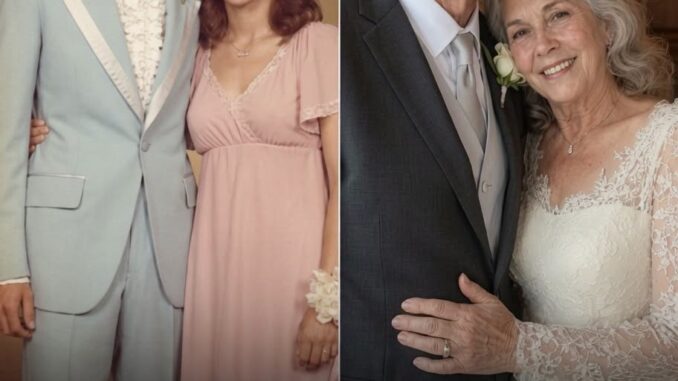
Some people believe life slows down when you get old. In my experience, it only becomes more honest—stripped of pretense, sharp around the edges, and capable of surprising you when you least expect it.
I learned that the hard way after I married Garrett, my high school sweetheart, at seventy-two.
It had started quietly enough. I had been living alone after my husband Howard passed, filling my days with church bake sales, Wednesday food pantry shifts, and the comforting rhythm of routines that didn’t ask too much of me. The house was quiet, but it wasn’t lonely in a painful way. It was just… settled.
Then Garrett walked into my life again.
I saw him first at a church bake sale, standing near the brownies like he had never left the world I remembered. He said my name—“Eleanor”—like it still belonged to him. And for a moment, I forgot I was seventy-two, widowed, and cautious about hope.
He looked older, of course. We both did. But the crooked smile was the same one I remembered from 1972, when he had once promised me a diamond ring behind the bleachers. We laughed like fools that day in front of the dessert table, as if fifty years had simply been a long afternoon nap.
After that, Tuesdays became ours. Coffee at the diner. Shared stories of lives that had gone on without each other. He had lost his wife, Patricia, nearly a decade earlier. I told him about Howard, and how grief doesn’t disappear—it just learns your habits.
Six months later, he asked me to marry him.
He didn’t have a ring yet, but he said he would get one. I said yes anyway.
Not for money. Not for security. But because some part of me still remembered the boy who once walked me home in the rain and talked about forever like it was something you could actually reach.
The engagement dinner at his mansion was the first crack in the dream.
His children, Margaret and Daniel, greeted me like an inconvenience dressed as a guest. Margaret smiled without warmth. Daniel shook my hand like I was there to inspect plumbing. I told myself it was grief, loyalty to their late mother, Patricia.
But then I heard them talking in the hallway.
“Daddy, please think about it,” Margaret said.
“I’m not changing anything,” Garrett replied, low and firm.
That was the first time I understood I might not be stepping into a family, but into a battlefield.
The morning after our wedding, the battle made itself known.
Margaret arrived before the flowers had even begun to fade, wearing a pale dress that looked too close to bridal white. She brought a notary and a leather folder, placing everything on the table like she had already decided the ending.
“Sign,” she said. “Put everything in Ethan’s name. Since you’re family now.”
Ethan—my new husband—stood near the window, silent. Not defending me. Not opposing her. Just… watching.
That silence told me more than her words ever could.
I read the papers slowly. They were meant to overwhelm me, to rush me into compliance. But I had learned something in seventy-two years: people who rush you are usually afraid you’ll notice what they’re doing.
So I didn’t rush.
I signed one line.
Not the transfer.
Just acknowledgment that I had received the documents.
And then I told them, quietly, “Now it’s my turn.”
What followed was a careful unfolding. Evidence. Recordings. A prenuptial clause Garrett had insisted on long before I ever understood why. My attorney arrived with calm precision, and suddenly the room that had been meant to corner me became a courtroom without a judge.
By the time it ended, Margaret’s certainty had fractured. Ethan’s confidence had collapsed into negotiation. And I realized something simple but permanent:
They had underestimated me because I had allowed myself to look harmless.
The real Garrett appeared in pieces after that. Quiet phone calls. Locked folders. Words I didn’t yet understand—“Whitfield,” “trust structures,” “protections already in place.”
Then, suddenly, he was gone.
A heart attack. No warning. No time for goodbye.
Grief has a strange rhythm when it arrives after shock. It doesn’t roar—it settles.
But what followed his death wasn’t grief. It was eviction.
Within days, Margaret produced paperwork. A family trust. Claimed ownership. Claimed I had no legal standing. Daniel placed my suitcase at my feet without meeting my eyes. And I walked out of the mansion wearing the same black dress I had worn to bury my husband.
I ended up in a small trailer by a gravel road, left behind by my late sister. The silence there was different. Not luxurious. Not comfortable. Just final.
I stopped calling. Stopped asking. Stopped expecting.
Until the black limousine arrived.
Two weeks after the funeral, while hanging sheets on a line behind the trailer, I heard gravel crunch beneath tires that didn’t belong there.
A man in a gray suit stepped out. “Mrs. Eleanor,” he said. “I’m Mr. Whitfield. Your husband’s attorney.”
The wind shifted. The clothespin fell from my mouth.
He carried a leather folder and a sealed envelope with my name in Garrett’s handwriting.
“Your husband instructed me to wait until after his passing,” he said. “He wanted you to understand what his children would do before you understood what he had done.”
Inside the trailer, I opened the letter with shaking hands.
Garrett had seen everything.
The cruelty. The control. The quiet attempt to erase me.
And while they were busy securing the mansion, he had secured something else entirely.
A lake cottage. A lifetime income. And a private trust no one had touched.
But the most important thing wasn’t money.
It was a small wooden box.
Inside it were photographs they had refused me. His class ring from 1972. And a diamond ring engraved with words I hadn’t seen in fifty years:
For Eleanor, whom I promised behind the bleachers.
I cried then—not because I had been saved from poverty or humiliation, but because someone had remembered me so completely that even time hadn’t been allowed to take anything away.
Garrett hadn’t fought his children publicly. He hadn’t turned love into spectacle or grief into performance. He had simply made sure that cruelty never had the final word.
Two months later, I moved into the lake cottage.
Life didn’t become dramatic after that. It became quiet in a different way—softer, steadier. Joyce from next door brought coffee on Sundays. I planted roses by the porch. I wore the ring every day, not as memory, but as confirmation.
Love hadn’t arrived late.
It had been waiting, carefully arranged, for the moment I was finally ready to receive it.
Leave a Reply