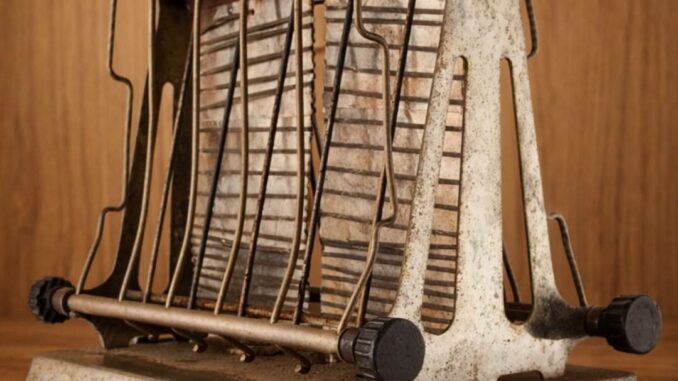
Take a moment to imagine a typical family kitchen nearly one hundred years ago. The smell of fresh bread fills the room, the morning sun streams through the windows, and a curious metal appliance sits proudly on the breakfast table. Unlike the sleek, automated toasters found in modern homes, this early kitchen device required patience, attention, and a little skill to operate. Yet for many families of the early 20th century, it represented something extraordinary—the future.
Today, many younger generations have never seen one in person, and even some history enthusiasts struggle to identify it at first glance. If someone placed this unusual appliance on a kitchen counter today, most people would probably guess it was a strange heater, a scientific instrument, or perhaps a decorative antique.
In reality, it was one of the earliest electric turnover toasters, a remarkable invention that helped transform everyday life.
A Simple Device with a Big Impact
At first glance, the vintage turnover toaster appears surprisingly basic. It consists of a wire frame holding slices of bread beside exposed heating elements. Unlike today’s automatic pop-up toasters, there were no digital settings, timers, or automatic shut-off mechanisms.
Instead, the process relied entirely on the user.
Once plugged into an electrical outlet, the heating coils would gradually glow bright red as they warmed. A slice of bread was placed into the metal holder, positioned close to the heating element. As one side toasted, the user watched carefully, judging the color and crispness by eye.
When the first side reached the desired level of browning, the bread had to be flipped manually so the opposite side could toast.
There was no buzzer announcing that breakfast was ready. There was no spring-loaded mechanism to pop the toast into the air. Every step required attention.
While this may sound inconvenient by today’s standards, it became a familiar morning ritual for millions of households.
Breakfast Was Once a Hands-On Experience
Modern kitchens are designed to save time. Appliances perform tasks automatically, allowing people to multitask while breakfast prepares itself.
Nearly a century ago, however, preparing food often required constant supervision.
The turnover toaster reflected this slower pace of life. Instead of pressing a button and walking away, family members remained nearby, watching the bread carefully to avoid burning it.
The experience became surprisingly personal.
Parents often taught children exactly when to flip the bread. Couples prepared breakfast together while chatting over coffee. The process encouraged people to pause, even briefly, before beginning the day’s responsibilities.
In many ways, the toaster became more than just a cooking appliance—it became part of the morning routine that brought families together.
A Symbol of the Electric Age
Perhaps the most fascinating aspect of the turnover toaster wasn’t simply its design but what it represented.
During the early decades of the 20th century, electricity was steadily making its way into homes across many parts of the world. Families who had relied on wood-burning stoves, coal ranges, or gas flames were discovering the convenience of electric appliances for the first time.
Each new electrical device offered a glimpse into a future filled with innovation.
The electric toaster demonstrated that everyday household tasks could become cleaner, faster, and more predictable. Instead of balancing bread over an open flame or using heavy stovetop equipment, homeowners could now toast bread with the help of electricity.
Although primitive compared to modern appliances, the turnover toaster represented significant technological progress.
It showed that electricity could improve even the simplest daily routines.
The Exposed Heating Elements
One feature that surprises modern viewers is the toaster’s exposed heating coils.
Today’s kitchen appliances are designed with multiple safety features. Heating elements are enclosed inside protective metal casings, preventing accidental contact.
Early electric toasters looked very different.
The glowing wires remained fully visible during operation, creating an appearance that seems almost alarming by modern standards. Anyone using the appliance needed to exercise caution to avoid burns.
At the time, however, this design was considered practical rather than dangerous.
Manufacturers prioritized function over appearance, and consumers accepted that operating electrical equipment required careful handling.
These exposed elements also gave the appliance a distinctive industrial appearance that many collectors appreciate today.
Engineering Before Automation
One reason vintage turnover toasters continue to fascinate historians is their straightforward mechanical design.
Rather than hiding the technology behind plastic panels or electronic displays, every working component remained visible.
The wire frame, electrical coils, and bread holder clearly demonstrated how the appliance functioned.
This transparency reflected the engineering philosophy of the era. Products were built to showcase their mechanics rather than conceal them.
Many early household appliances emphasized durability and repairability as well. Individual components could often be replaced instead of discarding the entire appliance.
This practical approach contributed to the longevity of many vintage kitchen tools that still survive today.
The Evolution of the Toaster
As electrical technology improved, toaster designs quickly evolved.
Manufacturers introduced enclosed heating chambers that offered better protection. Automatic timers reduced the risk of burnt toast, while spring-loaded mechanisms eliminated the need to flip bread manually.
Eventually, the familiar pop-up toaster became the industry standard.
These improvements made breakfast preparation faster, safer, and more consistent.
Although today’s toasters are far more convenient, they also removed much of the direct interaction users once had with the cooking process.
The turnover toaster gradually disappeared from kitchens as newer models took its place.
Why Collectors Love Vintage Toasters
Despite becoming obsolete decades ago, turnover toasters remain highly sought after by collectors.
Their appeal extends far beyond nostalgia.
Each appliance represents an important chapter in the history of household technology. They illustrate how engineers approached design during a period of rapid innovation and how families adapted to the growing presence of electricity in everyday life.
Collectors often admire:
- Their distinctive industrial appearance.
- The visible craftsmanship of metal construction.
- Their role in the history of home electrification.
- Their rarity and historical value.
- The fascinating stories they represent.
Many restored examples now appear in museums, antique collections, and historical exhibits dedicated to domestic life during the early 20th century.
A Window into Everyday History
Large historical events often dominate textbooks, but everyday objects can tell equally compelling stories.
A simple toaster may seem insignificant compared to major inventions like automobiles or airplanes. Yet appliances like these transformed ordinary life in meaningful ways.
The turnover toaster reveals how families embraced new technology one small step at a time.
It reminds us that progress doesn’t always arrive through dramatic breakthroughs. Sometimes it enters quietly, sitting on a breakfast table and making a routine task just a little easier.
These everyday innovations collectively reshaped homes around the world.
Lessons from a Simpler Time
Looking back, there’s something charming about the deliberate pace required by early kitchen appliances.
Without automation, people became more engaged with the process itself.
Preparing breakfast involved observation, patience, and participation rather than simply pushing a button.
While few people would trade today’s convenient appliances for vintage models, many appreciate the craftsmanship and character these older devices possess.
They serve as reminders of an era when technology was still new, exciting, and constantly evolving.
More Than Just an Antique
To modern eyes, an early turnover toaster may appear outdated or even unusual. Yet beneath its simple metal frame lies an important story about innovation, adaptation, and everyday life.
It symbolizes a turning point when electricity began replacing older cooking methods and ushered households into a new technological age.
Each slice of toast prepared on these early machines represented more than breakfast—it reflected growing confidence in modern conveniences that would eventually transform every room of the home.
Today, surviving examples continue to spark curiosity among collectors, historians, and anyone interested in how ordinary inventions helped shape the modern world.
So the next time you see one of these vintage kitchen devices at an antique shop, museum, or online photo, you’ll recognize it for what it truly is: not just an old toaster, but a remarkable piece of history that quietly helped revolutionize the everyday morning routine.
Leave a Reply