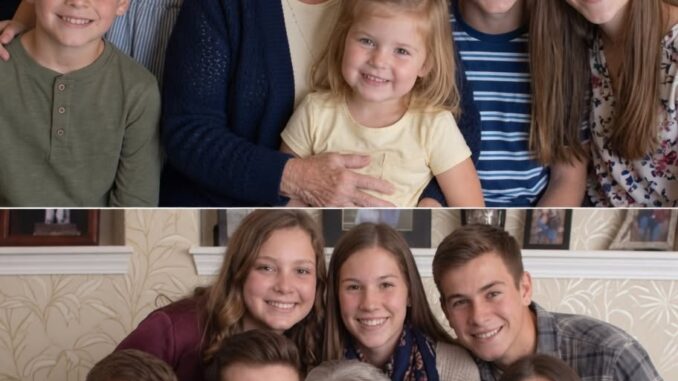
When my son Daniel and his wife Laura were killed in a car accident, I didn’t hesitate for even a second.
Seven children had just lost their parents. And I was their grandmother. That made the decision simple, even if everything else about it was impossible.
What I didn’t know then was that I wasn’t stepping into a grieving household.
I was stepping into a story that hadn’t finished unfolding.
Ten years later, my youngest granddaughter Grace walked into my kitchen carrying an old, dusty box she said she found hidden in the basement.
She placed it on the table like it might explode.
“Mom and Dad didn’t die that night,” she said.
I remember laughing at first. Not because it was funny, but because my brain refused to accept what my ears were hearing.
“Grace,” I said carefully, “we’ve been over this—”
“Just open it,” she interrupted.
So I did.
And the moment I lifted the lid, the air in the room changed.
Inside the box was money.
Stacks of it.
Carefully bundled, hidden like it was meant to disappear from the world entirely.
Underneath that was something even worse.
Documents.
Birth certificates. Social Security cards. Each one belonging to one of my seven grandchildren.
And beneath that… a folded map with routes marked out of state.
My hands started shaking before my mind caught up.
This wasn’t random.
This was planned.
Within minutes, all seven children were gathered in the living room.
“What is that?” Mia asked.
I didn’t answer immediately. I just placed the box on the table.
“This was in the basement,” I said. “Grace found it. And before anyone jumps to conclusions, we need to understand what it actually means.”
But they were already looking at each other differently.
Like the world had shifted slightly off its axis.
Aaron, the oldest, leaned forward and started counting the money.
“This is over forty thousand dollars,” he said slowly.
“That’s not the point,” I replied. “Look at the documents.”
The room went quiet.
Then came the words none of them could hold back.
“They were planning to leave.”
We spent the entire night in that living room trying to make sense of what we were seeing.
Every explanation felt incomplete.
If Daniel and Laura had died, why did their documents exist?
If they had planned to leave, why would they leave their children behind?
And if they didn’t die… then what had actually happened that night?
The question sat in the center of the room like a live wire no one wanted to touch.
By morning, I made a decision.
“We’re going to find out,” I said.
The bank confirmed what none of us were prepared to hear.
The account tied to my son’s name was still active.
“Recent activity,” the clerk said.
I had to ask her to repeat it twice.
Back home, the house erupted.
“They’re alive,” Grace insisted.
“No,” Aaron snapped. “There has to be another explanation.”
But there wasn’t one that fit cleanly anymore.
The truth was starting to take shape in the only way truth ever does—slowly, and without asking permission.
Three days later, there was a knock at the door.
I opened it and saw my son.
Older. Thinner. Real.
Behind him stood Laura, pale and trembling like she wasn’t sure she was allowed to exist there.
For a moment, no one spoke.
Then Daniel said it first.
“We can explain.”
But Grace stepped forward before anyone else could speak.
“You left us,” she said. “You let us think you were dead.”
Laura flinched.
Daniel tried again. “We didn’t have a choice—”
“There is always a choice,” Aaron cut in.
And just like that, ten years of grief turned into something sharper.
Anger.
They told us their version of events.
Debt. Pressure. Fear.
A plan to disappear temporarily, to “reset,” to return when things were stable again.
“We were going to come back for you,” Laura said quickly. “That was always the plan.”
But even as she said it, no one in the room believed her.
Because plans don’t last ten years.
And love doesn’t leave seven children behind in the dark.
Something inside me went quiet as I listened.
Not rage.
Not relief.
Just clarity.
Because I had raised those children alone.
I had worked myself to exhaustion, stretched every dollar, every hour, every piece of myself just to keep them safe.
And I knew what abandonment looked like when it was disguised as survival.
I stood up slowly.
“I’ve already closed the account,” I said.
Daniel’s head snapped toward me. “What?”
“I transferred everything into the children’s college fund.”
Panic flashed across his face. “Mom, you can’t—”
“I already did.”
Silence fell so fast it felt physical.
That was when Aaron stepped forward.
“You had ten years,” he said to his parents. “You chose yourselves every time. Grandma didn’t.”
No one argued with him.
Because it was true.
Laura’s voice cracked. “We loved you.”
Mia shook her head. “That makes it worse.”
And that was the moment something finally broke—not loudly, but completely.
When they left, there was no dramatic ending.
No shouting.
No final explanations that made everything make sense.
Just two people walking away from a life they had once tried to pause and never returned to.
I watched them go and felt something unexpected settle in my chest.
Not victory.
Not closure.
Just acceptance.
Because whatever their intentions had been, the result had not changed.
I had raised seven children through grief, confusion, and silence.
And I had done it without them.
That night, after the door closed, all seven of my grandchildren came to me without speaking.
We didn’t talk.
We didn’t need to.
They just gathered around me in the living room like they had done so many times before.
And in that moment, I understood something simple and unshakable:
Families aren’t defined by who disappears.
They’re defined by who stays.
Leave a Reply