Every school has students who naturally attract attention. They are the ones who volunteer first, speak the loudest, and always seem comfortable standing in front of a crowd. Then there are students like Lucas Jensen—quiet, respectful, and content to stay out of the spotlight.
Lucas wasn’t shy because he lacked confidence. He simply preferred to listen before speaking. His teachers often described him as thoughtful, and his classmates knew him as someone who was kind to everyone, even if he rarely joined the louder conversations that filled the hallways between classes.
He wore simple clothes, carried the same backpack he’d used for years, and never tried to impress anyone. To many students, he blended into the background. But those who knew him well understood that Lucas had been raised to value honesty, humility, and respect above recognition.
That lesson came from his mother.
She often reminded him that a person’s character was measured not by titles or accomplishments but by the way they treated others. “You never need to prove your worth,” she would tell him. “Let your actions speak louder than your words.”
Lucas remembered those words often, especially during challenging moments.
One Monday morning, Northwood High began its annual Heroes and Service Appreciation Week. The school hallways were decorated with colorful displays recognizing people who dedicate their lives to helping others. Students were encouraged to prepare short presentations about someone they admired—whether a family member, community volunteer, healthcare worker, educator, first responder, or military veteran.
The assignment was designed to celebrate service and inspire gratitude.
As the week approached, excitement spread throughout the freshman classrooms. Many students carefully prepared slideshows filled with photographs, awards, and family stories. Others brought meaningful keepsakes connected to the person they planned to honor.
When Lucas prepared his presentation, he kept it simple.
Inside his notebook rested a single photograph.
It showed his mother standing beside a military aircraft while wearing a flight suit. The picture had been taken years earlier during her time in the Air Force, before she retired to focus on family life.
Lucas had always admired that photograph.
Not because of the airplane.
Not because of the uniform.
But because of the quiet confidence reflected in his mother’s expression.
She had never spoken much about her career. Whenever friends asked questions, she usually redirected the conversation toward teamwork rather than personal achievements.
“Nothing important is accomplished alone,” she always said.
When presentation day arrived, students took turns sharing their stories.
One spoke about a grandfather who had spent decades serving as a firefighter.
Another described an aunt who worked as an emergency room nurse.
Someone else honored a local volunteer who organized food drives throughout the community.
Each presentation received warm applause.
Finally, Mr. Davies glanced down at his attendance sheet.
“Lucas, you’re next.”
Lucas calmly walked to the front of the classroom, carrying only his notebook.
He placed the photograph on the desk beside him and unfolded the page he had written the evening before.
“My hero is my mother,” he began.
The introduction sounded familiar to several classmates, who smiled politely while waiting to hear more.
“Her name is Sarah Jensen. She served in the United States Air Force, and during her career she flew advanced military aircraft.”
A few students exchanged surprised looks.
One whispered quietly to another.
Mr. Davies tilted his head with mild curiosity.
“That’s an interesting career,” he said.
Lucas nodded.
“She always taught me that responsibility, discipline, and teamwork matter more than recognition.”
Some students listened with genuine interest.
Others appeared uncertain.
Perhaps it was because Lucas rarely spoke about his family. Since he was such a private student, many classmates had never heard anything about his mother’s background.
Mr. Davies smiled politely before asking another question.
“Lucas, are you sure you’ve understood your mother’s role correctly?”
Lucas answered without hesitation.
“Yes, sir.”
The room grew quiet.
Rather than accepting the answer immediately, Mr. Davies chose his next words carefully.
“Sometimes family stories become larger over time,” he said. “It’s always important to verify information before presenting it as fact.”
Although he intended the comment as a reminder about research, several students interpreted it differently.
A few began whispering among themselves.
Lucas noticed the reactions but remained calm.
“I understand,” he replied. “But everything I’ve shared is true.”
The teacher nodded and moved the discussion forward, encouraging the next student to begin.
Lucas quietly returned to his seat.
He wasn’t angry.
He wasn’t embarrassed.
Mostly, he felt disappointed.
Not because someone questioned his story.
But because he knew exactly what his mother would have said.
“If people don’t understand something,” she often reminded him, “don’t argue. Truth has a way of revealing itself with patience.”
That afternoon Lucas mentioned the classroom discussion while helping his mother prepare dinner.
She listened without interrupting.
When he finished, she smiled gently.
“It sounds like your teacher simply had questions.”
“I guess.”
“Did you answer honestly?”
“Yes.”
“Then you’ve already done everything you needed to do.”
Lucas looked puzzled.
“You aren’t upset?”
She shook her head.
“Not at all. We can’t control what other people believe. We can only control how we respond.”
The conversation ended there.
Neither of them expected anything more to come from the assignment.
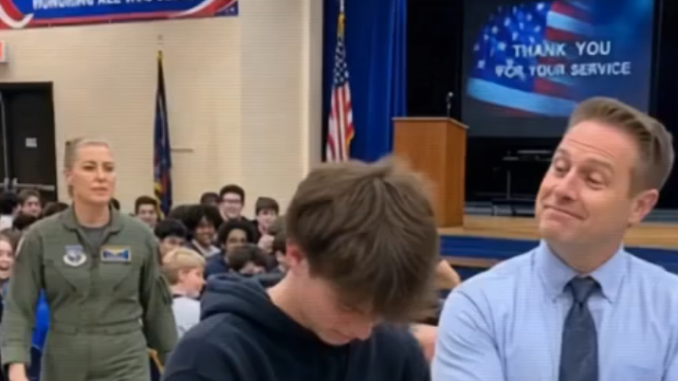
Two days later, however, the school hosted its annual Heroes Appreciation Assembly.
Community members from various professions had been invited to speak with students about leadership, perseverance, and public service.
Teachers, parents, and guests gradually filled the auditorium while students found their assigned seats.
Lucas noticed several visitors wearing uniforms representing different branches of military service, along with firefighters, healthcare professionals, rescue personnel, and local volunteers.
Then he spotted a familiar face near the entrance.
His mother.
She wore a neatly pressed navy-blue flight suit displaying several embroidered patches from her years of service.
Instead of drawing attention to herself, she quietly greeted organizers before taking her place among the invited speakers.
Mr. Davies happened to be standing near the stage, reviewing the event schedule.
When he glanced toward the guest section, he paused.
One of the event coordinators approached him.
“I’d like you to meet one of today’s guest speakers,” she said.
“This is Sarah Jensen.”
Mr. Davies smiled politely.
“It’s a pleasure to meet you.”
“The pleasure is mine,” Sarah replied warmly.
The coordinator continued.
“Sarah served for many years as a military pilot before retiring. Today she’ll be speaking about leadership, teamwork, and overcoming challenges.”
For a brief moment, Mr. Davies remained silent.
His expression changed almost instantly as he remembered Lucas’s classroom presentation.
Everything the student had shared suddenly made perfect sense.
A few minutes later Sarah stepped onto the stage.
Instead of describing exciting missions or dramatic experiences, she focused on the importance of preparation, discipline, trust, and supporting others.
She explained that success in aviation depended on hundreds of people working together behind the scenes.
“No one succeeds alone,” she told the students. “Whether you’re a pilot, a teacher, a doctor, or a student, every achievement is built on teamwork.”
The auditorium listened attentively.
Her message wasn’t about titles.
It wasn’t about recognition.
It was about integrity.
When the assembly concluded, students lined up to thank the guest speakers.
Mr. Davies approached Sarah and introduced himself again.
“I also teach Lucas,” he said.
Sarah smiled proudly.
“He enjoys your class.”
Mr. Davies hesitated before responding.
“I owe your son an apology. Earlier this week, I questioned something he shared during a classroom presentation. Looking back, I realize I should have listened more carefully before making assumptions.”
Sarah appreciated his honesty.
“We all make assumptions sometimes,” she replied kindly. “The important thing is being willing to learn from them.”
Later that afternoon, Mr. Davies spoke privately with Lucas.
“I wanted to thank you for remaining respectful earlier this week,” he said. “I should have given your presentation the benefit of the doubt instead of questioning it so quickly.”
Lucas smiled.
“My mom says everyone keeps learning.”
“She’s absolutely right.”
From that day forward, the classroom felt different.
Students became more thoughtful before dismissing someone else’s experiences, and Mr. Davies often reminded future classes that every person’s story deserves respect, even when it sounds unexpected.
Lucas never sought attention for what had happened.
He simply returned to being the same quiet, thoughtful student he had always been.
The experience left everyone with an important lesson that reached far beyond a classroom assignment.
True character isn’t measured by how loudly someone speaks or how impressive their background may seem.
It’s revealed through honesty, humility, and the willingness to treat others with respect before making assumptions.
Sometimes the most meaningful heroes are the ones who never ask for recognition at all—and the greatest lesson they leave behind is teaching others to lead with kindness, patience, and an open mind.
Leave a Reply