It began like any other uneasy night in rural Tennessee, the kind where the air feels heavy and still but nothing quite signals danger. Sydney Moore and Aramis Youngblood were at home with their young children, doing what exhausted parents do at the end of a long day—trying to settle everyone down, trying to make the evening calm enough for sleep. Outside, the sky had been shifting in subtle but unsettling ways, yet like many nights before it, it didn’t immediately demand attention.
Tornadoes rarely announce themselves in a way that feels believable in the moment. Even when weather alerts exist in the background, there is often a sense of distance, as if disaster belongs somewhere else, not here. So when conditions began to deteriorate, there was still a quiet assumption that it would pass, that it wouldn’t become what it ultimately became.
That illusion broke suddenly.
The wind intensified quickly, transforming from background noise into something alive and forceful. The house began to respond before anyone fully understood what was happening—walls vibrating, windows trembling, the structure itself seeming to strain under pressure. Then the sound changed completely, becoming a continuous roar that drowned out everything else, as if the world had narrowed to a single violent force moving directly overhead.
In moments like that, normal decision-making disappears. There is only instinct.
Sydney reached for their older child without hesitation, pulling him close as the environment around them destabilized. At the same time, Aramis moved toward their youngest, a four-month-old baby resting in a bassinet nearby. That object, designed for safety and stillness, became the center of his focus in an instant. Nothing about the situation felt real anymore, only urgent.
And then the structure failed.
The roof gave way with shocking speed, as though the house had simply been lifted open. Rain and debris poured in together, mixing inside the home in a chaotic blur. Furniture shifted, objects broke free, and the boundaries between inside and outside disappeared entirely. The storm had not just surrounded the house—it had entered it.
Aramis held on tightly to the bassinet, trying to anchor it against forces that were no longer predictable. But the wind inside the structure had become overwhelming, moving in directions that defied control or resistance. Every second demanded more strength than the last.
Then, in a moment that would define everything afterward, the bassinet was ripped away.
Not pushed or knocked aside—pulled violently upward and outward, disappearing into the storm as the house itself continued to disintegrate. In the same sequence of chaos, the remaining structure collapsed further, leaving the family exposed to wind, rain, and flying debris until the tornado moved on, leaving silence behind it.
What followed was not immediate relief, but disorientation.
After a storm of that magnitude, silence feels unnatural. The absence of noise becomes its own kind of pressure. When Sydney and Aramis finally realized the storm had passed, what remained of their home was barely recognizable. Walls, belongings, and familiar structure had been reduced to scattered fragments across a changed landscape.
But the worst realization came quickly: their baby was gone.
There is a particular kind of fear that comes with uncertainty. It is not the fear of confirmed loss, but of not knowing, where hope and dread exist at the same time and neither can settle. That was the space the family found themselves in as they tried to process what had just happened.
Despite shock and exhaustion, Sydney began moving through the debris field. The terrain around her had been transformed into something unfamiliar—broken wood, tangled materials, and uprooted trees blending into a single chaotic environment. She walked toward any sign of help or stability, covering a long distance through conditions that were still difficult and disorienting.
Aramis remained closer to what was left of their home. He could not bring himself to move away from the area where his child had last been. Instead, he searched nearby woods and scattered wreckage, calling out repeatedly, each attempt carrying both desperation and hope. Every sound from the environment seemed significant, as if the answer might be hidden within it.
Time stretched in ways that felt distorted. Minutes felt much longer. Every moment carried weight.
Then something changed.
In the quiet aftermath of destruction, Aramis heard a faint sound that didn’t belong to the wind or debris. It was subtle, easy to miss, but distinct enough to pull his attention immediately. He followed it carefully, moving through broken branches and unstable ground, focusing entirely on that fragile signal.
What he discovered defied expectation.
His infant son was alive.
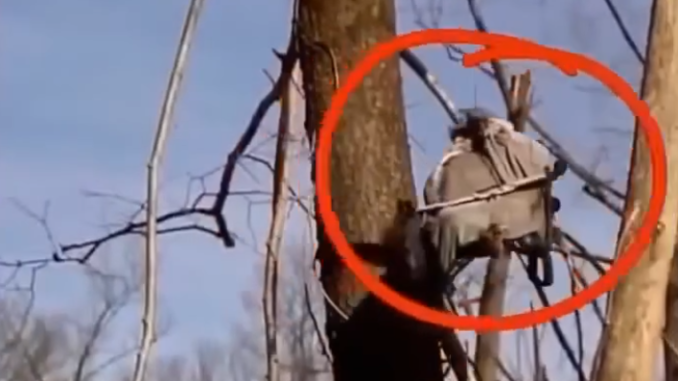
The baby had been carried by the force of the tornado and placed into the fork of a tree, where branches had somehow created a pocket of protection. It was not untouched—there were injuries, including a mild concussion and ear trauma—but he had survived the event that destroyed everything around him.
The emotional impact of that moment was immediate and overwhelming. Relief did not arrive gradually; it arrived all at once, flooding through shock, fear, and disbelief. Aramis held his child and began the slow walk back through the remains of their property, trying to reconcile what had just happened with what he was seeing.
What remained of the home told a different story entirely. Survival had been possible, but nothing else had been preserved. The family’s daily life—structure, belongings, comfort—had been erased in minutes. There was nothing left intact to return to.
They were alive, but everything else had to be rebuilt.
In the days that followed, the story began to spread beyond the immediate community. As people learned what had happened, reactions quickly followed. Many were struck not only by the destruction, but by the unlikely survival of the infant. The combination of loss and rescue created a powerful emotional response.
Support began to arrive from multiple directions. A fundraising effort eventually raised more than $100,000 to help the family recover. Local neighbors provided essential supplies such as clothing, food, and baby care items. Others who had never met the family contributed as well, responding to the story with empathy and action.
In the aftermath of devastation, a network of support formed almost organically.
For Sydney and Aramis, the experience became layered in meaning. The trauma of what occurred did not disappear, nor did the memory of how narrowly their child had survived. But alongside that pain was something else—an awareness of how quickly life can be taken apart, and how unexpectedly it can also be held together by circumstances beyond control.
Rebuilding was not immediate. It never is after disasters like this. It came in stages, shaped by support, resilience, and time.
What happened that night cannot be simplified into a single explanation. Tornadoes do not offer clarity or fairness—only outcomes. But within the destruction, something extraordinary occurred: a life was spared under improbable conditions, and a family found itself forced to begin again from nothing.
And perhaps that is why the story stays with people.
Not only because of what was lost, but because of what somehow remained.
Leave a Reply