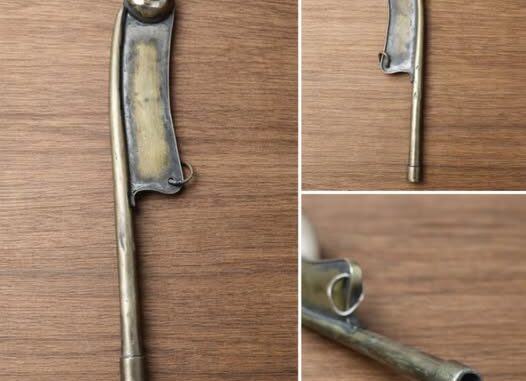
Have you ever come across a small brass or silver object with a hollow handle, a rounded ball-like end, and a shape unlike anything you’ve seen before? At first glance, it may look like an old decorative tool or even a miniature musical instrument. In reality, it’s a piece of maritime history with a very important purpose.
This distinctive object is known as a boatswain’s call, also called a bosun’s whistle. Although compact in size, it played a vital role aboard ships for centuries, helping crews communicate quickly and efficiently long before radios and loudspeakers existed.
Today, these whistles remain treasured by collectors, naval enthusiasts, and museums because they represent an important chapter in maritime tradition.
What Is a Boatswain’s Call?
A boatswain’s call is a specially designed whistle traditionally used aboard sailing ships and naval vessels.
Its primary purpose was communication.
Unlike an ordinary whistle, the boatswain’s call was capable of producing several different tones and signal patterns. These distinctive sounds allowed crew members to recognize specific commands, even in the middle of strong winds, crashing waves, and the constant noise of a busy ship.
Before electronic communication became available, this small instrument served as one of the most effective ways to relay instructions across the deck.
Why Was It So Important?
Life aboard large sailing ships required careful coordination.
Crew members often worked high in the rigging, managed sails, handled ropes, or operated equipment spread across different parts of the vessel. Shouting instructions wasn’t always practical, especially during storms or when dozens of sailors were working simultaneously.
The boatswain’s call solved this problem by producing a sharp, high-pitched sound that carried remarkably well over long distances.
Its unique tone could easily cut through background noise, allowing important commands to reach the crew quickly.
A Long Maritime History
The boatswain’s call has been part of naval tradition for hundreds of years.
Its exact origins are difficult to pinpoint, but versions of the whistle were already being used during the great age of sailing ships, long before modern communication systems were invented.
As naval fleets expanded around the world, the whistle became a standard tool carried by boatswains—experienced officers responsible for supervising many of the ship’s daily operations.
Over time, the design changed very little because it proved both reliable and highly effective.
Even after ships adopted radios and electronic communication, the boatswain’s call continued to be used during ceremonial events and naval traditions.
A Simple Design with a Specialized Purpose
Although the whistle appears unusual, each part serves a specific function.
The main components typically include:
- A narrow tube where air is blown into the whistle.
- A rounded chamber that helps create the distinctive sound.
- A curved body that provides a comfortable grip.
- A small ring for attaching a lanyard or chain.
Together, these elements allow trained users to produce a variety of tones and signal patterns.
Experienced sailors could change the pitch and sound by adjusting their breath and carefully positioning their fingers over parts of the whistle.
More Than Just One Sound
Unlike ordinary whistles that produce only a single note, the boatswain’s call allows for much greater control.
By changing:
- Air pressure
- Finger placement
- Hand position around the sound chamber
users can create different notes and sequences.
Historically, these sound patterns communicated various shipboard instructions.
Some signals were used to gather the crew, while others indicated that certain tasks were about to begin or announced formal ceremonies.
Every navy developed its own traditions and standard signal patterns over time.
What Was It Used For?
The boatswain’s call served many practical purposes aboard ships.
Common uses included:
- Calling crew members together.
- Signaling the beginning of daily duties.
- Communicating work assignments.
- Marking formal ceremonies.
- Announcing the arrival of important visitors.
- Supporting naval traditions during official events.
Because the whistle could be heard clearly across the deck, it became one of the most dependable communication tools available.
The Example Described Here
The particular whistle described features several characteristics that help identify it.
According to the available information, it includes:
- Material: Sterling silver
- Maker: A.E. Co., Utica, New York
- Length: Approximately 5½ inches (14 cm)
- Weight: About 0.8 ounces
- Type: Traditional boatswain’s call
Its sterling silver construction suggests it may have been intended not only for practical use but also as a well-crafted piece reflecting maritime tradition.
Collectors often value examples made from precious metals because of both their craftsmanship and historical appeal.
Understanding the Shape
To someone unfamiliar with nautical equipment, the whistle’s appearance can be confusing.
The rounded “ball” near one end is actually part of the whistle’s sound chamber.
The long narrow section acts as the mouthpiece through which air travels.
The curved plate helps support the whistle during use while allowing the user to control airflow more precisely.
Finally, the small ring attached to the side allows the whistle to be worn around the neck with a cord or chain, reducing the chance of accidentally dropping it overboard.
A Symbol of Maritime Tradition
Today, boatswain’s calls are still used in certain ceremonial settings.
Some naval organizations continue using them during formal events, inspections, and traditional ceremonies that honor centuries of maritime history.
Outside military settings, these whistles are also popular among:
- Maritime museums
- Antique collectors
- Historical reenactors
- Nautical enthusiasts
- Military memorabilia collectors
Their unique appearance and rich history make them fascinating artifacts even for people with little knowledge of ships.
Why Collectors Appreciate Them
Antique boatswain’s calls are valued for several reasons.
Some collectors focus on rare manufacturers or precious-metal examples, while others appreciate the connection to naval history.
Factors that often influence collectibility include:
- Overall condition
- Material used
- Manufacturer markings
- Age
- Historical significance
- Provenance, if known
Sterling silver versions, especially those bearing identifiable maker’s marks, are often particularly desirable.
A Small Tool That Played a Big Role
One of the most remarkable aspects of the boatswain’s call is how such a small object could carry so much importance.
Without batteries, electronics, or complicated mechanisms, it allowed officers to communicate quickly across large ships operating in some of the world’s harshest environments.
Its effectiveness came entirely from thoughtful design and skilled use.
Even centuries later, the basic design remains instantly recognizable.
Final Thoughts
At first glance, a boatswain’s call may appear to be an unusual decorative object or an unfamiliar antique. In reality, it is one of the most recognizable tools in maritime history.
Used for centuries aboard sailing ships and naval vessels, this compact whistle helped crews communicate clearly in challenging conditions where voices alone weren’t enough. Its clever design, dependable performance, and enduring role in naval tradition have made it both a practical instrument and a lasting symbol of life at sea.
Whether discovered in an antique collection, displayed in a museum, or passed down through generations, the boatswain’s call serves as a reminder of the ingenuity and discipline that shaped maritime history long before modern technology transformed communication aboard ships.
Leave a Reply