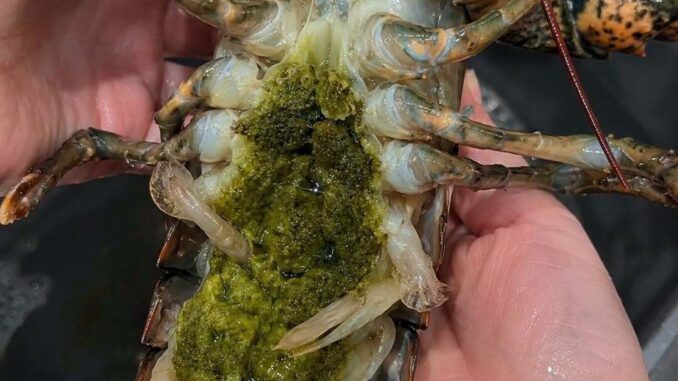
It looks unsettling the moment you crack open the shell. A strange, creamy green substance tucked inside an otherwise beautiful lobster instantly raises alarm. Is it spoiled? Is it dangerous? Or is it actually something prized by seafood lovers? For decades, the mysterious green material—known as tomalley—has divided diners around the world. Some consider it the richest, most flavorful part of the lobster, spreading it on toasted bread or blending it into luxurious sauces. Others refuse to let it touch their plate, convinced it signals something unhealthy. The truth is more complicated than either side often realizes. Hidden inside that vibrant green paste is an organ that performs a vital job for the lobster, and because of that role, it can also collect substances from the surrounding environment. Understanding exactly what tomalley is, why some people treasure it, and why health experts recommend moderation can help you make an informed decision the next time lobster appears on your dinner table.
The green substance is called tomalley.
It is not spoiled meat.
It is not an egg sac.
It is also not a sign that the lobster was cooked incorrectly.
Tomalley functions as the lobster’s digestive gland.
In simple terms, it performs many of the same jobs that the liver and pancreas perform in humans.
It helps digest food.
It stores nutrients.
It filters materials that pass through the lobster’s body.
Because it carries out these important biological functions, its appearance is completely natural.
For generations, many seafood enthusiasts have considered tomalley a delicacy.
Its flavor is often described as intensely rich, slightly sweet, deeply briny, and more concentrated than the lobster meat itself.
Professional chefs sometimes incorporate small amounts into seafood sauces, soups, bisques, or butter to enhance flavor.
Others enjoy spreading it on toasted bread or mixing it with cooked lobster meat.
Among passionate seafood lovers, the green paste has developed an almost legendary reputation.
Not everyone shares that enthusiasm.
Many first-time diners are surprised by its appearance.
Its vivid green color and creamy consistency can make people hesitate before taking a bite.
Some simply dislike the texture.
Others avoid it because they have heard conflicting advice regarding its safety.
That caution is understandable.
Unlike the tail or claw meat, tomalley serves as a filtering organ.
As lobsters feed throughout their lives, this organ can accumulate certain naturally occurring substances from the marine environment.
In some regions, health authorities have advised limiting or avoiding tomalley consumption because it may concentrate environmental contaminants, including certain pollutants or toxins produced during harmful algal blooms.
For this reason, several public health agencies recommend enjoying lobster meat while consuming tomalley only sparingly, particularly if advisories have been issued for the waters where the lobster was harvested.
These recommendations are generally precautionary.
Eating a small amount of tomalley occasionally is unlikely to pose a problem for most healthy adults when the lobster comes from clean waters.
However, consuming large quantities regularly is generally not recommended.
Pregnant individuals, young children, and people with certain health conditions may wish to exercise additional caution and follow local food safety guidance.
The quality of the lobster itself also matters.
Fresh lobster should have a clean, mild ocean scent.
If any part of the lobster—including the tomalley—has an unusually sour, rotten, or ammonia-like odor, the lobster should not be eaten.
Likewise, slimy textures or obvious signs of spoilage indicate the seafood should be discarded.
Freshness remains one of the most important factors in seafood safety.
Another point of confusion involves lobster roe.
Unlike tomalley, roe consists of eggs carried by female lobsters.
Before cooking, the eggs appear dark.
After cooking, they turn a bright red color.
Tomalley, by contrast, usually remains green and occupies a different part of the body cavity.
The two are entirely different structures despite often appearing together inside the shell.
Seafood traditions vary widely around the world.
In some coastal communities, eating tomalley is considered completely ordinary.
In others, people routinely remove and discard it without a second thought.
Neither approach is inherently right or wrong.
Much depends on personal taste, local culinary customs, and individual comfort.
Knowing what it is allows each person to make an informed choice rather than reacting out of uncertainty.
Ultimately, the real value of understanding tomalley is not deciding whether everyone should eat it.
Instead, it is recognizing that food often carries fascinating biological stories hidden beneath the surface.
The lobster’s green digestive gland has inspired debate for generations because it represents both remarkable flavor and practical caution at the same time.
It can be appreciated for its culinary tradition while also respected for the role it plays inside the animal.
The next time you open a freshly cooked lobster and notice that unmistakable green paste, you will know exactly what you are looking at.
Whether you decide to savor it, leave it untouched, or remove it entirely is a matter of personal preference.
The most important ingredient on any plate is confidence in your own decision.
Understanding what tomalley is—and why experts recommend moderation—allows you to enjoy lobster with greater knowledge, greater comfort, and a healthy respect for both culinary tradition and food safety.
Leave a Reply