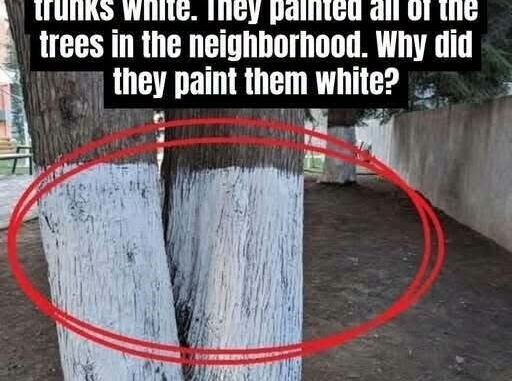
The first time you really notice it, it feels wrong. Why are all these tree trunks painted white, lined up like silent signals along the road? It isn’t random. It isn’t decorative. It’s a message about survival, damage, and a danger most people never realize trees face until it’s too late. Once you understand what that white strip actually means, you’ll never drive past a painted orchard or roadside planting the same way again. What looks like an odd splash of paint is actually the result of decades of experience, careful observation, and one remarkably simple technique that can mean the difference between a healthy tree and one permanently scarred by the elements.
For many people, the sight raises immediate questions. Some assume the trees have been marked for removal. Others believe the paint is meant to keep insects away or identify government property. A few even think it’s simply for decoration. The truth is far more practical—and far more important. That thin layer of white paint serves as a protective shield, helping vulnerable trees survive conditions that can destroy them long before pests or disease ever become a problem.
Trees may look incredibly strong, but their bark is surprisingly sensitive, especially when the trees are young. While mature trees develop thicker bark capable of withstanding years of changing weather, younger trunks remain vulnerable to sudden shifts in temperature. During winter, a bright sunny afternoon can warm one side of a trunk dramatically, causing the living tissue beneath the bark to become active. Then, as temperatures rapidly plunge after sunset, that same tissue freezes almost instantly, creating enormous internal stress.
The damage caused by this rapid expansion and contraction is known as sunscald or southwest injury. It often appears as long vertical cracks running down the trunk, where the bark splits open under the pressure. These wounds expose the tree’s inner layers to insects, fungi, bacteria, and moisture, creating opportunities for disease that may persist for years. In severe cases, the damage weakens the tree so significantly that growth slows dramatically or the tree dies altogether.
Those pale trunks aren’t a quirky aesthetic choice; they’re a quiet act of protection. In winter, sunlight can heat one side of a tree’s bark, then night temperatures plunge, snapping that warmed tissue like glass. The result is sunscald: long, ugly cracks that can stunt growth, invite disease, or even kill a young tree before it ever has a chance to mature. What seems like a harmless cycle of warm days and cold nights can become surprisingly destructive when repeated throughout an entire winter.
The solution, however, is remarkably simple. By coating the bark with diluted white latex paint, growers create a reflective surface that reduces how much heat the trunk absorbs during sunny winter days. Instead of warming dramatically under direct sunlight, the painted surface reflects much of that energy away, keeping the bark at a more stable temperature throughout the day. As evening arrives, there is less drastic cooling because the trunk never overheated in the first place.
This technique has been used for generations by orchard owners, landscapers, and arborists caring for fruit trees and ornamental plantings. Apple, peach, pear, cherry, and many other species benefit from this extra layer of protection during their early years. Although the practice is most common in regions with cold winters and bright sunshine, it can also help trees exposed to intense sunlight in other climates where bark damage remains a concern.
The paint itself is carefully chosen. Professionals typically use water-based white latex paint diluted with water rather than oil-based products, which can interfere with the tree’s natural ability to breathe. The goal isn’t to seal the bark but to provide a reflective coating that gradually weathers away over time without harming the living tissue underneath. Applied correctly, the paint protects without restricting the tree’s normal growth.
Some growers choose tree wraps instead of paint, particularly for ornamental trees in residential landscapes. These protective coverings serve a similar purpose by reducing direct sunlight and limiting sudden temperature fluctuations. However, wraps must be installed and removed properly, as leaving them on too long can trap moisture or create hiding places for insects and rodents. White paint remains a popular option because it requires relatively little maintenance and provides season-long protection.
Leave a Reply