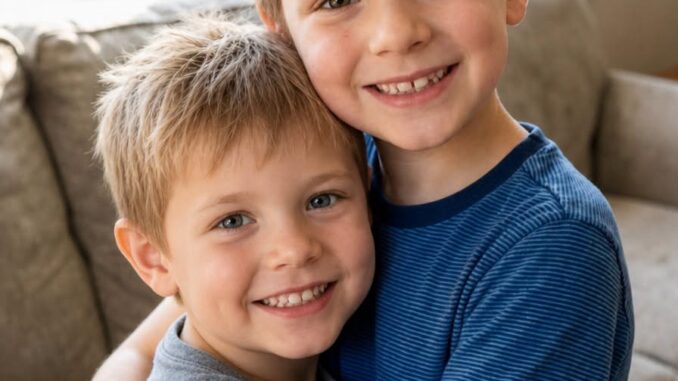
Life after a profound loss often feels like walking through a dense, unyielding fog. For Elana, the world shattered six months prior when a devastating highway crash claimed the life of her eight-year-old son, Ethan. While her husband, Mark, survived the harrowing accident, Ethan did not. In the immediate aftermath of the tragedy, Elana was shielded from reality by well-meaning medical professionals who deemed her too fragile to identify her own child’s body. That single decision denied her the finality of a proper goodbye, leaving her grief suspended in an endless, agonizing loop of unanswered questions and unexpressed sorrow.
The Return of an Older Brother
The routines of daily life slowly resumed, dictated by the needs of their younger son, Noah. At five years old, Noah possessed an innocence that seemed entirely untouched by the tragedy that had upended his family. He had just returned to kindergarten for his second week when the trajectory of their healing process shifted dramatically.
As Elana pulled into the crowded school parking lot, the background noise faded into a dull hum. Noah buckled halfway into his seat, looked at her with absolute serenity, and uttered words that instantly fractured her reality:
“Mom, Ethan came to see me.”
The sentence hung in the air, sharp and unbelievable. Ethan had been gone for half a year. Elana forced her hands to remain steady on the steering wheel, keeping her voice light and gentle to mask the sudden terror gripping her heart.
“Oh, sweetheart,” she replied, her voice trembling slightly. “You missed him today?”
“No,” Noah insisted, frowning at her misunderstanding. “He was here. At school.”
The word “here” sliced through the delicate armor Elana wore every day. When she carefully probed further, asking what his brother had said, Noah offered a chillingly specific detail that made the air in her lungs turn ice cold: “He said you should stop crying.”
A Growing Unease at the Cemetery
The following Saturday, Elana drove Noah to the cemetery, carrying a bouquet of white daisies. Ethan’s headstone still looked glaringly new, polished and clean against the weathered earth around it, as if it had not yet earned its place among the ancient markers of the dead.
“Come say hi to your brother,” Elana whispered, her heart aching.
Noah remained completely still. He stared at the marble marker, then looked right past it, his young eyes tracking something invisible to his mother.
“Mom,” Noah whispered, his voice barely audible over the wind. “Ethan isn’t there.”
A cold shiver raced across Elana’s skin. “What do you mean he isn’t there?”
“He told me,” Noah answered with absolute, childlike simplicity. “He’s not in there.”
By Monday, the unsettling encounters continued. Noah reported seeing his older brother again by the chain-link fence near the playground. When Elana pressed for details about their conversations, Noah hesitated, his eyes darting away nervously.
“It’s a secret,” he mumbled.
Every maternal instinct in Elana’s body flared into high alert. The word “secret” in connection with a deceased sibling felt deeply wrong. She knelt down, looking straight into his eyes. “Noah, we don’t keep secrets from Mom. If anyone ever tells you to keep a secret from me, you must tell me anyway. Do you understand?”
Noah nodded slowly, though his hesitation lingered.
The Discovery on the Security Footage
Determined to uncover the truth, Elana took decisive action the very next morning. She walked directly into the kindergarten administrative office and requested the security camera footage from the playground perimeter. Initially hesitant, the school administrator yielded under Elana’s unyielding gaze.
In the quiet office, they watched the monitor. The screen showed bright jackets and running children during recess. Then, Noah wandered slowly toward the rear fence near the maintenance shed.
He stopped. He smiled. He waved.
“Zoom in,” Elana demanded, her voice tight.
The camera angle shifted and sharpened. On the other side of the chain-link fence, a man was crouching low. He wore a standard work jacket and a baseball cap pulled down low to obscure his face, staying half-hidden while leaning close to speak through the metal bars. Noah was laughing, responding to the stranger as if this interaction were entirely normal.
Then, the man slipped something small through the gaps in the wire.
“Who is that?” Elana asked, her vision narrowing with sudden fury.
Ms. Alvarez swallowed hard. “That’s one of the contractors. He’s been here all week fixing the exterior lighting.”
Elana didn’t hear the word contractor. Instead, her mind flashed instantly back to the crash report she had deliberately avoided studying in detail months ago—the details of the truck, the driver, and the catastrophe that stole her family’s peace.
“That’s him,” Elana whispered, the realization hitting her with the force of a physical blow.
“Who?” the administrator asked, bewildered.
“The truck driver,” Elana said, her voice dropping to a dangerous, icy register. “The one who killed my son.”
Confronting the Past
Within minutes, campus security and local law enforcement were mobilized. When officers arrived, they located the man near the maintenance shed. He offered no resistance, running away or fighting back.
In a small conference room at the station, the man sat quietly without his cap. He appeared noticeably thinner than he had in the courtroom photographs, featuring red-rimmed eyes and hands tightly clasped together. When Elana entered the room, he looked up.
“Mrs. Elana,” he said hoarsely.
Hearing her name spoken by the man responsible for her family’s destruction made her skin crawl. Noah, who had accompanied her, pressed close to her side and whispered, “That’s Ethan’s friend.”
Gently, Elana sent Noah out of the room with the administrator, turning her full, unyielding attention toward the seated man.
“Why were you talking to my son?” she demanded.
He flinched, staring down at his interlocked fingers. “I didn’t mean to scare him.”
“You told him you were Ethan,” Elana stated, her anger simmering just beneath the surface. “You told a five-year-old child to keep secrets from his mother.”
The man’s shoulders folded inward under the crushing weight of her words. “I know.”
An investigating officer asked for his identification.
“Raymond Keller,” he replied softly.
“Why approach the child?” the officer pressed.
Raymond stared intensely at his hands. “I saw him at the school pickup last week. He looks so much like Ethan.” His voice cracked, rough with emotion. “I intentionally requested the repair contract for this school.”
The confession hit Elana like a physical assault. “Why would you do that?”
“I can’t sleep,” Raymond confessed, his voice breaking. “Every time I close my eyes, I’m back in that truck. I suffer from syncope—fainting spells. I was supposed to undergo medical clearance tests, but I skipped them. I was terrified of losing my job.”
“And you chose to drive anyway,” Elana stated coldly.
“Yes.”
“And my son died because of it.”
“Yes.”
The small conference room felt suffocatingly small, saturated with the irreversible gravity of that truth.
“And you thought talking to my living son would help you?” Elana asked, disbelief coloring her tone.
“Me,” he admitted in a whisper. “I thought… if I could do something good, if I could somehow help you stop crying, maybe I would finally be able to breathe again.”
Elana leaned forward, her eyes locked on his. “So you used my living child as a tool to soothe your own unbearable guilt.”
Raymond offered no defense.
Reclaiming the Truth
The legal and administrative response was swift. Elana secured a strict no-contact order, banned him permanently from the property, and insisted on a rigorous review of the school’s visitor and perimeter security protocols.
When Noah re-entered the room, he was clutching a small plastic dinosaur that Raymond had handed him through the fence. Kneeling down to his eye level, Elana took his small hands in hers.
“Noah, that man is not Ethan,” she told him gently, ensuring her voice remained steady.
The little boy’s lower lip trembled. “But he said—”
“He told you something that wasn’t true,” Elana explained. “Grown-ups are never supposed to place their sadness onto children. And they should never ask children to keep secrets from their parents.”
Noah blinked hard, processing the complex reality. “So Ethan didn’t talk to him?”
“No,” Elana said, the admission feeling like sharp glass in her throat. “Ethan didn’t.”
Noah finally broke down, crying not with loud tantrums, but with the quiet, devastating grief of a child realizing something precious had been manipulated. Elana held him tightly until his breathing slowed and normalized.
That evening, back in the quiet safety of their home, Elana shared every detail with Mark. Her husband’s face contorted first with violent rage, and then with a deep, crushing wave of survivor’s guilt.
“I should have been the one in that seat,” Mark whispered into the darkness that night.
“Don’t,” Elana told him firmly, resting her hand against his chest. “We don’t have the luxury of drowning. We have Noah.”
Moving Forward in Honesty
Two days later, Elana returned to the cemetery alone. The autumn wind cut sharply through her heavy coat, but she felt oddly grounded. Kneeling by Ethan’s headstone, she pressed her fingertips against the cold stone, tracing his name.
“Hi, baby,” she whispered into the empty air. “I’m sorry I couldn’t see you then. I’m sorry I couldn’t say a proper goodbye.”
The atmosphere around the grave felt different now—not haunted by phantom whispers or manipulative illusions, but entirely honest.
“I can’t forgive him,” she told her late son quietly. “Maybe I never will. But I refuse to let anyone else speak for you. No more borrowed words, and certainly no more secrets.”
She pressed her full palm firmly against the cold marble marker.
“I am going to keep Noah safe,” she promised. “And I am going to keep your memory clean and protected.”
The pain of the loss remained, heavy and enduring, as it always would. But it was no longer wrapped in confusion and deception. It was the clean, sharp pain of absolute truth—and for the first time in six months, Elana felt strong enough to carry it forward.
Leave a Reply