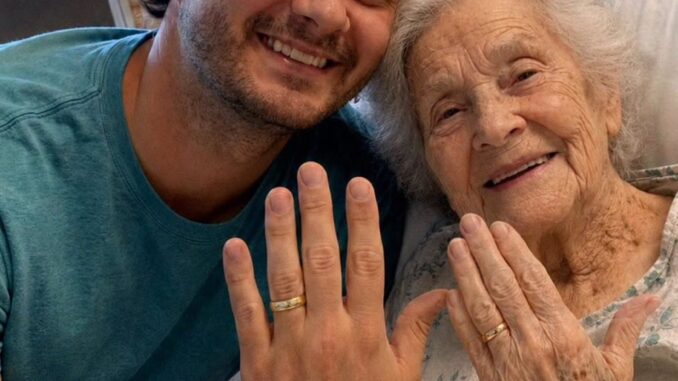
When I started working at a nursing home, I expected the job to be difficult but straightforward. I never imagined that one resident would completely change the way I understood family, belonging, and my own past.
Her name was Gloria.
She was 82 years old, remarkably sharp, stubborn in the best possible way, and capable of making almost anyone smile.
I was 34 and had spent much of my childhood moving through foster homes. Because of that, I had learned to appreciate small acts of kindness. A warm conversation, a familiar face, or someone remembering how you took your tea could mean more than people realized.
Gloria seemed to understand that better than anyone.
The Resident Who Became Family
The first time I delivered her breakfast, she studied me carefully.
“You’re new,” she said. “But you don’t move like someone who’s new.”
I laughed.
“I’m Daniel.”
She smiled.
“Sit down for a minute, Daniel. Tell me about yourself.”
Nobody had asked me that in a very long time.
From that morning forward, we developed a routine.
I’d bring her tea after my shift, and she’d tell me stories about her childhood, her late husband, and the years she spent growing up on a farm.
She had plenty of stories, but there was one subject she rarely discussed.
Her family.
One evening, she mentioned a nephew named Marcus.
“He stopped visiting once he realized I wasn’t going anywhere,” she said. “But he’ll probably return when he hears I’m gone.”
I asked whether that made her angry.
Gloria simply shook her head.
“Bitterness takes too much room. I don’t want to live with it.”
There was another thing about Gloria that always caught my attention.
She carried an old canvas hospital bag everywhere.
It was faded, worn, and clearly decades old. Whenever someone tried moving it, Gloria immediately reached for it.
One day I asked what was inside.
“Everything important,” she replied.
I smiled.
“Can I see?”
“Maybe someday.”
I respected her privacy and didn’t ask again.
A Sudden Change
Several months later, I noticed that Gloria wasn’t looking well.
Her hands were trembling more than usual, and her breathing had become noticeably weaker.
Not long afterward, she was taken to the hospital.
Because she had no one else available to accompany her, I went with her.
During her stay, I visited whenever I could.
One afternoon, Gloria motioned for me to sit beside her.
She looked tired, but her eyes were still remarkably clear.
“Daniel, I have something to ask you.”
I took her hand.
She paused for a moment.
“I know this may sound strange, but I’ve spent most of my life alone. I don’t want to leave this world without knowing what it’s like to have someone call me their husband.”
Then she asked me to marry her.
I was completely stunned.
I didn’t know what to say.
Gloria smiled gently.
“You don’t have to answer immediately. Think about it. And don’t say no simply because you’re worried about what other people might think.”
The Hardest Decision
I spent the night awake.
I knew exactly how the situation would look to other people.
I was a younger nursing-home employee marrying an elderly resident who was seriously ill and had no obvious family support.
My friend Sarah was especially concerned.
“Daniel, you understand what people are going to assume, right?”
“I know.”
“Management could investigate. People could question your intentions. Your career could be affected.”
I understood all of that.
But I also knew Gloria was asking for something deeply personal.
She wasn’t asking me to prove anything.
She simply didn’t want to face the end of her life feeling completely alone.
The next afternoon, I returned to her room.
“I’ve made my decision,” I told her.
Her eyes immediately filled with emotion.
“I’ll marry you.”
She squeezed my hand.
A week later, we had a small ceremony in her hospital room. A chaplain officiated, and Sarah agreed to be a witness.
There was no elaborate celebration.
No large gathering.
Just a quiet ceremony between two people who had unexpectedly become important to each other.
Three days later, Gloria passed away peacefully in her sleep.
I was holding her hand when she took her final breath.
The Lawyer and the Old Bag
At Gloria’s funeral, I stood alone near the graveside when a man approached carrying the old canvas bag she had guarded so carefully.
He introduced himself as Mr. Charleston, Gloria’s attorney.
He handed me the bag.
“She wanted you to have this.”
I looked down at it.
“Why?”
The lawyer gave me a serious look.
“She chose you for a reason.”
Before he could explain further, another man approached.
I recognized him immediately from Gloria’s stories.
Marcus.
Her nephew.
He looked at me with suspicion.
“You must be Daniel.”
I nodded.
“I’m Marcus.”
He didn’t bother hiding his anger.
“A young nursing-home worker marries my aunt just before she dies,” he said. “You can imagine how that looks.”
I told him the marriage had never been about money.
He said he intended to challenge the marriage and anything Gloria had left behind.
Then he demanded that I give him the bag.
I refused.
Not because I wanted whatever might be inside, but because it was the last thing Gloria had entrusted to me.
Doubts Begin
After the funeral, rumors spread quickly at the nursing home.
People whispered whenever I walked by.
Management scheduled a formal meeting.
I began thinking that perhaps the easiest solution would be to return everything to Marcus.
I didn’t want Gloria’s final decision to destroy my career.
That evening, I sat on my bed staring at the canvas bag.
I still hadn’t opened it.
Then Mr. Charleston called.
“Daniel, please listen to me. Gloria knew this would happen. She prepared for it.”
“What did she prepare for?”
“Open the bag. Read the letter. Then you’ll understand.”
After hanging up, I stared at the bag for another few minutes.
Finally, I opened it.
There was no treasure.
No jewelry.
No stacks of cash.
Instead, I found dozens and dozens of old letters tied together with faded ribbon.
There were photographs, records, and a sealed envelope with my name written across it.
My hands began to shake.
I opened the letter.
And suddenly, my entire life made sense.
The Secret Gloria Had Kept
The letter began with a confession.
When Gloria was 17, she had given birth to a baby boy.
Because of circumstances she described in the letter, she had been separated from him.
For decades, she searched for him.
She wrote letters she could never send.
She kept photographs and records.
Eventually, she discovered that her son had died.
But he had left behind a child.
A boy who had grown up in foster care.
A boy who eventually became a nursing-home orderly.
Me.
I stopped reading.
I couldn’t speak.
Gloria hadn’t randomly chosen me.
She had recognized me from the moment I entered her room.
She had already discovered the connection between us.
But she hadn’t wanted to approach me as a stranger claiming to be family.
She wanted to know me first.
She wanted me to care about her because she was Gloria—not because she was a relative with a story about my past.
The realization was overwhelming.
The woman I had thought of as a lonely resident had actually been searching for me for years.
Why She Asked Me to Marry Her
Mr. Charleston explained the final piece.
Gloria had been concerned that her family history would become tangled in a lengthy legal dispute after her death.
She had therefore taken steps to document our relationship and establish her wishes clearly.
The lawyer showed me records proving the connection between Gloria and my biological family, along with documentation supporting the inheritance arrangements she had made.
There was also evidence from a DNA test that confirmed our relationship.
Marcus had little basis for the claims he had threatened to make.
The truth was finally undeniable.
Gloria hadn’t married me because she wanted to manipulate me.
She had married me because she wanted to make sure the person she had spent years searching for would know who she was.
She wanted me to know that I had never been as alone as I thought.
The Family I Never Knew I Had
A month later, I stood inside the small house Gloria had left behind.
Above the fireplace, I placed the photograph I’d found in her bag.
It showed Gloria as a young woman holding a baby.
My father.
I stared at the photograph for a long time.
All those years, I had believed my family story began and ended with foster care.
I was wrong.
Someone had been looking for me.
Someone had remembered me before I even knew she existed.
And when Gloria finally found me, she didn’t demand anything from me.
She simply became my friend.
Then, when her life was nearing its end, she trusted me with the truth.
I used some of the resources she left me to create a visitor program at the nursing home where we had met.
The goal was simple: make sure residents who had no regular visitors didn’t have to spend their days feeling forgotten.
Sarah helped me organize the first group of volunteers.
As residents began receiving visitors and companionship, I remembered something Gloria had once told me.
Bitterness was a house she refused to live in.
She had spent much of her life carrying loss, but she chose to leave something better behind.
And now I understood why she had chosen me.
She hadn’t just wanted someone beside her at the end.
She wanted to make sure that, after a lifetime of searching, her family would finally find its way home.
Sometimes the people we think are strangers turn out to be the missing pieces of our own story.
Leave a Reply