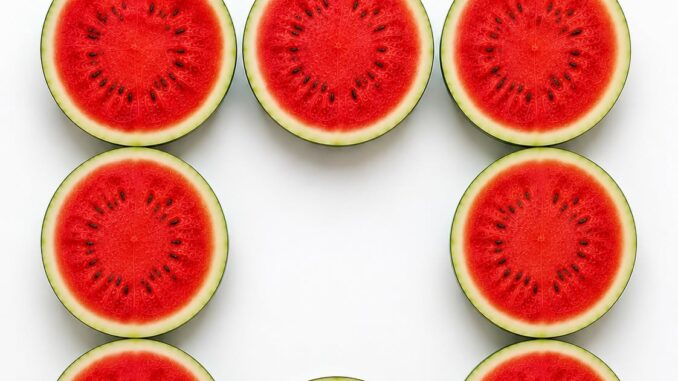
At first glance, the popular watermelon puzzle appears remarkably simple. Several familiar green fruits are arranged in a pattern, and the viewer is asked one basic question: how many watermelons can you see? Many people respond almost immediately because the brain recognizes each rounded green object as a watermelon. But a closer examination reveals the detail that makes the challenge interesting. Not every visible watermelon is necessarily complete, which means counting shapes and calculating the actual amount of fruit can produce different answers.
The first step is therefore to resist the temptation to count quickly. Instead of asking how many watermelon-shaped objects appear in the image, ask how much watermelon those objects represent. A complete fruit contributes one whole unit. A watermelon missing a quarter contributes three quarters, while a half contributes one half. Once every visible piece has been classified, the fractions can be combined to determine the total amount represented in that particular version of the puzzle.
This distinction explains why people often disagree about the answer. Someone may count every recognizable watermelon shape as one object, even when sections have clearly been removed. Another viewer may immediately notice the missing pieces and begin calculating fractions. Both people are looking at exactly the same image, but they are answering slightly different questions. One is counting recognizable objects, while the other is calculating the equivalent number of complete fruits.
There is another complication: not every version circulating online is necessarily identical. Images can be cropped, resized, edited or reposted with altered details. A missing edge or partially hidden piece may change the calculation. For that reason, a numerical answer should always be tied to the exact picture being examined. Without seeing the specific version, claiming that one particular total is universally correct would be unreliable.
A careful solution begins with the complete watermelons. Count only those that are visibly whole and record that number separately. Do not include partial fruits yet. Once the complete objects have been identified, examine the remaining shapes individually and determine what fraction of a whole watermelon each one represents. This creates a much more reliable process than attempting to perform the entire calculation mentally while scanning the image.
Next, combine matching fractions. Two halves make one whole watermelon. Four quarters also make one whole. Two quarters equal one half, and other combinations can be converted in the same way. Writing those values down can prevent a common mistake in which a viewer notices that pieces are missing but accidentally counts the same fraction twice.
Overlapping shapes require additional attention. A section that appears to belong to one fruit may actually be part of another object positioned behind it. Similarly, two partial shapes may look like independent watermelons even though their combined amount represents only one complete fruit. The goal is not to guess what the illustrator intended but to calculate what is visibly represented.
This is why the challenge is more about observation than difficult mathematics.
The arithmetic involved is usually elementary. Most people can add halves and quarters without difficulty. The challenge occurs earlier, when the brain decides what it believes it is seeing. Human visual perception is extraordinarily efficient at identifying familiar objects, and that efficiency can sometimes cause small details to receive less attention.
When people see a round green object with the familiar appearance of a watermelon, the brain quickly assigns it to the category “watermelon.” That rapid recognition is useful in everyday life because analyzing every individual line, color and contour would be inefficient. We normally need to recognize objects quickly rather than calculate their exact geometry.
Visual puzzles take advantage of that shortcut.
They present something familiar while quietly changing one or two important details. The viewer recognizes the larger pattern first and may overlook the smaller irregularity. Only after someone asks whether every object is actually complete does attention shift toward the missing sections.
This effect is not evidence that someone has poor eyesight or low intelligence.
Two people can look at the same image and notice different features first. One person’s attention may immediately go to the number of objects. Another may focus on symmetry. Someone else may notice missing sections before counting anything.
The order in which details are noticed can influence the first answer.
Screen conditions matter as well. A puzzle viewed on a small phone can look different from the same image displayed on a larger monitor. Compression may blur edges, while low brightness can make boundaries between pieces difficult to distinguish. Cropping can be even more important because part of a fruit near the edge may disappear entirely.
That is another reason viral puzzle answers should be checked rather than repeated automatically.
A caption may have been written for an earlier version of an image. The picture may then be reposted, cropped or altered while the original answer remains attached. Eventually, thousands of people can argue over a calculation even though they are not all examining exactly the same visual information.
A systematic approach eliminates much of that confusion.
Start in one corner of the picture and move consistently from left to right or from top to bottom. Assign every visible object a simple category: whole, three-quarter, half, quarter or another clearly identifiable fraction. Record each item once.
Then perform the arithmetic separately.
For example, if a hypothetical puzzle contained four complete watermelons, two halves and four quarters, the calculation would be straightforward. The two halves would combine into one whole, and the four quarters would form another. The total would therefore be six complete-watermelon equivalents.
That example illustrates the method rather than the answer to the image described in the original post.
Without the actual puzzle image, its specific total cannot responsibly be determined here.
This approach is more useful than simply publishing a number because readers can verify the calculation themselves. A good puzzle solution should explain why the answer follows from the visible evidence.
If another person obtains a different result, compare the calculations.
Perhaps one person treated a three-quarter fruit as complete. Perhaps a quarter was overlooked. Maybe two partial pieces were accidentally counted twice. Or perhaps the two people are genuinely looking at different versions of the image.
Explaining the method turns disagreement into something testable.
This is one reason visual counting puzzles remain popular online.
They produce an immediate sense of confidence followed by doubt. Someone sees the picture, reaches an answer within seconds and then notices a detail that forces the entire calculation to be reconsidered.
That moment of revision is the real attraction.
The image itself has not changed.
What changes is the viewer’s interpretation of it.
Once the missing pieces become obvious, it can be surprisingly difficult to remember why the original answer seemed so convincing. The brain has reorganized the visual information around a new pattern.
Similar effects occur in many other puzzles.
Spot-the-difference images rely on viewers overlooking small changes inside otherwise familiar scenes. Hidden-object challenges place unusual details inside visually busy backgrounds. Optical illusions exploit expectations about depth, size, direction or contrast.
Counting puzzles use the same general principle.
They encourage the brain to recognize first and measure second.
The best strategy is to reverse that order.
Before deciding what an object represents, examine how much of it is actually visible. Look at boundaries rather than labels. Check whether a familiar shape is complete before assigning it a value.
This simple habit can improve accuracy considerably.
It also demonstrates a broader principle about problem solving.
Fast intuition is useful, but it is not infallible. When a question has been deliberately designed to produce an obvious answer, that is often a reason to examine the details more carefully.
The first answer can still be correct.
It simply deserves verification.
There is no need to turn the puzzle into a test of intelligence.
Claims that only a tiny percentage of people can solve an ordinary visual puzzle are often used to make posts more dramatic. Unless such percentages come from a properly conducted study, they should not be treated as scientific facts.
The same applies to personality claims.
A watermelon-counting puzzle cannot determine whether someone is a genius, highly creative, unusually observant or psychologically different from other viewers. It measures performance on one particular visual task under one particular set of conditions.
That can still be entertaining.
People can compare answers, challenge friends and discuss which detail they noticed first without attaching unsupported psychological conclusions to the result.
In fact, explaining the disagreement can be more enjoyable than revealing the number.
Someone who initially counted every shape may suddenly understand why another person calculated fractions. Another viewer may discover a piece that everyone else overlooked.
The discussion becomes part of the puzzle.
The most reliable answer is the one that another person can reproduce.
If you claim there are a certain number of watermelon equivalents, show the calculation. Identify the complete fruits, list the partial ones and demonstrate how the fractions combine.
Then another viewer can check every step.
That is much stronger than saying an answer is correct simply because a viral caption says so.
It also protects against altered versions.
If one repost contains an extra half-watermelon or loses a quarter through cropping, the calculation will reveal why its total differs from another image.
Context matters even in something as simple as a fruit puzzle.
So before answering the next viral watermelon challenge, ignore the pressure to respond within five seconds.
Look at every object individually.
Count the complete fruits first.
Identify the fractions.
Combine those fractions carefully.
Check the edges of the image for cropped pieces.
Then calculate the total.
If someone reaches a different answer, compare methods rather than immediately assuming one person failed the puzzle.
The disagreement itself may reveal the hidden detail.
That is ultimately why these images are so effective.
They do not require advanced mathematics.
They exploit the difference between recognizing something and measuring it accurately.
The brain sees “watermelon” almost instantly.
The puzzle asks a more precise question: how much watermelon is actually there?
Once that distinction becomes clear, the challenge becomes much easier.
And the next time a seemingly obvious counting puzzle appears on your screen, the best response may not be to count faster.
It may be to slow down long enough to make sure every “whole” object really is whole.
Leave a Reply