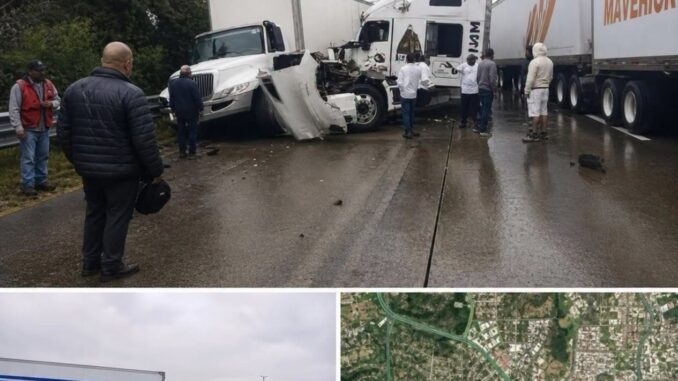
A routine journey along the Mexico–Querétaro Highway turned into a scene of destruction when a trailer lost control near Huehuetoca. Metal folded under the force of the collision, vehicles were crushed, and traffic stopped across one of the region’s busiest routes. The source account reports that 19 people lost their lives, leaving families and an entire community to confront the consequences of a few catastrophic seconds.
Drivers who had been commuting, transporting goods, or simply trying to reach their destinations suddenly found themselves trapped behind wreckage. The trailer came to rest across all three lanes, blocking movement and creating a long line of stranded vehicles. Sirens replaced the ordinary noise of traffic as emergency crews worked through damaged cars, shattered glass, and the confusion surrounding the impact.
Witness descriptions pointed to a frightening combination of conditions. Light rain had affected the road, traffic was dense, and the trailer appeared unable to slow in time. Questions immediately arose about speed, driver fatigue, and possible brake failure. The available account does not establish one final cause, and those possibilities must remain questions until investigators complete their work.
Large commercial vehicles carry enormous momentum. When control is lost on a crowded highway, other drivers have very little time or space to react. A choice made far earlier in a journey, a mechanical fault that was not detected, or a brief moment of exhaustion can become impossible to correct once a heavy vehicle begins moving unpredictably.
The number of deaths made this more than a traffic disruption. Each person represented a family waiting for someone who did not return. Behind the official count were individual journeys interrupted without warning. Survivors and witnesses were left with images and sounds that would not disappear when the road reopened.
First responders entered a dangerous and unstable environment. They had to reach injured people, manage the risk posed by damaged vehicles, and create a path through congestion. Their work continued while other motorists remained nearby, unsure whether they should stay inside their cars, move away, or try to help.
The source also describes moments of solidarity among those caught in the aftermath. Drivers assisted one another, shared information, and responded to immediate needs while professional crews organized the larger rescue effort. Such cooperation cannot undo the loss, but it can prevent panic from creating additional harm.
The traffic jam stretching for kilometers also complicated the response. Ambulances, rescue vehicles, and investigators needed access to a corridor already sealed by wreckage and stranded cars. Clearing a route was therefore part of the emergency itself, requiring coordination while crews continued searching damaged vehicles and protecting people who remained near the collision scene.
Once the immediate emergency passed, attention turned toward responsibility and prevention. Residents demanded safer roads and stronger controls. Those demands reflect recurring concerns on heavily traveled corridors: whether vehicles receive proper maintenance, whether drivers are given adequate rest, whether speeds are enforced, and whether emergency systems can respond quickly when several lanes become blocked at once.
An effective investigation must look beyond the most visible moment of impact. If mechanical failure contributed, records and inspections matter. If fatigue was involved, schedules and working conditions matter. Weather, road design, traffic density, and driver decisions all require careful examination. Treating a disaster as the result of one easy explanation can allow other hazards to remain in place.
The wreck near Huehuetoca is a painful reminder that highway safety depends on many people long before a vehicle enters traffic. Drivers, companies, mechanics, regulators, and road authorities each hold part of the responsibility. For the families of the 19 people reported dead, those questions are not abstract. They are tied to the hope that the truth will be established and that another ordinary day will not end in the same kind of loss.
Leave a Reply