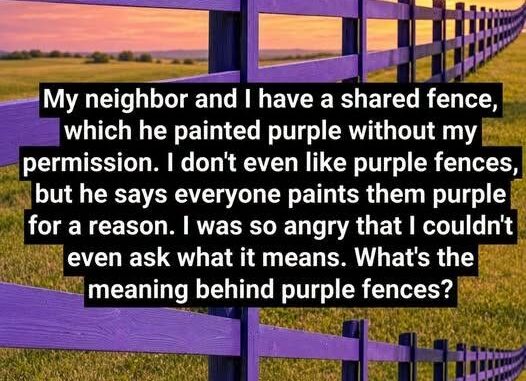
If you’re walking through a rural area, hiking near farmland, or driving along a country road and suddenly notice a fence post or tree marked with bright purple paint, you might wonder why someone chose such an unusual color.
In some parts of the United States, however, purple paint can carry an important message: private property—do not enter.
The practice is sometimes known as a “purple paint law.” Certain states allow property owners to use specific purple markings on trees, posts, or fences as an alternative to traditional “No Trespassing” signs. But there is an important catch: the rules and legal meaning vary from state to state.
Why Would Someone Paint a Fence Purple?
For property owners with large amounts of rural land, posting signs along every boundary can be inconvenient.
Signs can become damaged, fade in the weather, fall down, or be removed. Paint, on the other hand, can provide a long-lasting visual marker.
Purple is also an unusual color in nature and on fences, which makes it easier to recognize as an intentional property marking.
So when you encounter purple paint in an unfamiliar rural area, it is wise not to assume that it is simply decoration.
What Does Purple Paint Mean?
In states that recognize purple paint as a legal property marker, the markings generally communicate a message similar to:
“This property is private. Do not trespass.”
The exact requirements can differ considerably.
Some states have rules concerning the height, size, placement, orientation, and spacing of the marks. Other states may not recognize purple paint as a substitute for a traditional warning sign at all.
That means you shouldn’t assume that every purple-painted fence in the country has the same legal meaning.
Purple Paint Laws Began in the South
Arkansas is commonly credited with pioneering the use of purple paint as a legal trespassing marker. The idea subsequently spread to other states, particularly in the South and Midwest.
The reasoning was straightforward: a distinctive paint mark could provide property owners with a durable way to communicate their boundaries.
Today, several states have laws addressing purple paint, but their requirements aren’t identical.
For example, one state might allow purple markings on trees, while another could specify particular requirements for fences or posts.
This is why local law matters.
Don’t Assume Every Purple Mark Is a Trespassing Warning
This is one of the most important things to remember.
A purple mark doesn’t automatically mean “No Trespassing” everywhere.
It could be:
- A legally recognized property marker.
- A landowner’s informal warning.
- A forestry or land-management marking.
- A decorative feature.
- A marker with another local purpose.
If you’re unsure what a marking means, the safest approach is to respect the apparent property boundary rather than crossing it.
Why Is Purple Used?
Purple is particularly useful because it is highly visible and relatively uncommon.
Imagine walking through a wooded area filled with brown tree trunks and green vegetation. A bright purple stripe immediately stands out.
The unusual color makes the marking easier to notice than a small sign hidden among vegetation.
That visibility is particularly valuable on large properties where visitors may approach from different directions.
Purple Paint on Trees
You may encounter purple markings directly on trees rather than on fences.
In jurisdictions where this practice is legally recognized, painted trees can serve as boundary indicators.
If you’re hiking and see a series of deliberately placed purple marks along trees, don’t treat them as random graffiti or decoration. They may be indicating the edge of private property.
The safest choice is to stay on an established public trail and avoid crossing marked boundaries.
Purple Paint on Fence Posts
Purple markings may also appear on fence posts or other structures.
A single purple mark might not tell you much by itself, but a repeated series of marks along a boundary can make the landowner’s intention much clearer.
If the markings appear alongside a fence, gate, warning sign, or other indication that you’re approaching private land, don’t enter without permission.
The Exact Rules Can Be Different
One common mistake is assuming that the same measurements apply everywhere.
They don’t.
Requirements for purple paint can vary by jurisdiction. Laws may specify things such as:
- The color or shade of paint.
- Whether the marking must be vertical.
- Minimum dimensions.
- How high the mark must be above the ground.
- How frequently markings must appear.
- Whether trees, posts, fences, or other surfaces may be marked.
- Whether additional signs are required.
Because these details differ, property owners should check their state’s current trespassing laws before relying on purple paint as their only warning.
What Should Hikers and Visitors Do?
If you’re hiking, exploring, hunting, or simply walking through a rural area, you don’t need to be frightened when you see purple paint.
Instead, treat it as a reason to pay closer attention to your surroundings.
Stay on public trails and roads unless you have permission to enter private property. Don’t climb over fences simply because there isn’t a conventional “No Trespassing” sign.
And don’t assume that an apparently empty field or forest is public land.
Large rural properties can look completely undeveloped while still being privately owned.
Why This Simple System Is Useful
For landowners, a clearly visible property marker can help communicate boundaries without requiring dozens of signs.
For visitors, learning about purple paint can prevent an innocent mistake from becoming a trespassing problem.
It’s a good example of how something that looks unusual can actually have a practical purpose.
The next time you see a bright purple stripe painted on a fence post or tree in a rural area, don’t immediately dismiss it as someone’s strange decorating choice.
It may be telling you something important.
The Bottom Line
Purple-painted fences, posts, and trees can indicate private property and a warning against trespassing in states that recognize purple paint laws.
However, there is no nationwide rule giving every purple mark the same legal meaning.
The requirements vary by location, so the safest general rule is simple: if purple markings appear to identify a property boundary, respect the boundary and stay out unless you have permission.
That little splash of purple may be more than an unusual color choice—it could be a very clear message to keep moving along the public path.
Leave a Reply