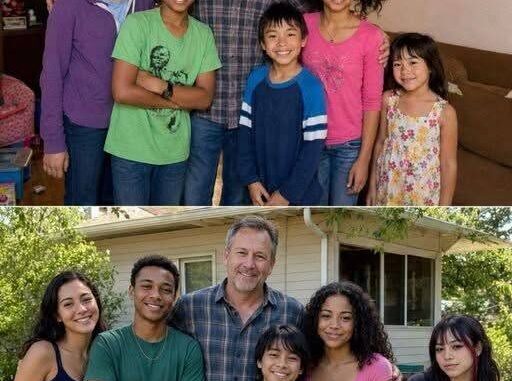
Thomas came into my life when I was five years old.
He wasn’t my biological father.
But as the years passed, that distinction became almost meaningless.
Because Thomas was the man who stayed.
When my mother died unexpectedly, I was only seven. I remember the adults speaking quietly, relatives making phone calls, and me sitting on the edge of my bed holding one of my mother’s sweaters because it still smelled like her.
Everyone assumed Thomas would eventually send me to live with my grandparents.
They were wrong.
He stayed.
The Man Who Became My Dad
Thomas had no idea how to raise a little girl when he first found himself responsible for me.
He learned anyway.
He checked a library book to figure out how to braid my hair. His first attempts were terrible, and I cried because the braid was crooked.
He laughed and promised he’d improve.
Eventually, he did.
He packed my lunches.
He learned the names of my teachers.
He attended school meetings.
He sat beside me when I had nightmares.
Whenever someone asked why he was doing all of this for a child who wasn’t biologically his, he always gave the same answer.
“She’s my daughter.”
He never said it defensively.
He said it as though there was no other answer worth considering.
Our Family Grew
Two years later, our family changed again.
Thomas adopted twins, Michael and Mara.
They were seven years old when they arrived, carrying two small suitcases and very different personalities.
Michael was cautious.
Mara asked questions about everything.
Within weeks, the three of us were arguing over the television remote like we’d grown up together.
Two years later, Thomas became a foster father to two more children, Noah and Susan.
At first, everyone expected the arrangement to be temporary.
Thomas didn’t see children that way.
He believed children needed a safe place to grow.
Eventually, he adopted Noah and Susan too.
Suddenly, there were five children in the house.
There were shoes everywhere.
Backpacks filled the hallway.
Laundry seemed endless.
There were arguments over bathrooms, birthday cakes, school projects, and noisy holiday mornings.
Our home wasn’t perfect.
But it was ours.
None of us had the same beginning.
Thomas made sure we had the same home.
He Worked Hard for Us
Thomas worked two jobs through much of my childhood.
There were mornings when he’d already left before I woke up.
Yet he always seemed to find his way to the important moments.
He attended parent-teacher meetings.
He remembered birthdays.
He learned which foods each of us disliked.
He sat through school performances, even when they weren’t particularly entertaining.
When one of us asked if he was tired, he’d smile.
“A little.”
Then he’d add:
“But I’m okay.”
He never made us feel like we were burdens.
Not once.
Growing Apart
As we became adults, our lives naturally changed.
I moved out and began my career.
Michael married.
Mara moved several states away.
Noah eventually became a father himself.
Susan, however, became increasingly distant.
None of us understood why.
She left home shortly after turning eighteen.
There was no dramatic argument.
She simply packed her things and left.
Thomas continued trying to reach her.
He mailed birthday cards.
He called during holidays.
Sometimes she answered.
Often she didn’t.
One day, I finally asked Susan why she wanted nothing to do with him.
She looked at me with an expression I’d never seen before.
“You don’t know him the way I do.”
I didn’t understand.
“What does that mean?”
She shook her head.
“Maybe someday you’ll find out.”
Then she walked away.
When I asked Thomas about it, he simply said Susan needed time.
I wasn’t satisfied with the answer.
But I trusted him.
The Phone Call That Never Came
Years passed.
Thomas became a grandfather.
He adored his grandchildren.
He remained the person everyone called when something went wrong.
Then, at fifty-six, he died unexpectedly.
The news came so quickly that none of us were prepared.
One moment he was part of our lives.
The next, he was gone.
The funeral was one of the hardest days I’d ever experienced.
All five of us were there.
Even Susan.
She stood quietly toward the back of the room wearing a black coat.
She looked older than I remembered.
She didn’t speak much.
But she stayed until almost everyone else had left.
I wanted to approach her.
I wanted to ask what had happened all those years ago.
Instead, I watched her walk outside.
The Unexpected Meeting
A week later, Thomas’s attorney contacted all five of us.
He asked us to meet at his office.
None of us knew why.
When we arrived, a small wooden box sat on the lawyer’s desk.
It was old and scratched.
The attorney waited until everyone had taken a seat.
“Your father left specific instructions concerning this box.”
I looked at my siblings.
“Our father?”
The attorney nodded.
“Those were his words.”
He unlocked the box.
Inside were five envelopes.
Each one had a name written across the front.
Mine.
Michael’s.
Mara’s.
Noah’s.
And Susan’s.
I immediately recognized Thomas’s handwriting.
My hands trembled as I opened mine.
The First Sentence Changed Everything
The first line stopped me.
My sweet girl,
I continued reading.
Thomas explained that Susan had discovered something when she was seventeen.
She had found documents in his study concerning the early years of our family.
They described work Thomas had done long before some of us had entered his life.
He had spent years helping children who had been separated from their families.
He had worked through complicated circumstances involving foster care, guardianship, and adoption.
But there was another part of the story.
One child he had tried to help years earlier had a connection to the circumstances that eventually brought another member of our family into his care.
Susan had discovered those documents accidentally.
And she had reached a painful conclusion.
She believed Thomas had built our family because he was trying to repair something from his past.
She thought we were part of an obligation.
Thomas admitted that he had never properly explained what the documents meant.
The Truth Thomas Wanted Us to Know
His letter explained that he had never wanted any of us to feel as though our childhood had been part of some grand plan.
He wrote that helping children had been important to him before he became our father.
But once each of us entered his life, everything changed.
We weren’t projects.
We weren’t responsibilities.
We were his children.
That distinction mattered.
He wanted us to understand that his decision to care for us wasn’t something he regretted or endured.
It was something he chose.
Again and again.
Susan Finally Opened Her Letter
Across the room, Susan had been staring at her envelope.
She finally opened it.
For several minutes, nobody spoke.
Then she lowered the letter.
“I didn’t know this part.”
I looked at her.
“What did you know?”
Susan wiped her eyes.
“I found the documents when I was seventeen.”
She explained that she had misunderstood what she found.
She thought Thomas had chosen each of us because he was trying to make up for something.
She believed there was a hidden reason behind the family he’d created.
“And I was angry,” she said.
The Question We Should Have Asked
Mara looked at her.
“Why didn’t you ask him?”
Susan looked down.
“Because I thought I already knew the answer.”
That sentence stayed with me.
Sometimes people become convinced they understand a situation before they’ve heard the whole story.
Susan had been seventeen.
She had found documents she didn’t fully understand.
She had interpreted them through the emotions of a teenager trying to make sense of her own place in the family.
And then she had walked away.
“I thought I’d figured out something about him that none of you knew,” she said.
Her voice broke.
“I thought I was the only one who saw the truth.”
The Calls She Never Answered
Then Susan revealed something none of us had known.
“Thomas called me every week for almost a year.”
I stared at her.
“What?”
She nodded.
“I never answered.”
Michael looked stunned.
“Why?”
Susan wiped her face.
“Because I was embarrassed.”
She explained that she had been angry and convinced she had uncovered something important.
She didn’t know how to admit that she might have been wrong.
So she ignored him.
For nearly a year.
Thomas kept trying.
He didn’t give up immediately.
He simply kept reaching out.
Another Letter
The attorney then handed us another document.
It was a letter Thomas had written for all five of us.
It wasn’t about money.
It wasn’t about property.
It wasn’t about business.
It was about family.
Thomas wrote that none of us had chosen the circumstances of our childhood.
He knew that some of us might eventually wonder whether we truly belonged.
So he wanted us to understand something.
Family was a choice.
Not just a word.
A daily choice.
It was choosing to show up.
Choosing to stay.
Choosing to sit beside someone when they were sick.
Choosing to attend a school meeting.
Choosing to listen to a frightened child in the middle of the night.
Choosing to celebrate someone’s accomplishments.
Choosing to keep loving someone even when life became difficult.
Thomas had made those choices for all five of us.
Biology Was Never the Point
Thomas understood something that none of us had fully appreciated while he was alive.
Biology can explain where someone came from.
It doesn’t necessarily explain who stayed.
It doesn’t explain who packed your lunch.
Who remembered your favorite food.
Who waited outside the principal’s office.
Who learned how to braid your hair.
Who sat in the audience when you were nervous.
Who became the person you called when life became difficult.
Thomas had done those things.
For all five of us.
He never needed a biological connection to consider himself our father.
Susan’s Regret
Susan folded her letter carefully.
“I should have come back.”
Nobody answered immediately.
Then I reached across the table and took her hand.
“You came back now.”
Her face crumpled.
Mara started crying.
Michael wiped his eyes.
Noah turned away for a moment.
For several minutes, the five of us simply sat together.
There was nothing we needed to say.
We were grieving the same person.
And perhaps, for the first time in years, we were truly grieving together.
Five Different Beginnings
None of us had started life the same way.
I had lost my mother and been raised by a man who wasn’t my biological father.
Michael and Mara had entered Thomas’s life through adoption.
Noah and Susan had first arrived through foster care.
Our childhood stories were different.
But Thomas had refused to make those differences important.
He gave us the same home.
The same expectations.
The same opportunities to become ourselves.
Most importantly, he gave us the same answer whenever we questioned whether we belonged.
You are my child.
That was enough for him.
The Secret Wasn’t What We Expected
For years, Susan believed there was a secret explanation behind Thomas’s decision to build our family.
There was, in a way.
He had cared about helping children long before he became our father.
He had experiences from his past that influenced his choices.
But the secret wasn’t that we had been part of some carefully planned mission.
The secret was much simpler.
Thomas had chosen us.
Then he kept choosing us.
Year after year.
Birthday after birthday.
School year after school year.
Through arguments, difficult moments, celebrations, and ordinary days.
What We Learned After He Was Gone
Losing Thomas was painful.
But the letters gave us something unexpected.
They gave us a chance to understand parts of his life that we had never seen.
They also gave Susan an opportunity she thought she had lost forever.
She finally understood why Thomas had kept calling.
She understood that he hadn’t been trying to prove anything.
He simply wanted his daughter to come home.
There was no dramatic confrontation.
No hidden fortune.
No complicated final demand.
Just a father trying to make sure his children knew how much they mattered to him.
The Family He Built Remained
When we left the attorney’s office, none of us felt like the same people who had walked in.
The wooden box stayed behind.
The letters came with us.
But the most important thing wasn’t the paper.
It was what the letters reminded us of.
Thomas had spent his life building something that couldn’t be measured by biology.
He had built a family.
And even though he was gone, that family was still there.
Five siblings sitting together.
Five different beginnings.
One shared home.
One man who had decided that love was something you demonstrated through your actions.
A Different Definition of Family
Thomas wasn’t our biological father.
But he was our dad.
He was the person who stayed when circumstances could have given him every reason to walk away.
He didn’t make us feel like charity cases.
He didn’t remind us of everything he had sacrificed.
He simply raised us.
And after his death, we finally understood just how intentional that choice had been.
Family isn’t always created by people sharing the same blood.
Sometimes it’s created by someone opening a door.
Sometimes it’s created by someone saying, “You belong here.”
And sometimes the greatest proof of family isn’t where you came from.
It’s who stayed.
For Thomas, that was always the answer.
And for the five of us, it would be his greatest legacy
Leave a Reply