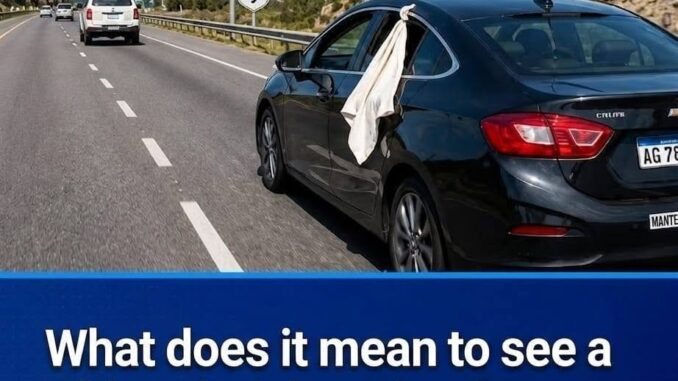
Driving requires us to interpret a constant stream of signals. Brake lights tell us a car is slowing. Indicators reveal a planned turn. Road signs provide rules and warnings. Yet an occasional signal appears that is neither official nor explained in a driving manual, such as a white cloth hanging from a car window.
The white cloth is an informal signal created by drivers rather than a device recognized by traffic law. Its meaning can vary by place and circumstance, but it usually suggests that something is wrong with the vehicle or someone inside it. Other drivers are being asked to notice, slow down, and use extra care.
White carries familiar symbolic meanings. It can represent surrender, peace, or a request for help. A bright piece of fabric is also easy to see against a dark car, especially from a distance. Those qualities may explain why the custom developed even without an official rule establishing it.
A mechanical breakdown is one common reason for displaying the cloth. A vehicle stopped on the shoulder may have a dead battery, engine trouble, a flat tire, or another problem that prevents it from moving. The fabric helps draw attention when hazard lights are not working or do not explain why the car is stationary.
The cloth may also be associated with a medical emergency. Someone inside the vehicle may be ill or injured, and the occupants may be trying to signal that they need help. Because the practice is not standardized, however, another driver cannot know the exact situation simply by seeing the fabric.
Some groups use white cloths during convoys, pilgrimages, funerals, or organized trips. The signal can help participants recognize vehicles traveling together. In other cases, it may indicate that a car has run out of fuel and is temporarily immobilized.
The most important limitation is legal. A white cloth does not turn a private car into an emergency vehicle. It does not give the driver permission to ignore traffic lights, exceed the speed limit, travel in restricted lanes, or demand right of way.
Police cars, ambulances, fire engines, and other authorized vehicles receive special treatment under local law when they use approved lights and sirens. A homemade signal has no equivalent legal power. Other motorists may voluntarily make space or show courtesy, but they still must obey traffic rules and avoid creating another hazard.
When a moving vehicle displays a white cloth, the safest response is awareness rather than guesswork. Increase following distance, avoid sudden maneuvers, and watch for unusual movement. The driver may be distracted, the car may be developing a fault, or the cloth may have an entirely different local meaning.
If the vehicle is stopped, do not stop in a live traffic lane. Slow down when conditions allow and leave room for anyone standing near the car. If there appears to be an immediate danger or medical emergency, contact local emergency services and provide the location, direction of travel, vehicle description, and what you observed.
Stopping to help can be kind, but it should be done only when there is a genuinely safe place to pull over. Park at a distance that protects both vehicles, activate hazard lights, and remain alert to traffic. On a high-speed road, calling trained professionals is often safer than approaching on foot.
The persistence of the white-cloth custom reveals a gap in ordinary vehicle communication. Hazard lights tell others that a vehicle is stopped or moving unusually, but they do not say whether the problem is mechanical, medical, or something else. Drivers filled that gap with a visible, improvised symbol.
Because the symbol is informal, it can never provide certainty. A cloth might mean distress in one region and group identification in another. It could also be hanging from the window for a reason unrelated to either. Treating it as a reason to become cautious is wiser than treating it as proof of a particular emergency.
The same principle applies to many unusual road situations. Observation should lead to safer driving, not panic. Slow down when appropriate, keep a safe distance, avoid blocking emergency access, and share useful information with professionals.
A white cloth in a car window is best understood as a possible request for attention, not a legal command. It reminds drivers that people sometimes create their own signals when official tools feel inadequate. The responsible response is simple: remain alert, protect everyone around you, and let trained emergency or roadside services handle situations that require intervention.
Leave a Reply