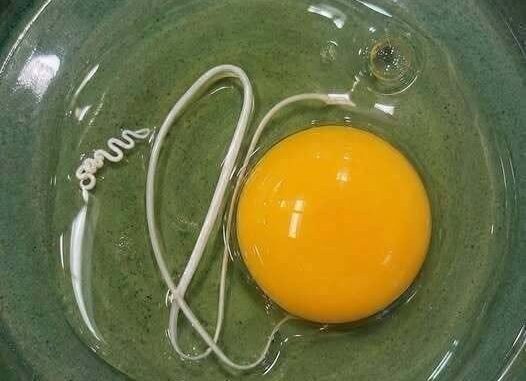
Have you ever cracked open an egg and noticed a small, white, string-like strand attached to the yolk?
If you have, you may have wondered what it was. At first glance, the strand can look unusual, especially if you don’t know that it is a normal part of an egg.
Fortunately, there is usually nothing strange about it.
That white, twisted structure is called the chalaza. It is a natural part of the egg and plays an important role in helping keep the yolk positioned inside the egg white.
So, what exactly is the chalaza, and does seeing one tell you anything about the egg?
What Is a Chalaza?
A chalaza is a twisted strand of concentrated egg white, also known as albumen.
Most chicken eggs contain two chalazae. They are located on opposite sides of the yolk and extend into the surrounding egg white.
Their main function is to help keep the yolk suspended in its normal position.
You can think of them as small natural support structures inside the egg. Rather than allowing the yolk to move freely around the egg, the chalazae help hold it in place.
When you crack an egg into a bowl, you may notice one of these white strands attached to the yolk. It can sometimes be quite noticeable, particularly when the egg is relatively fresh.
Is the Chalaza a Blood Vessel or Baby Chick?
No.
The chalaza is not a blood vessel, embryo, or developing chick.
It is simply part of the egg’s natural structure.
An ordinary unfertilized egg can have clearly visible chalazae, including eggs purchased from a grocery store.
Because the strand is attached directly to the yolk, some people may initially mistake it for something unusual. However, its presence is completely normal.
There is generally no need to remove it before cooking.
Why Does an Egg Have a Chalaza?
The yolk contains many of the egg’s nutrients and is surrounded by several layers of egg white.
The chalazae help maintain the yolk’s position within that structure.
Their twisted shape allows them to act somewhat like natural anchors. They hold the yolk in place while still allowing it to remain suspended inside the egg.
If you look closely at a freshly cracked egg, you may notice that the yolk tends to remain fairly compact rather than immediately spreading throughout the bowl.
The chalaza is one part of the egg’s internal structure that helps make this possible.
Does a Visible Chalaza Mean an Egg Is Fresh?
A visible chalaza can be associated with a fresher egg, but it should not be used by itself as a guarantee of freshness or safety.
Eggs naturally change as they are stored.
Over time, the egg white generally becomes thinner, while the yolk can become flatter and more fragile. The chalazae may also become less distinct.
This means that a prominent chalaza can be one visual indication of an egg’s internal condition, but it isn’t a reliable freshness test on its own.
Other factors, including proper storage, the egg’s date markings, appearance, and handling, are also important when deciding whether an egg should be used.
What Happens to an Egg as It Gets Older?
An eggshell may look almost identical from the outside even as changes take place inside.
Eggshells contain tiny pores through which moisture and gases can gradually move.
As an egg ages, several changes can occur:
- The air cell becomes larger. The air space inside the shell increases over time.
- The egg white becomes thinner. The thick albumen gradually loses some of its original firmness.
- The yolk becomes less firm. An older yolk may appear flatter and may break more easily.
- The chalaza may become less noticeable. The twisted strands can lose some of their firmness and definition.
These changes are natural and are part of the aging process of an egg.
Why Does the Chalaza Look So Strange?
The chalaza has a twisted, rope-like appearance, which can make it look unusual when you first encounter one.
It may appear as a white thread running from the yolk into the surrounding egg white.
Its appearance can also vary. Some chalazae are very obvious, while others are small and difficult to notice.
You may see one more clearly in some eggs than in others, and that variation is normal.
Should You Remove the Chalaza Before Cooking?
In most everyday cooking, there is no need to remove it.
The chalaza is edible and can be cooked along with the rest of the egg. Once the egg is cooked, it generally blends into the other components.
Some recipes may call for a particularly smooth appearance, in which case a cook may choose to remove visible strands. But this is a matter of preference rather than a general requirement.
A Small Detail With an Interesting Purpose
The next time you crack an egg and notice a white strand attached to the yolk, you don’t need to worry.
That little structure is the chalaza, a normal part of the egg that helps keep the yolk positioned within the egg white.
Its unusual appearance may make it seem mysterious at first, but it is actually a simple example of the natural structure of an egg.
And while a prominent chalaza can sometimes be associated with a fresher egg, it shouldn’t be treated as a definitive freshness or food-safety test.
So rather than wondering what that strange white strand is, you can simply recognize it for what it is: one of the small natural structures that helps hold an egg together.
Leave a Reply