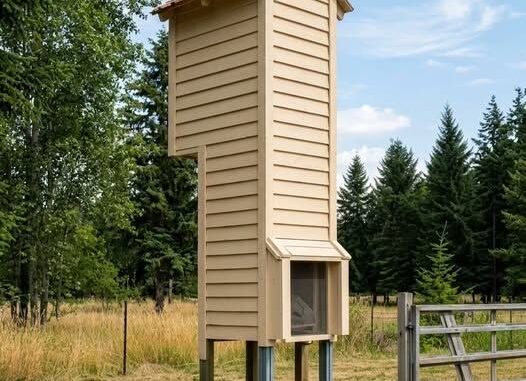
At first glance, a tall wooden structure standing beside a driveway might seem unusual. It may look like an old piece of farm equipment, a decorative feature, or even part of an unfinished project.
But structures like this can have a surprisingly practical purpose.
In locations where a driveway meets a road at an awkward angle, visibility can become a serious challenge. A house, fence, trees, hillside, or sharp bend may prevent a driver from seeing approaching vehicles clearly. In such situations, having a better view before entering the roadway can make a significant difference.
One creative solution sometimes used in these circumstances is a raised viewing structure equipped with mirrors. The concept is relatively simple: position reflective surfaces so that someone leaving a driveway can see a portion of the road that would otherwise be hidden.
A Simple Idea Based on Reflection
The principle behind the design is straightforward.
A mirror can redirect light, allowing a person to see an area that is not directly visible from their position. By placing mirrors at carefully selected angles, a structure can provide an alternative line of sight around an obstruction or bend.
Some people have informally referred to structures of this type as a “driveway periscope” because of the way they allow a driver to look beyond a limited sightline.
Unlike electronic cameras or sensor-based systems, a traditional mirror does not require batteries, an internet connection, or software. Its function relies on basic geometry and the reflection of light.
That simplicity is part of what makes the idea interesting.
Why Visibility Matters on the Road
Limited visibility is a common concern when entering a busy road from a private driveway.
A driver may need to look in several directions before proceeding, but buildings, vegetation, parked vehicles, walls, or the shape of the roadway can make that difficult. Even when traffic is relatively light, an obstructed view can make it harder to judge whether the road is clear.
Improving visibility can help people make more informed decisions.
However, a mirror should never be treated as a replacement for careful driving. Reflections can distort distances, and a mirror may not show every vehicle, cyclist, pedestrian, or other road user.
Drivers should still stop where appropriate, check carefully in both directions, and proceed only when they are confident the road is clear.
Low-Tech Design With a Practical Purpose
Modern safety technology often involves cameras, sensors, warning systems, and connected devices. Those technologies can be useful, but not every problem requires an advanced electronic solution.
Sometimes a basic design can address a very specific challenge.
A wooden viewing tower with reflective surfaces is an example of how someone might respond creatively to a difficult sightline. The structure can remain in place without requiring a constant power supply, although it still needs appropriate maintenance and should be designed and installed safely.
The important point is not that one particular design works everywhere. Rather, it demonstrates how observing a problem carefully can lead to a practical solution tailored to a specific location.
Maintenance Still Matters
Any outdoor structure is exposed to weather. Wood can deteriorate over time, while mirrors can become dirty, damaged, or difficult to see through clearly.
For that reason, a structure intended to improve visibility should be inspected periodically. Loose components, damaged materials, poor visibility, or changes in the surrounding landscape can reduce its usefulness.
Trees and vegetation can also grow into the viewing area and create new obstructions.
Before installing any roadside visibility aid, property owners should also consider local regulations, road authority requirements, and the safety of pedestrians and other road users. A structure should never create a new obstruction or hazard while attempting to solve an existing one.
The Bigger Lesson
The most interesting part of this kind of roadside design may not be the tower itself.
It is the thinking behind it.
Someone noticed that a particular location created a visibility problem and looked for a way to improve the situation. Instead of accepting the limitation, they considered the position of the road, the driveway, the surrounding obstacles, and the way light could be redirected.
That type of practical problem-solving can be valuable far beyond driving.
Many everyday challenges can be improved by first identifying exactly what is causing the difficulty. Sometimes the answer involves sophisticated technology. Other times, a small adjustment, better positioning, or a simple physical tool may be enough.
A Reminder to Drive Carefully
A better view can help, but safe driving ultimately depends on attention and good judgment.
When leaving a driveway near a bend or other area with limited visibility, drivers should slow down, stop when necessary, look carefully for approaching traffic, and avoid assuming that an apparently empty road is completely clear.
Visibility aids should be considered an additional tool rather than a guarantee of safety.
The roadside tower is therefore an interesting example of practical design. Made from relatively simple materials and based on the basic principle of reflection, a structure like this can help address a very specific visibility challenge.
It also offers a broader reminder: useful innovation does not always have to be complicated.
Sometimes, solving a problem begins with simply noticing it.
A thoughtful idea, carefully designed for the right situation, can make an ordinary task easier and potentially help people approach their surroundings with greater awareness.
And in road safety, having a clearer view is always a valuable place to start.
Leave a Reply