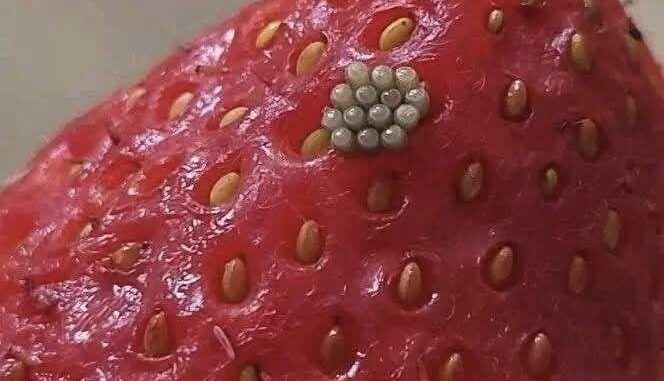
Have you ever brought home a container of fresh strawberries, rinsed them, and suddenly noticed something unusual on the fruit?
If you’ve spent time online, you may have seen videos showing people placing strawberries in salt water and discovering tiny insects or larvae afterward. The reactions can be dramatic, with some viewers immediately deciding they will never eat strawberries again.
But there is more to the story than those viral clips suggest.
Strawberries, like other fresh produce, can occasionally come into contact with insects, eggs, larvae, soil or other natural material. Discovering something unusual doesn’t automatically mean the entire container is unsafe.
It’s also important to distinguish between different things that may appear on a strawberry.
Some pale spots or clusters may be insect eggs, while other findings could be plant material, debris, mold or—in some circumstances—small insect larvae.
A photograph alone usually isn’t enough to identify exactly what something is.
So what actually happens when strawberries are placed in salt water?
Can tiny larvae really emerge?
Does salt water make berries safe to eat?
And what is the best way to wash strawberries before consuming them?
Let’s take a closer look.
What Could Those White Spots Be?
A strawberry can occasionally have unusual material attached to its surface.
Depending on its appearance, it might be an insect egg cluster, plant material, residue or another type of naturally occurring debris.
Some insect species lay eggs on plants and fruit, and certain egg masses can appear as small, pale spheres arranged closely together.
That means a picture of white objects on a strawberry shouldn’t automatically be described as “worms.”
There is an important difference between insect eggs attached to the outside of fruit and larvae that develop within fruit.
Correct identification matters, particularly when an image is being shared online.
Can Strawberries Actually Contain Insect Larvae?
Yes, certain insects can affect strawberries and other soft fruits.
One example is the spotted-wing drosophila, a small fruit fly species whose females can lay eggs in ripening soft-skinned fruit.
The resulting larvae are tiny and can develop within the fruit.
Strawberries aren’t the only fruit that can be affected. Other soft fruits can also serve as hosts for various insects.
However, this does not mean that ordinary strawberries are filled with worms.
The presence of insects in agricultural environments is a biological reality, but it shouldn’t be confused with a claim that every container of berries is infested.
Why Has the Salt-Water Trick Become So Popular?
The method shown in many online videos is simple.
People place strawberries in a container of water and add salt. After allowing the fruit to sit for a while, they sometimes discover small particles, insects or other material in the water.
The result can be surprising because something that was difficult to notice on a red strawberry can become much easier to see against a bowl of water.
Soaking may loosen material from the surface of the fruit.
It may also cause some small organisms to move.
But there is an important distinction:
Salt water should not be treated as a proven method for disinfecting strawberries.
Seeing something emerge from a berry doesn’t mean the salt solution has made the fruit microbiologically safe.
What Can Happen During a Soak?
Several different things can happen when strawberries are immersed in water.
1. Surface Material May Come Loose
Small pieces of dirt, plant material and other debris can detach from the fruit.
2. Insects May Become Easier to See
Small insects or other organisms located on the outside of the fruit may become visible after immersion.
3. Existing Larvae May Become Noticeable
If a fruit contains an insect larva, soaking or handling the fruit may make it easier to spot.
4. Hidden Material Can Become More Obvious
The contrast between pale material and dark or colored water can make things that were previously difficult to see much more noticeable.
None of these possibilities proves that salt water has sterilized the fruit.
Does Salt Water Kill Harmful Germs?
This is where viral cleaning videos can become misleading.
Washing produce and disinfecting produce are not the same thing.
Ordinary salt water is not a substitute for proper food-safety practices, and consumers shouldn’t assume that a homemade salt solution will eliminate pathogens.
Fresh produce can potentially become contaminated during growing, harvesting, transportation, handling or preparation.
For that reason, food-safety authorities generally recommend washing fresh produce thoroughly under clean, running water before eating it.
The purpose is to remove dirt and reduce surface contamination.
It isn’t to make the food completely sterile.
How Should You Wash Strawberries?
A straightforward approach is usually best.
Before eating strawberries, wash your hands and prepare a clean surface.
Place the berries under cool, clean running water and gently rinse them.
You can move them around carefully with your hands so the water reaches the surfaces.
Avoid using household soap, detergent or other cleaning chemicals on the fruit.
After washing, allow the strawberries to drain or gently pat them dry with a clean paper towel if appropriate.
It’s also generally better to wash berries close to when you’re going to eat them rather than washing a large quantity long before storage, because extra moisture can contribute to faster deterioration.
What If You Find a Larva or Insect?
Don’t panic.
If you notice an insect, egg cluster or possible larva on a strawberry, inspect the surrounding fruit carefully.
Discard any berries that are visibly moldy, badly damaged or otherwise questionable.
If only one berry appears affected, you don’t necessarily need to assume that every strawberry in the container has the same issue.
However, if many berries show signs of infestation, unusual deterioration or contamination, discarding the affected batch may be the more practical choice.
If you are unsure about a food-safety concern, guidance from an appropriate food-safety authority is more reliable than viral social-media advice.
What About Moldy Strawberries?
Mold is different from an insect or insect egg.
Strawberries are soft, high-moisture fruits, so visible mold can spread beyond the area where it is immediately noticeable.
A strawberry with obvious mold should generally be discarded rather than simply cutting away the visible spot.
It’s also a good idea to inspect nearby berries, particularly if they have been touching the affected fruit.
Keeping berries refrigerated and handling them carefully can help maintain their quality.
Should You Soak Strawberries in Salt Water?
There’s no need to rely on a salt-water soak as your primary method of cleaning strawberries.
If you enjoy the process out of curiosity, remember that it isn’t a substitute for standard produce-washing practices.
The most important steps are much simpler:
- Wash your hands before handling food.
- Inspect strawberries before eating them.
- Rinse fresh produce under clean, running water.
- Remove damaged or visibly spoiled berries.
- Don’t use soap or household cleaning products on food.
- Keep perishable berries properly refrigerated.
- Follow food-safety guidance for storage and handling.
These habits are more useful than trying to recreate dramatic social-media experiments.
Why Viral Strawberry Videos Can Be Misleading
Short videos are designed to attract attention.
A bowl of clear water suddenly containing tiny moving objects makes compelling content.
But the viewer usually doesn’t know exactly what those objects are.
They could be insects, larvae, eggs, plant debris or something else entirely.
Without laboratory identification or reliable documentation, it’s difficult to make a precise claim based solely on a viral video.
This is why phrases such as “all strawberries contain worms” should be treated skeptically.
The reality is more ordinary.
Agricultural products can occasionally have contact with insects and other natural contaminants, just as many other fresh foods can.
Does Finding an Insect Mean the Fruit Is Dangerous?
Not necessarily.
An insect or insect egg isn’t automatically evidence of a dangerous pathogen.
At the same time, consumers shouldn’t assume that produce is completely free of microorganisms simply because it looks clean.
The best approach is to combine careful inspection with normal food-safety practices.
If something looks spoiled, moldy or significantly damaged, don’t eat it simply because it has been washed.
When food looks questionable, throwing it away is often the simplest choice.
A Little Perspective Goes a Long Way
Fresh fruits and vegetables come from agricultural environments.
Before reaching a supermarket, they may pass through farms, packing facilities, transportation systems and retail displays.
It’s therefore unrealistic to expect every piece of produce to be completely untouched by nature.
The important goal is not to create a perfectly sterile food environment.
It’s to handle food sensibly and reduce avoidable risks.
That means washing produce, keeping it properly stored and paying attention to visible signs of spoilage.
Final Thoughts
Those viral strawberry-and-salt-water videos may look shocking, but they don’t tell the whole story.
Tiny insects, eggs or larvae can occasionally be associated with fresh fruit, but that doesn’t mean every strawberry contains worms or that strawberries are inherently unsafe.
It’s also important not to mistake a salt-water soak for a proven disinfection method.
If you want to prepare strawberries safely, stick with simple habits: inspect the fruit, rinse it thoroughly under clean running water, keep it refrigerated when appropriate and discard berries that are visibly spoiled or moldy.
And if you discover something unusual, don’t immediately assume the worst.
Sometimes the strange object on a strawberry is simply an example of the nat
Leave a Reply