Three years ago, my life changed forever when I lost my son, Caleb.
He was only nineteen.
Even after all this time, there are mornings when I wake up and, for a brief moment, forget that he is gone. Then reality returns.
I remember that he won’t walk into the kitchen, call me about dinner, or send me another silly photograph.
Grief became something I had to learn to live alongside.
Every Sunday, I visited Caleb’s grave. In the beginning, those visits were painful. I sometimes stayed for hours, talking to him, crying, or simply sitting quietly beneath a nearby tree.
Eventually, the cemetery became a peaceful place where I could remember him.
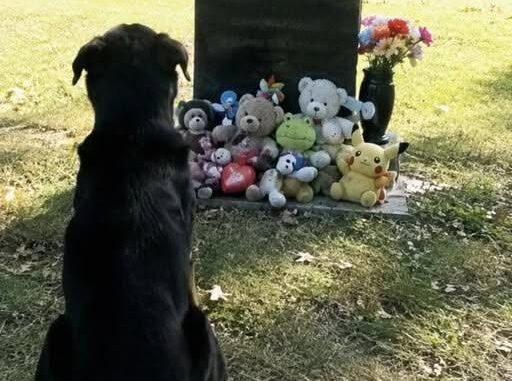
Then I noticed a dog.
He was a scruffy brown-and-white mixed breed with gentle eyes. I assumed he belonged to another visitor, but there was something unusual about him.
He had no collar or leash.
He simply walked through the cemetery and headed directly toward Caleb’s grave.
The dog lay beside the headstone and remained there quietly.
I thought it was unusual, but I didn’t pay much attention.
The following Sunday, he was there again.
And the Sunday after that.
Soon, his visits became part of my routine.
Whenever I arrived, the dog seemed to already know where he wanted to be. He never barked or disturbed the flowers. He simply settled beside Caleb’s grave as though he were visiting someone he knew.
Eventually, I asked the cemetery groundskeeper if he knew anything about him.
“That dog has been around for quite a while,” he told me. “People have tried to get close to him, but he doesn’t seem interested in staying anywhere.”
I asked whether anyone knew where he lived.
He didn’t have an answer.
I tried to convince myself that there was nothing unusual about it. Perhaps the dog liked the quiet surroundings. Maybe someone had walked him through the cemetery before.
Still, one question remained in my mind.
Why did he always go to Caleb’s grave?
After several months, curiosity finally got the better of me.
One Sunday, I arrived earlier than usual. The cemetery was quiet, and the dog was already lying beside Caleb’s headstone.
I sat nearby for a while.
Eventually, the dog stood, stretched, and began walking toward the entrance.
For some reason, I decided to follow.
He moved with surprising confidence. Instead of wandering around, he seemed to have a destination.
We left the cemetery and walked through several quiet streets. I kept my distance while watching him carefully.
After nearly twenty minutes, we reached a small residential neighborhood.
At the end of a dead-end street stood an older house.
The dog climbed the front steps and scratched twice at the door.
A moment later, the door opened.
Someone stepped outside.
I stopped.
The person looked at the dog and then at me.
Their expression immediately changed.
“You’re Caleb’s mother,” they said.
My heart began beating faster.
“How do you know my son?”
They looked at the dog before answering.
“I knew Caleb.”
I didn’t know what to say.
The dog walked over and sat beside them.
“Is he your dog?” I asked.
They shook their head.
“Not exactly.”
The answer only made me more curious.
After a moment, they invited me inside.
The house was modest and comfortable. Books filled several shelves, and photographs were displayed throughout the room.
Then I noticed one photograph on a small table.
I walked closer.
It was Caleb.
He looked younger, perhaps seventeen or eighteen.
And beside him was the same dog.
I picked up the photograph.
“Where did you get this?”
The person smiled sadly.
“Caleb used to come here.”
I stared at them.
They explained that Caleb had encountered the dog in the neighborhood several years earlier. The animal had been wandering around, and Caleb began helping care for him.
He brought food.
He took him on walks.
He spent time with him.
Eventually, the dog became attached to Caleb.
I smiled through my tears.
“That sounds exactly like him.”
Then I learned something I had never known.
After Caleb died, the dog continued returning to places connected with him. Eventually, he began appearing at Caleb’s grave.
Nobody had trained him to go there.
Nobody had forced him.
He simply kept returning.
The person told me they had seen me at the cemetery but had been hesitant to approach me.
“They didn’t want to make your grief harder,” they explained.
I understood.
Losing someone leaves behind so many unanswered questions. I suddenly realized there were parts of Caleb’s life that I had never seen.
Not because he had done anything wrong.
Simply because no parent can know every moment of their child’s life.
He had friends I had never met.
He had places I had never visited.
He had helped people and animals without telling me.
And somehow, learning that made me feel closer to him.
Then they handed me another photograph.
It showed Caleb sitting outside with the dog beside him.
On the back was a short message Caleb had written:
“Some friends don’t need words.”
I couldn’t hold back my tears.
The dog eventually walked over and rested his head against my knee.
I gently placed my hand on his fur.
“What did Caleb call him?” I asked.
The person smiled.
“Buddy.”
I laughed softly.
“Of course he did.”
For a while, none of us spoke.
There was no need.
Before leaving, I asked whether Buddy would continue visiting the cemetery.
“I think he probably will,” they said.
I looked down at him.
“Then I’ll see him there.”
The following Sunday, Buddy was waiting beside Caleb’s grave.
This time, I sat beside him.
He rested his head near my leg while I talked to Caleb.
I told him about the house.
I told him about the photographs.
And I told him about Buddy.
For the first time in a long while, the cemetery didn’t feel quite as lonely.
That experience changed the way I thought about grief.
I used to believe that remembering someone meant holding tightly to everything that had been lost.
Now I understand that remembrance can also mean discovering the pieces of a person’s life that continue through other people, places, stories, and memories.
Caleb’s life was bigger than the nineteen years I had with him.
He had formed friendships.
He had shown kindness.
He had helped an animal that needed someone.
And he had created memories that continued to exist even after he was gone.
Buddy still visits the cemetery.
So do I.
When I see him lying beside Caleb’s headstone, I no longer wonder why he is there.
I think he remembers.
And perhaps that is enough.
Sometimes the people we love leave behind unexpected reminders of who they were.
For me, it was a photograph, an old story, and a gentle dog named Buddy.
They reminded me that although Caleb’s life ended far too soon, the kindness he showed during those years did not disappear.
It remained in the memories of the people who knew him.
It remained in the stories I was still discovering.
And, in one small way, it remained in a dog who never forgot the young man who had once treated him with kindness.
Leave a Reply