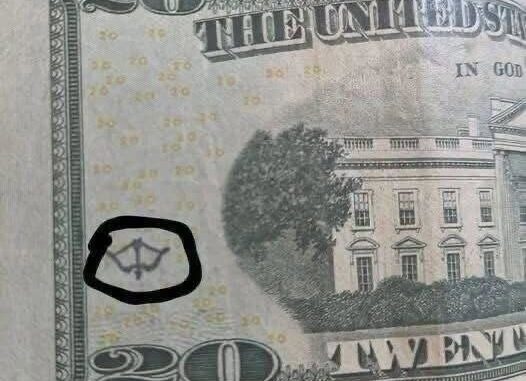
Have you ever looked closely at a $20 bill and noticed a tiny shape that seems to resemble a bow and arrow?
Most people handle cash without paying much attention to the fine details. We check the denomination, make a purchase and put the bill away. But occasionally, a small marking catches our eye and raises an unexpected question: Is that shape part of the design, or does it have a special meaning?
The answer is usually less mysterious than online rumors might suggest.
A tiny shape on a banknote can be part of its artwork, a security-related design feature, the result of several nearby lines coming together, or even an optical effect caused by the condition of the bill.
Why U.S. Currency Has So Many Tiny Details
American banknotes contain a remarkable amount of fine artwork.
A $20 bill includes portraits, borders, numbers, lettering, seals, background patterns and other intricate elements. Many of these details are deliberately incorporated into the design of the currency.
Some features are also intended to make counterfeiting more difficult.
Because so many elements are packed into a relatively small area, it’s easy to overlook them during everyday use. When you finally examine a bill closely, certain patterns can look surprisingly unusual.
That’s especially true when several lines or decorative elements appear close together.
Why the Mark Might Look Like a Bow and Arrow
There is a simple explanation for why people can see familiar objects in tiny patterns.
Human beings are naturally inclined to recognize shapes and patterns. We can see faces in clouds, animals in rock formations and familiar objects in abstract designs.
This phenomenon is commonly known as pareidolia.
On a banknote, a few intersecting lines might look like an arrow. Curved elements might appear to form a bow. When the shapes are viewed together, your brain may automatically interpret them as a recognizable object.
That doesn’t necessarily mean the object was intentionally hidden in the design.
In other words, something can look like a symbol without actually being a secret symbol.
Compare It With Another $20 Bill
If you notice an unusual marking on your $20 bill, one of the easiest things you can do is compare it with another genuine $20 note.
Look at the same location on both bills.
Ask yourself:
-
Is the shape present on both notes?
-
Does it appear in roughly the same position?
-
Do the surrounding lines and artwork match?
-
Is the difference caused by a fold, stain or other damage?
If the same feature appears on another bill, it’s likely a normal part of the currency’s design.
If it appears significantly different, however, that doesn’t automatically mean you’ve discovered a rare collectible. More investigation would be needed to determine why the difference exists.
Condition Can Change What You See
The condition of a banknote can have a surprising effect on tiny details.
A well-used bill may have folds, creases, stains or worn ink. A small crease can make separate lines appear connected, while a dark mark can make a particular section of the artwork stand out.
Lighting can also affect what you see.
A feature that looks obvious under bright light may be much harder to notice under normal indoor lighting.
For that reason, examining a bill under good lighting and comparing it with another example can help prevent misunderstandings.
Is It a Hidden Message?
Whenever someone discovers an unusual shape on currency, speculation can spread quickly.
Some people may wonder whether it represents a secret organization, historical reference or hidden message.
However, appearance alone isn’t enough to establish that a symbol has a specific meaning.
Banknotes contain thousands of visual details, and some combinations of lines can naturally resemble familiar objects.
Unless there is reliable documentation showing that a particular feature was deliberately designed to represent something, it’s better to describe it as a resemblance rather than a confirmed hidden message.
That distinction is particularly important when claims about unusual currency begin circulating online.
Different $20 Bills Can Look Different
Another factor to consider is the age and design of the banknote.
U.S. currency has gone through multiple design changes over the years. Different versions can contain differences in artwork, colors, security features and other design elements.
As a result, two legitimate $20 bills may not look exactly the same if they come from different periods.
If you’re investigating an unusual feature, first identify the version of the note you’re examining.
That can provide useful context before you assume something is unusual.
What Actually Makes a Bill Valuable?
Seeing a strange-looking shape doesn’t automatically make a banknote valuable to collectors.
Collectors may be interested in specific characteristics such as genuine printing errors, unusual serial numbers, recognized varieties, scarcity, historical significance and the overall condition of the note.
A damaged bill may look unusual without having any additional collector value.
On the other hand, a subtle production error that has been properly documented could potentially attract collector interest.
That’s why online claims about supposedly “rare” bills should be treated carefully.
If you think you’ve found something genuinely unusual, compare the note with reputable currency references or seek an opinion from an experienced collector or qualified currency professional.
Don’t Confuse an Unusual Mark With a Counterfeit
It’s also important to remember that an unfamiliar appearance doesn’t automatically mean a bill is rare.
A note can be altered, damaged or marked after it enters circulation.
If you’re concerned about whether your money is genuine, focus on recognized security characteristics rather than one mysterious-looking shape.
Official information about U.S. currency can help consumers understand the security features found on different denominations.
So, What Does the Bow-and-Arrow Shape Mean?
Without seeing the exact $20 bill, its location, its design version and its condition, it isn’t possible to identify a particular marking with certainty.
The shape you’re seeing could simply be part of the bill’s intricate artwork. It could also be the result of several nearby design elements appearing to form a recognizable shape.
Wear, folding and lighting may further change how the feature appears.
The important takeaway is that a shape that resembles a bow and arrow isn’t automatically evidence of a secret message, rare error or valuable collectible.
Take a Closer Look at Your Money
The next time you have a $20 bill in your hand, take a moment to examine it.
Look at the portrait, borders, lettering, numbers and fine patterns. You may be surprised by how much detail is packed into an ordinary banknote.
That’s what makes these discoveries interesting.
A small shape that looks mysterious can lead to questions about currency design, security features, collecting and even the way our brains recognize patterns.
So if you’ve noticed a tiny bow-and-arrow-like mark on your $20 bill, there’s no need to jump to the most dramatic explanation.
Compare it with another genuine note, examine the surrounding artwork and consider the condition of the bill.
Sometimes the mystery isn’t a hidden message at all.
Sometimes it’s simply a fascinating detail that has been sitting in plain sight all along.
Leave a Reply