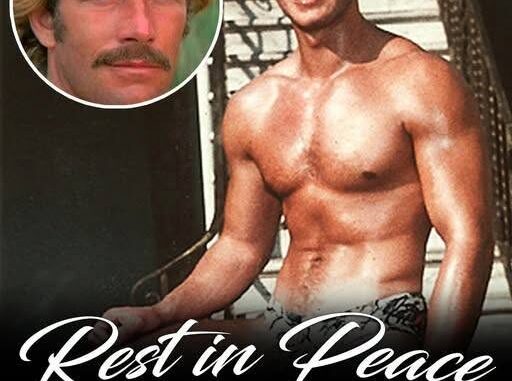
Richard Harrison, the American actor who built a long career in European adventure films, sword-and-sandal movies, spaghetti Westerns, and later low-budget action productions, has died at the age of 90.
Harrison reportedly died in Los Angeles from natural causes. His death was confirmed by producer and longtime friend Joan Borsten.
Born in Salt Lake City, Utah, on May 26, 1936, Harrison moved to Hollywood as a teenager with ambitions of becoming an actor. His early years in the entertainment industry included modeling work and jobs connected to the bodybuilding world.
Before establishing himself as a film actor, Harrison worked at gyms operated by well-known bodybuilders Vic Tanny and Bert Goodrich. He also appeared in bodybuilding and fitness publications, experiences that helped draw attention to his athletic appearance.
Harrison eventually began studying acting with respected teacher Sanford “Sandy” Meisner while working at Fox. He gradually found small opportunities in Hollywood productions, appearing in films including Kronos, Jeanne Eagels, Too Much, Too Soon, South Pacific, and Tall Story.
However, his biggest professional opportunities came after he left the United States and began working in Europe.
A New Career in Italian Cinema
During the early 1960s, European audiences developed a strong appetite for historical adventures and sword-and-sandal films. Harrison’s athletic build and screen presence made him well suited to the genre.
One of his early major roles came in The Invincible Gladiator in 1962. The film placed him in the type of heroic role that had previously brought international attention to actors such as Steve Reeves.
Harrison continued appearing in European productions, including Avenger of the Seven Seas and Gladiator 7.
He also became involved in the growing spaghetti Western genre. In 1963, he appeared in Gunfight in the Red Sands, an Italian-Spanish Western that featured a score by composer Ennio Morricone.
That connection to Morricone’s music became one of the memorable aspects of Harrison’s European film career.
The Role That Could Have Changed Everything
One of the most interesting stories associated with Harrison’s career involves Sergio Leone’s A Fistful of Dollars.
Harrison was reportedly considered for the lead role but ultimately declined the opportunity.
According to Harrison’s later account, filmmakers asked him to recommend an American actor who might be suitable for the part. He suggested Clint Eastwood, partly because Eastwood was comfortable riding horses.
Eastwood ultimately took the role of the mysterious gunslinger, and A Fistful of Dollars became a landmark in the development of the spaghetti Western.
The film helped establish Eastwood as an international star and became the first installment of Sergio Leone’s famous “Dollars” trilogy.
Harrison’s decision therefore became an unusual footnote in film history: he passed on a role that went to another American actor whose career would soon reach another level.
From Europe to Hong Kong
As the European film industry changed during the late 1970s, Harrison’s career took another unexpected direction.
He moved toward Hong Kong productions and spent years appearing in action and martial-arts films, including numerous low-budget ninja movies.
The experience was very different from the European adventure films that had originally made him recognizable to international audiences.
Harrison later spoke openly about the quality and production methods of some of those movies. Many were made quickly and on limited budgets, and he sometimes found the working conditions frustrating.
Nevertheless, the films became part of an unusually diverse career that stretched across several international film industries.
More Than 100 Films
Over the course of his career, Harrison appeared in more than 100 movies and also worked behind the camera on several productions.
Although many of his later films were inexpensive genre pictures, some eventually developed dedicated followings among cult-film enthusiasts.
His work covered an unusually wide range of genres. He played ancient warriors, Western characters, action heroes, and other larger-than-life figures, often working far from the Hollywood studios where he had originally hoped to establish himself.
His final acting credits included Angel Eyes in 1993 and Jerks in 2000.
Remembering a Unique Film Career
Richard Harrison may not have reached the same level of mainstream fame as some of his American contemporaries, but his career was remarkable in its international scope.
He began in Hollywood, found greater opportunities in Italy, became associated with sword-and-sandal adventures and spaghetti Westerns, and later worked extensively in Hong Kong cinema.
For fans of classic genre movies, his name remains connected to a period when international filmmakers produced adventure stories on a large scale, often with modest budgets and striking locations.
His story also serves as an interesting reminder that film history is filled with unexpected turns. An actor can decline one opportunity, move to another country, and ultimately build an entirely different career from the one originally imagined.
For viewers who remember the European Westerns and sword-and-sandal films of the 1960s and 1970s, Harrison’s performances remain part of that cinematic era.
His passing marks the end of a long career that crossed several countries, genres, and generations of filmmaking.
Richard Harrison may not have become one of Hollywood’s biggest household names, but his work left a lasting impression on the audiences who discovered his films—and his unusual journey through international cinema makes his career a memorable chapter in movie history.
Leave a Reply