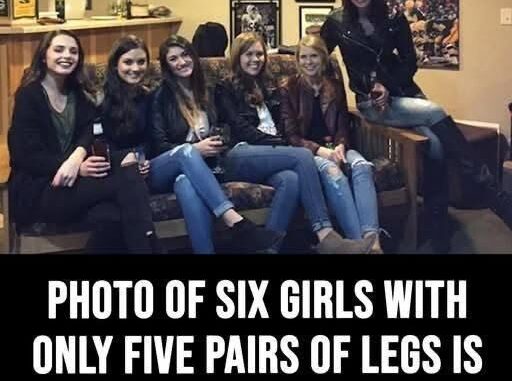
The scene appears ordinary: six friends sitting close together and smiling for a camera. Then someone counts the visible legs. One, two, three, four, five pairs—but six people. The person near the middle appears to have none.
There is no mystery involving the people in the picture. The confusing part is how a camera compresses a crowded scene into a flat image. A person sitting farther back can have her knees and lower legs hidden by someone positioned closer to the lens. When clothing, shadows, and similar colors interrupt the outlines, the brain may assign the visible legs to the wrong bodies.
Because the photograph itself is not shown here, an exact person-by-person mapping cannot be confirmed. Still, the description points to a familiar kind of visual illusion: ordinary overlap making one part of a scene seem to disappear.
The Quick Count That Creates the Puzzle
Most viewers do not study a group picture as a collection of separate shapes. They see complete people immediately. The brain recognizes faces, shoulders, arms, and familiar sitting poses, then assumes it can follow each body downward.
That shortcut works in many photos. If people stand in a line with space between them, counting legs is easy. Put the same people shoulder to shoulder on a couch, however, and the arrangement becomes less tidy. One friend leans forward. Another sits deep against the back cushion. Someone crosses an ankle or turns her knees to the side.
The tops of their bodies can still appear to form a single neat row. Their legs do not have to follow the same order. A quick count therefore produces the unsettling impression that there are fewer limbs than people.
How Overlap Hides What Is There
When one object blocks another, we usually understand that the hidden part continues behind it. We know a table has legs even if a chair covers them. This process becomes harder when several similar objects overlap, particularly when they belong to people sitting close together.
Imagine two friends side by side. The one nearer the camera extends her legs toward the front of the frame. The other sits farther back with her knees angled inward. From the camera’s position, the front person’s thighs may cover the second person’s lap, and her lower legs may block the view of the feet behind them.
The second person’s legs still exist, of course. They simply do not create a separate, easily visible pair in the photograph. If the couch conceals part of her legs as well, the remaining clues may be too small to notice at normal viewing size.
A camera also removes much of the depth we experience when looking around a room. In person, a slight movement of your head could reveal which knee is in front. In one still image, you must infer that relationship from edges, shadows, and the position of each body.
Why the Middle Person Draws Attention
The person in the center is often where viewers first detect the mismatch. Her torso is easy to identify, but the legs directly beneath it may actually belong to a neighbor who is sitting farther forward. The eye follows the most convenient vertical line and treats it as a connection.
That is a reasonable guess, but anatomy in a seated group does not have to line up vertically in a photograph. A person’s hips can be behind another person’s legs. Her knees may point to the side while her shoulders face the camera. The visible leg closest to her torso may belong to someone else entirely.
Dark clothing or flat lighting can strengthen the illusion by hiding the boundaries between overlapping shapes. Those details may vary from one version of the picture to another; the essential trick is the arrangement of people at different depths.
A Better Way to Examine the Image
If you encounter the photo, slow down before trying to count pairs of feet. Start with the cushions and hips. Where is each person actually sitting? Who appears to lean forward, and who is farther back? Then follow the outlines of thighs and knees where they are visible.
Look for points where one leg crosses in front of another. A continuous edge may disappear beneath a neighbor’s clothing and reappear lower down. That interruption is a clue to depth, not proof that a limb ends there. Zooming in can help, although low image quality may still prevent a perfect reconstruction.
It also helps to stop insisting that every pair of legs must sit directly under its owner’s shoulders. People can rotate their hips, tuck their feet underneath themselves, or lean across one another for a group shot. Once you allow for these normal poses, five visible pairs no longer require a sixth person to be legless.
Why Such Photos Spread So Quickly
This sort of picture invites a tiny challenge: count the people, then count the legs. The answer seems clear enough to share, yet confusing enough to make others look twice. That combination gives the image its appeal.
The effect says more about how we interpret photographs than about anyone in them. We make fast assumptions because they are usually useful. Occasionally, a crowded composition defeats those assumptions and produces an apparent impossibility.
The explanation is probably less dramatic than the caption suggests. A friend sitting farther back can be hidden by the people in front, while another person’s visible legs appear to occupy her place. Without the original image, the exact arrangement remains an inference. The larger lesson is clear: before deciding that something has vanished from a photo, check what might simply be out of view.
Leave a Reply