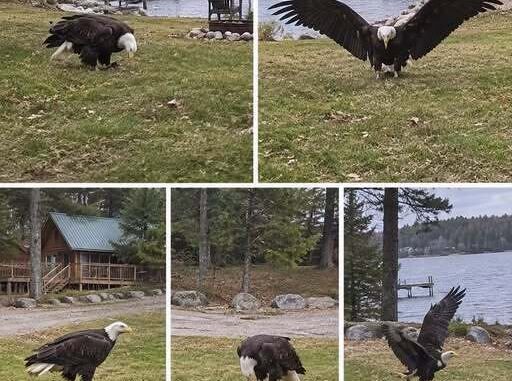
A towering bird, startled hikers, and wildlife specialists examining a creature supposedly larger than any known eagle: the story reads like the beginning of a remarkable discovery.
But the available information does not establish that such a discovery occurred.
The supplied account names Brownsville but provides no capture date, wildlife agency, research facility, named biologist, or documented measurements. Searches for confirmation found circulating posts and retellings, rather than reliable evidence supporting the reported capture of a record-breaking bird.
That leaves the central claim unverified. The suggestions of an unknown species, an ancient surviving lineage, and missing livestock should not be presented as scientific findings.
There is still an interesting story here—about impressive birds, ambiguous images, and the way an intriguing caption can grow into an elaborate narrative.
A Caption With a Longer History
The phrase “giant eagle captured in Brownsville, Texas” is not a newly documented announcement. Search results show versions of that caption circulating on image-sharing and discussion sites several years ago.
That earlier circulation matters because a recently published article can make an old claim appear current.
It also raises a basic question about the word “captured.” In photography, an animal can be captured in an image. That does not mean authorities physically caught it and transported it to a facility.
The supplied narrative describes an actual capture and examination. Those additional claims require their own evidence; an older photograph caption cannot confirm them.
Without the original image and a dependable account of its creation, the circumstances remain uncertain.
What Would Support a Record-Breaking Discovery?
A claim that a bird exceeds every modern record needs more than descriptions such as “enormous” or “towering.”
Readers would need specific measurements, an identified species, and an explanation of how the measurements were obtained. Independent specialists would need an opportunity to examine the evidence.
The supplied text offers none of those details.
It says biologists confirmed the bird’s exceptional size but does not identify those biologists or quote a report. It mentions a temporary facility without naming the organization responsible for it.
These omissions do not establish that an unusual animal could never exist. They mean this particular account does not support the conclusion it asks readers to accept.
A scientific discovery becomes persuasive through documentation that can be checked.
Real Eagles Are Already Impressive
An eagle does not have to belong to an unknown species to look extraordinary.
The Cornell Lab of Ornithology describes the bald eagle as one of North America’s largest birds. Its identification guide lists a wingspan of approximately 204 centimeters—about 6 feet 8 inches—and a body length of roughly 71 to 96 centimeters. It also notes the bird’s heavy body, large head, and hooked bill.
Those features can create a powerful visual impression, especially in a close photograph.
The figures provide context, not an identification of the bird in the circulating Brownsville claim. No image was supplied here, and there is insufficient evidence to determine its species or actual size.
That distinction is important: explaining that known eagles are large does not settle the origin of a particular photograph.
Why an Image Cannot Provide Every Answer
A photograph records an appearance from a particular viewpoint. Without a dependable scale reference, estimating an animal’s dimensions can be difficult.
A nearby subject may appear disproportionately large beside distant objects. Cropping may remove clues about distance. A caption may also assign a location that the image itself cannot establish.
These are possible explanations to consider, not findings about the specific image associated with this rumor.
It would be equally unsupported to declare that the photograph is AI-generated, digitally enlarged, or entirely authentic without examining it and its history.
The responsible approach is to separate what an image visibly shows from what someone says it proves.
Speculation About Mutations and Ancient Lineages
The supplied account suggests that researchers are considering a surviving ancient lineage or a mutation.
Those ideas give the story dramatic momentum, but no identified research supports them in the material provided.
An unusually large-looking animal would not, by appearance alone, establish a new species. Nor would it demonstrate that an extinct lineage had survived unnoticed.
Such conclusions would require appropriate biological evidence and expert analysis.
Describing unnamed researchers as “whispering” about possibilities also makes their supposed views impossible to evaluate. Readers cannot determine whether the statements reflect an actual discussion or merely add atmosphere to the narrative.
A stronger article should leave those theories out unless an attributable source supports them.
The Livestock Claims Need Separate Evidence
The account also refers to unusual shadows and disappearing livestock around Brownsville.
Even if reports of missing animals were documented, connecting them to a particular bird would require further evidence.
No dates, properties, incident records, or named witnesses are provided here. There is therefore no basis for claiming that a giant eagle has been taking livestock or threatening the community.
Adding unexplained losses to an unverified wildlife story can create unnecessary alarm. It turns uncertainty into an implied danger without establishing the connection.
Each claim needs to stand on its own evidence before it becomes part of a larger explanation.
Keeping Curiosity Grounded
Stories about extraordinary animals appeal because they suggest that the natural world still holds surprises.
That curiosity is valuable. It can encourage people to learn about birds, observe wildlife more closely, and ask thoughtful questions.
But curiosity works best when it remains open to ordinary explanations as well as extraordinary ones.
Before sharing a claimed discovery, look for a named organization, a clear date, documented findings, and reporting that does more than repeat the same narrative.
Several websites carrying similar wording are not necessarily several independent confirmations.
An Unresolved Claim, Not a Confirmed Discovery
The reported capture of a record-breaking eagle near Brownsville remains unsupported by the reliable evidence located here.
The older circulating caption establishes that the claim has a history online. It does not establish the capture, the measurements, or the existence of an unknown species.
Real eagles offer plenty to admire without adding unverified scientific conclusions. Their size and presence can make a genuine encounter memorable on its own.
If documented findings emerge, the story can be reconsidered. Until then, the “giant eagle” belongs in a discussion of an unconfirmed online claim—not an announcement that the skies over Brownsville contain a newly discovered creature.
Leave a Reply