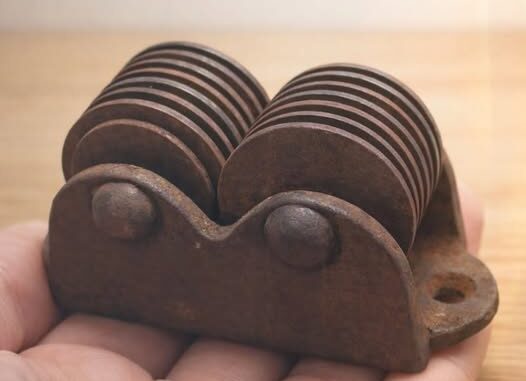
We had been sorting through Grandpa’s house for hours when I opened the bottom drawer of his workbench. It was full of things nobody had thought to throw away: loose screws, pieces of twine, a broken tape measure, and small parts wrapped in yellowing newspaper. Beneath them sat an object so heavy that I nearly dropped it.
It was made of dark metal, with two rows of circular wheels tucked inside a sturdy frame. A hole near one side suggested it had once been fixed to a counter or another piece of equipment. When I turned the wheels with my fingers, they still moved. That made the object feel less like scrap and more like a tool waiting for a task.
Grandpa had kept everything he believed might be useful. He could recognize an unfamiliar screw by sight and always seemed to have the right part for a repair. Finding something in his drawer did not prove it was valuable, but it made us curious.
I carried the object into the kitchen and set it on the table. My mother thought it might sharpen blades. My brother guessed it belonged to an old sewing machine. I wondered whether a strip of fabric or wire was meant to pass between the wheels. None of our ideas quite explained the weight or the mounting hole.
A Clue from Someone Who Remembered
The next afternoon, a longtime family friend stopped by to help us identify a few of Grandpa’s tools. When he saw the metal frame on the table, he smiled.
“That’s a knife cleaner,” he said.
I thought he was joking. We were accustomed to washing knives with soap and water, then drying them and putting them away. Why would someone need a heavy cast-iron device for that?
He explained that older carbon-steel knife blades demanded more care. They could discolor or develop surface rust if moisture remained on them. A mechanical cleaner helped polish the metal. Depending on the design, a blade could be worked between discs or other cleaning surfaces so both sides received attention.
The little mounting hole suddenly made sense. Fixing the device in place would have kept it steady while someone used it. The moving wheels were not decorative, and the substantial frame was not simply an odd design choice.
Our friend was careful about one point: without a maker’s mark or the rest of its mechanism, he could not tell us its exact age or model. Knife cleaners came in different forms. Some were simple devices, while larger hand-operated machines could clean several knives at once. The object on our table appeared to be one piece of that practical history.
Historic examples show how varied these tools were. Some hand-cranked models used brushes, leather strips, or polishing powder rather than wheels like the ones in our find. They were made to maintain the flat faces of blades; sharpening, when included, was a separate function. Our piece had no visible instructions, so we resisted the urge to assign it a precise date or manufacturer.
Why a Household Needed One
Today, kitchen tools often arrive with easy-care materials and clear instructions. It is tempting to imagine that everyday chores were always much the same, just performed without electricity. The knife cleaner suggested otherwise.
Before stainless-steel blades became common, keeping cutlery presentable could involve regular polishing. For a household with many knives, doing every blade entirely by hand took time. Mechanical cleaners offered a way to make the job more manageable. Some designs also included sharpening features, though cleaning a blade and restoring its cutting edge are different tasks.
I could picture the tool fastened to a work surface, handled by someone who knew exactly how much pressure to use. Its purpose had once been obvious enough that nobody thought to leave instructions with it. Years later, surrounded by dishwashers and stainless-steel cutlery, we had mistaken it for a machine part.
That change in perspective was the most interesting part of the discovery. An object does not have to be rare or mysterious to teach you something. Sometimes it shows how much effort a familiar task once required.
What It Told Us About Grandpa
We could not know when Grandpa had acquired the cleaner. He might have used it, found it at a sale, or saved it because he recognized what it was. I wished we had asked him about the collection while he was alive. He would probably have answered in a sentence, then demonstrated how the wheels turned before telling us to put it somewhere safe.
As we sorted the rest of the house, we began setting unfamiliar items aside instead of quickly deciding they were useless. A worn tool could still offer a clue through its shape, its moving parts, or a stamped name. A knowledgeable neighbor or a local collection might help identify it, even if its exact history remained unknown.
We did not attempt to polish a kitchen knife with Grandpa’s old device. Its wheels moved, but age and wear could make an unfamiliar tool unsafe or damage a blade. After wiping dust from the frame, we placed it on a shelf where the family could see it.
The object was not a secret invention or a valuable treasure. It was a reminder that the most ordinary work leaves behind surprising artifacts. Grandpa’s drawer had held a tool for a task we still perform, just in a way we no longer recognized. Once we understood its purpose, the strange iron frame felt a little less strange—and his habit of keeping it made a little more sense.
Leave a Reply