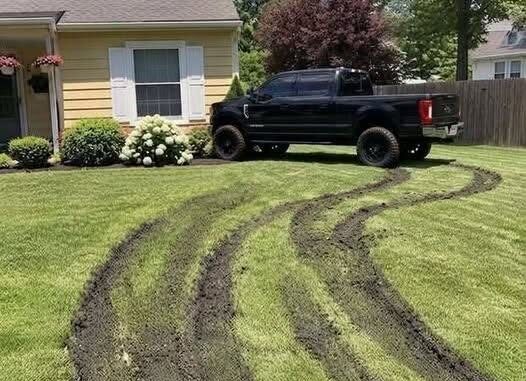
They thought she was nothing more than a decoration on her own lawn.
For years, the widow had lovingly cared for the property she and her late husband, Harold, had built their life around. The garden, the old stone border, and every carefully tended corner held memories of the life they had shared.
Then, one afternoon, a neighbor drove a heavy truck across the edge of her yard.
Flowers were crushed. The ground Harold had once cared for so meticulously was torn apart.
When she confronted the neighbors, they brushed her off.
“It’s just grass,” they said.
They expected an argument. Maybe a few angry words. Then they assumed she would eventually calm down and let the incident fade away.
But she didn’t give them the reaction they were waiting for.
She simply went inside and closed the door.
She Chose Evidence Over Anger
Harold had always reminded her that anger could feel powerful while accomplishing very little.
So instead of retaliating, she began documenting what had happened.
She photographed the tire tracks and the damaged flowers. She recorded the date and time the truck had crossed her property. Then she contacted a surveyor to establish the exact boundary and requested written estimates for the repairs.
One by one, she gathered the documents.
She didn’t shout. She didn’t threaten anyone. She quietly made sure the facts were recorded.
Each photograph, measurement, and estimate strengthened her position.
The Neighbor’s Sudden Change of Tone
Some time later, the neighbor’s husband returned.
This time, he spoke with a politeness she hadn’t heard from him before.
She immediately sensed that something had changed.
Rather than arguing or accusing him, she listened. Then she calmly placed a folder on the table.
Inside were the photographs, the survey information, the repair estimates, and the notes she had carefully collected.
The neighbors had assumed she would simply accept the damage and move on.
They hadn’t expected her to be prepared.
The Folder That Spoke for Her
For once, she didn’t need to raise her voice.
The evidence made the situation clear: this wasn’t an imaginary boundary dispute or a misunderstanding that could be dismissed with a laugh. Her property had been damaged, and she had taken the time to document it.
The folder changed the conversation.
What had begun with careless behavior and dismissive comments now had to be addressed seriously. The neighbors could no longer rely on her silence or assume she would give up.
She had remained calm—not because the damage didn’t matter, but because she wanted to respond in a way that protected her home and her rights.
A Quiet Lesson in Self-Respect
Harold’s advice had stayed with her.
Anger might have given her a moment of satisfaction, but patience and preparation gave her something more useful: a clear record of what happened and a way to stand up for herself.
Her garden still carried the scars of that afternoon. No folder could bring back every crushed flower or erase the frustration she had felt.
But she had learned that being quiet didn’t mean being powerless.
She had every right to protect the home she and Harold had built together.
And when her neighbors finally realized she had kept the evidence, they discovered that the woman they had underestimated was not someone they could simply dismiss.
Sometimes, the strongest response isn’t the loudest one.
Sometimes, it’s a carefully organized folder placed on the table—and the calm confidence of someone who knows the truth is on record.
Leave a Reply