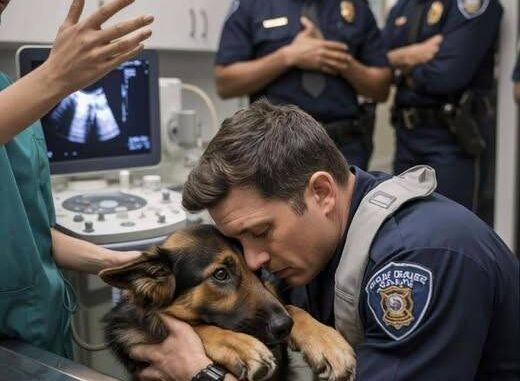
The morning began with a heartbreaking decision.
Rex, a loyal police dog who had spent years working alongside Officer Alex, was critically ill. His kidneys were failing, fluid had built up in his lungs, and the veterinary team feared there was nothing more they could do.
Dr. Marsh prepared to euthanize him.
But just as the final moments approached, Rex made one small, deliberate movement.
He leaned his weight against Alex.
That simple gesture made the veterinarian pause.
She set the syringe down and looked at Rex again—not just as a critically ill patient, but as a dog she had known for years.
Something about the moment made her want to take another look.
A Second Examination Changed Everything
Dr. Marsh reviewed Rex’s condition once more and returned to the ultrasound.
This time, she noticed an unusual formation: a small metallic fragment embedded deep inside his body, close to critical tissue.
The discovery changed the picture.
The kidney damage and fluid in Rex’s lungs had appeared to point toward irreversible organ failure. But the newly discovered fragment suggested another possibility: prolonged, localized poisoning caused by the foreign object.
Instead of facing an inevitable goodbye, Rex might have a treatable problem.
There was still no guarantee.
Dr. Marsh explained that Rex was weak and that surgery carried serious risks. Even if the operation succeeded, his recovery would likely be long and difficult.
Alex listened carefully.
Then he authorized the surgery.
As Rex was taken into the operating room, Alex waited with two fellow officers. Hours passed behind the closed doors, each one filled with uncertainty.
Finally, the veterinarian returned with news.
The fragment had been removed.
Rex was stable.
The road ahead remained fragile, but for the first time that morning, there was a road ahead.
A Long Road Back to Health
Rex’s recovery did not happen overnight.
The contamination had been building for months. Removing the fragment could stop the problem from worsening, but it could not instantly undo the damage already done.
Under Dr. Marsh’s careful monitoring, Rex slowly began to improve.
His kidney function reached a stable, manageable level. The fluid in his lungs cleared, and he gradually regained the weight he had lost.
The department reviewed his medical record and the strain he had endured.
Eventually, it recommended that Rex retire from active duty.
He would no longer work in the field.
Instead, he would go home with Alex as a companion.
At home, the family adjusted to Rex’s slower pace and need for extended rest. His body had changed, but the familiar attentiveness that had made him such a valued partner remained.
He was still Rex.
He simply had a different role to play.
The Moment That Stayed With Everyone
The story of that morning spread among people who worked with animals.
A police dog had arrived at the clinic to be euthanized. In what seemed like his final moments, he leaned against the person he trusted most.
That gesture prompted a veterinarian to examine him again.
And that second look uncovered a hidden cause that had gone unnoticed for months.
The fragment was small enough to have been missed, yet its effects had been devastating.
For Alex, the experience was more than a medical turning point.
When people asked him about that day, he described it plainly. He believed Rex had managed one final, crucial message in the examination room.
He was not finished.
And someone had chosen to listen.
Rex’s recovery was not a miracle without effort or uncertainty. It was the result of a second examination, a difficult decision, skilled veterinary care, and weeks of patient recovery.
But the moment that changed everything was simple.
A tired dog leaned against his partner.
And instead of saying goodbye, Alex and Dr. Marsh gave him another chance.
Leave a Reply