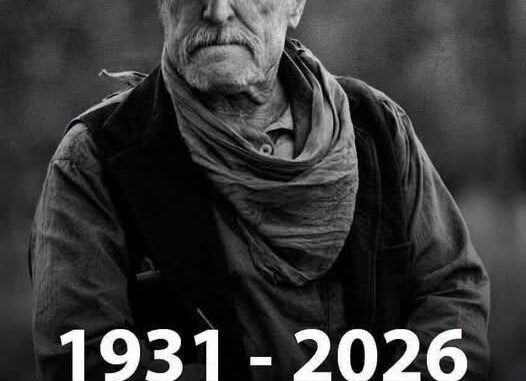
Hollywood has lost one of its most remarkable and unforgettable performers.
Robert Duvall had a rare ability to make quiet moments feel as powerful as dramatic ones. He never needed to dominate a scene to command attention. Instead, he relied on subtle expressions, carefully measured words, and the smallest gestures to reveal the complicated inner lives of his characters.
As Tom Hagen in The Godfather, Duvall brought an understated intelligence to the role. His performance communicated loyalty, professionalism, and calculation without ever demanding the spotlight. He proved that sometimes the most powerful character in a room is the one who speaks the least.
Years later, Duvall delivered another unforgettable performance in Apocalypse Now as Lieutenant Colonel Bill Kilgore. The character’s confidence and battlefield bravado were almost surreal, yet Duvall played him with such casual conviction that the performance became both memorable and unsettling.
Then came Tender Mercies, where Duvall portrayed Mac Sledge, a troubled country singer struggling to rebuild his life. Unlike some of his more forceful roles, this performance was filled with vulnerability and restraint. Duvall allowed the character’s pain, regret, and hope to emerge gradually, earning him the Academy Award for Best Actor.
These characters could hardly have been more different.
Yet Duvall gave each of them something unmistakably human.
That was one of his greatest gifts as an actor.
He understood that people rarely reveal everything they are feeling. Sometimes emotion appears in a pause, a glance, a change in posture, or a moment of silence. Duvall trusted audiences to recognize those details without having them explained.
That trust became a defining feature of his career.
Over the decades, his face itself seemed to become part of his storytelling. The lines and expressions that came with age didn’t diminish his presence. Instead, they gave his later performances even greater depth, suggesting histories and experiences that existed beyond the boundaries of the script.
Duvall’s legacy is therefore about much more than the number of acclaimed films he appeared in or the awards he received.
It is about the people he brought to life.
His characters often felt as though they had existed long before the camera arrived and would continue living somewhere after the final scene. They carried secrets, regrets, hopes, fears, and memories that audiences were invited to discover rather than simply being told about.
That is a rare kind of artistry.
Robert Duvall reminded us that great acting doesn’t always require grand speeches or dramatic gestures. Sometimes, it is found in restraint.
In silence.
In a look that lasts half a second longer than expected.
In the quiet recognition of another person’s pain.
His performances made complicated strangers feel familiar and deeply human.
And that may be the greatest mark an actor can leave behind: not simply being remembered for the characters he played, but for making audiences feel that those characters were real.
Robert Duvall’s work will continue to speak through the films he left behind.
His performances will remain.
His characters will remain.
And generations of viewers will continue discovering the remarkable actor who understood that sometimes the quietest performance can leave the loudest impression.
Leave a Reply