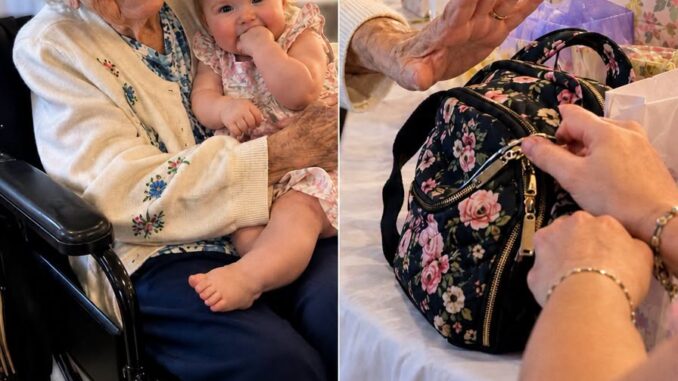
Everyone insisted my 101-year-old grandmother would never make it to the gathering. She proved them wrong—and the bag suspended from her wheelchair contained something I never anticipated.
“Not yet,” Grandma stated.
Her voice remained barely a whisper, yet I halted instantly. She kept her palm resting over mine.
“Wait until everybody arrives.”
I scanned the garden. “Everybody is already here.”
Grandma shook her head. “Your mother.”
I turned around. Mom stood inside assisting with the cake, and my uncle went to fetch her.
For some reason, my heart had begun pounding harder. I still possessed no clue what rested inside the package.
Grandma sat beneath the canopy of the apple tree with my daughter, Lily, resting on her lap. My husband, Mark, kept one hand positioned behind Lily’s spine because Grandma lacked the strength to hold her securely on her own. She appeared unbothered, continuing to gaze down at Lily as though the rest of us had vanished entirely.
“She has your ears,” she remarked.
I chuckled. “That is not exactly a compliment.”
“They are good ears.”
“They stick out.”
“So did yours.”
“Exactly.”
Grandma smiled, then pressed one finger against Lily’s cheek. “Worth waiting for.”
That nearly undid me.
Mom emerged carrying the cake knife. “What are we doing?”
Grandma gestured toward the package. “Sit down.”
Mom frowned. “Why?”
“Because I am 101 and you still refuse to follow instructions.”
My uncle laughed, and Mom took a seat.
I peeled away the tissue paper. Underneath lay a wooden box—not new, dark walnut, scarred at the corners, featuring a tiny brass clasp.
I recognized it immediately. “Oh my God.”
Mom leaned forward. “What?”
“Grandma’s sewing box.”
Back when I was a child, that box resided beside her chair. Buttons filled one compartment, needles occupied another, and spools of thread arranged themselves by color. Always, resting at the absolute bottom and wrapped in brown paper, was something I was strictly forbidden to touch.
I stared at Grandma. “You brought this?”
“For Lily.”
My eyes welled up. “Grandma, she is one. She cannot sew.”
Grandma gave me a look. “Neither could you at one.”
That was fair.
I popped the clasp. The upper tray still held dozens of buttons: pearl, wood, blue glass, and tiny red ones shaped like blossoms. Beneath them rested folded pieces of fabric.
I lifted the first item—a small white dress featuring yellow flowers embroidered around the collar.
My breath caught. I recognized it instantly.
Mom whispered, “No.”
It was the identical dress from the photograph, the picture Grandma had kept beside her chair for years showing me at four years old standing on her front step wearing that very garment.
I traced the stitching. “You kept it?”
Grandma looked offended. “Naturally I kept it.”
“For 38 years?”
“Things do not spoil simply because people age.”
Mom was crying now, while I laughed through my own tears.
Next, I lifted the following layer to reveal another dress, smaller and pale blue.
Mom produced a sound I had never heard before and reached for it. “My dress.”
I stared at her. “What?”
Grandma nodded. “Your mother wore that when she turned two.”
Mom pressed the fabric against her mouth. The garment was over 60 years old, hand-smocked with tiny covered buttons trailing down the back.
I looked at Grandma. “You crafted both of these?”
“Yes.” She then pointed deeper into the box. “Keep going.”
Beneath Mom’s dress rested an item wrapped in tissue. I opened it carefully to find a third dress, newer, fashioned from cream-colored linen with tiny green leaves stitched along the hem.
It remained unfinished; one sleeve was attached while the other was not, and a row of pins secured part of the collar in place.
I stopped breathing.
Grandma announced, “That belongs to her.”
I glanced at Lily, then back at Grandma. “You made this?”
“Started it.”
“When?”
She averted her gaze. “Years ago.”
Mom’s eyes widened. “How many years?”
Grandma ignored her. “Check the pocket.”
No pocket was visible to me, until I noticed a tiny inner fold near the waist containing an envelope. My name was written across it in Grandma’s handwriting, though it appeared much shakier than the writing on cards she had mailed me years prior.
I opened it, reading the opening line:
For the baby I hope I live long enough to meet.
I could read no further, placing the letter down and shielding my face.
Mark crouched beside me. “You alright?”
I nodded even though I was not.
Grandma commanded, “Read it.”
“Out loud?”
“If you are able.”
I looked around. My mother was weeping, my uncle pretended not to notice, and half the party had grown silent.
I swallowed hard and began.
“My darling girl,
You once confessed your fear that you might never become a mother.
I remained silent because certain pains cannot be fixed by finding the right sentence.
So I went home and performed the only useful action I could imagine.
I started a dress.”
I paused as the garden blurred.
I recalled the conversation from when I was 34, two years into trying, right after we learned our initial round of fertility treatment had failed. I had shared it with almost no one except Grandma.
Sitting in her kitchen, I had murmured, “Maybe this simply is not meant to happen for me.”
Grandma had reached across the table, stating, “Maybe. But today is not every day.”
That was all she said. She never urged me to relax, never claimed it would happen the moment I stopped trying, and never promised a miracle—simply: Today is not every day.
Apparently, she had returned home afterward and commenced sewing.
I resumed reading.
“I did not make it because I knew you would bear a child.
I made it because hope requires a place to sit while it waits.
Should no baby ever wear it, your life would not become any smaller.
You were never waiting to become enough.
Yet if one did arrive, I wanted that child to possess something crafted before she was even known.”
I lost my ability to read for a moment. Mark grasped my hand while Grandma watched me with wet eyes.
I continued.
“I finished most of it when I turned 94.
Then my hands deteriorated.
I left the sleeve because I figured perhaps one day you could finish something I initiated.”
I stared at the unfinished garment. “I am terrible at sewing.”
Grandma smiled. “I know.”
Everyone chuckled, which helped immensely.
I returned to the letter.
“The other dresses belong to your mother and to you.
Three little girls.
Three distinct eras.
If I remain fortunate enough to meet yours, dress her in whichever one fits.
Do not guard them so tightly that nobody gets to live inside them.
Garments are meant to wrinkle.
Children are meant to stain things.
Love is never improved by keeping it untouched.”
I lowered the page. That statement struck me harder than everything else.
Because I had spent Lily’s initial year consumed by fear—not constantly, but frequently enough. Following a pregnancy loss at 14 weeks, I had treated joy as though it were something punishable if trusted too deeply. When Lily finally arrived, I tracked her breaths, checked the monitor every ten minutes, and awakened Mark because I worried she felt overly warm, or alternatively, too chilly. I researched every rash, every sound, and every unusual diaper. I had desired her for so long that possessing her sometimes felt less like receiving a gift and more like holding something fragile.
Grandma had noticed, naturally.
The letter proceeded.
“And one final matter.
Stop looking terrified every time that child climbs anything.
You climbed everything.
Your mother was even worse.”
Mom protested, “That is a total fabrication.”
Grandma immediately countered, “You climbed onto a garage roof at age eight.”
“I was retrieving a ball.”
“You utilized the drainpipe.”
“I proved resourceful.”
Even I laughed aloud.
Then I reached the concluding paragraph.
“If I am present when this is opened, someone hand me the baby.
If I am absent, inform her that I waited a very long time to meet her.
And tell her I felt glad she arrived.”
I could not finish the signature, instead pressing the folded letter against my chest before crawling across the grass to wrap my arms securely yet carefully around my grandmother. She felt frighteningly tiny—merely bone, cotton, and warm skin.
Throughout most of my existence, Grandma had felt solid, carrying laundry baskets, shifting furniture, and lifting me long after I outgrew being carried. Now I worried my embrace might injure her.
She patted my back. “You are making a scene.”
“You wrote the letter.”
“Years ago.”
“That makes it worse.”
She chuckled softly.
Lily suddenly reached for the box, naturally targeting a blue glass button as her primary objective.
“No,” three generations of women declared simultaneously.
Everyone burst into laughter once again.
We served cake 20 minutes later. Grandma declined a full slice, then consumed half of mine. She remained for under two hours—the maximum duration her body could sustain.
By the time my uncle wheeled her toward the gate, her complexion had turned pale once more. I walked alongside her.
“Was this worthwhile?”
She stared at me as though I had posed the most foolish inquiry imaginable. “Obviously.”
“The drive nearly killed you.”
“Everything nearly kills you at 101.”
“Grandma.”
She reached out for my hand. “I refused to sit at home simply because things grew difficult.”
I swallowed hard, finding no counterargument.
At the vehicle, she glanced back toward the garden where Lily sat in the grass smashing birthday cake between both hands.
Grandma smiled. “There.”
“What?”
“That is what I desired.”
“What?”
She gestured weakly. “One of yours.”
I observed my daughter, then remembered the photograph of myself at four on Grandma’s front step wearing the handmade dress.
“I assumed you wanted a picture of her on your step.”
“I do.”
“You just stated that was what you wanted.”
“I am allowed to desire two things.”
At her age, evidently, she still enjoyed negotiating.
We hoisted her into the car with my uncle and Mark working together. Right before the door slammed shut, she called my name, prompting me to lean down.
“Finish the sleeve.”
I gazed back at the box. “I will try.”
“No.” Her grip tightened around mine. “Do not try. Finish it.”
That was quintessential Grandma.
She departed, and I lingered on the road weeping until her automobile vanished from sight.
Three days afterward, Mom and I visited Grandma’s residence. She felt exhausted from the party rather than ill, spending most of that week sleeping.
The sewing box accompanied me home, along with the unfinished dress. I purchased a beginner sewing kit—a humiliating experience—watched instructional videos, and called Mom, who proved somehow even worse at it than I was.
“I thought Grandma taught you.”
“She attempted to.”
“What went wrong?”
“I detested it.”
“So did I.”
Apparently, we descended from a lengthy lineage of women who benefited from one person’s craftsmanship while steadfastly refusing to learn the trade themselves.
Eventually, my uncle discovered Grandma’s vintage sewing machine tucked inside a closet. While Grandma could no longer operate it herself, she retained a full capacity for criticism.
I brought the dress to her so she could inspect my initial attempt at the sleeve.
“This seam is atrocious.”
“I am aware.”
“Rip it out.”
“It required two hours to complete.”
“Then you will execute it faster the second time.”
I glared at her while she simply smiled.
For six weeks, I labored over that garment—not daily, typically after Lily fell asleep, sometimes devoting 20 minutes, other times working past midnight. I unpicked and redid the sleeve twice and the collar three times.
One evening, frustration mounted to such a degree that I nearly tossed the entire project back into the box, deciding “unfinished” could pass as sentimental. Then Grandma’s voice echoed inside my mind:
Finish it.
So I complied.
When Lily reached 13 months of age, we brought her over to Grandma’s house, dressing her in the cream garment. It fit almost perfectly, though the hem ran slightly long and my stitching lacked Grandma’s neatness by a wide margin. Still, it remained securely attached.
We carried Lily out to the front step—the exact location from the photograph resting beside Grandma’s chair. Grandma already waited inside the doorway within her wheelchair, with Mom standing nearby holding the vintage picture of me.
I set Lily down, and she promptly attempted to crawl away.
“Naturally,” I remarked.
Mom laughed. “Place something in front of her.”
Grandma suggested, “Hand her a button.”
“No.”
“A large one.”
“No.”
“You possess zero sense of fun.”
Eventually, Mark positioned himself behind the camera making ridiculous noises, causing Lily to glance up and freeze for a single second.
Click.
We captured the shot.
Me at four in the yellow-flowered dress.
Mom at two in pale blue.
Lily at one in cream and green.
Three photographs, the identical step, and the same woman standing behind the creation.
Grandma stared at the new image on my phone for an extended duration before handing it back.
“Print it.”
“I intend to.”
“People fail to print things nowadays.”
“I print things.”
“You store 8,000 pictures on that phone.”
“How could you possibly know that?”
“You told me.”
Fair point.
I printed it that very afternoon in a large format and placed it inside a frame. During my subsequent visit, it occupied the small table beside Grandma’s chair, with the older photograph of me shifted slightly to the left to create just enough room for both.
Grandma passed away four months later at the age of 101 and seven months. Her passing occurred quietly in her own bed with my mother and uncle present, while I arrived 20 minutes too late.
For a long time, that detail troubled me; after everything, I desperately wanted one final sentence, one more ridiculous instruction, or one more chance for her to inform me that I was executing something incorrectly.
Yet eventually, I realized Grandma had spent years bidding farewell in installments:
The sewing box.
The letter.
The dress.
The birthday celebration.
The photograph.
“I promised you I would make it.”
And she did.
She made it to Lily’s first birthday.
She made it into the photograph.
She made it into the dress.
She made it into the manner my mother now insists, “Do not save that,” whenever I hesitate to let Lily touch something vintage.
And she made it into a habit I am struggling mightily to break: reserving things for someday.
The cream dress has already sustained a stain—strawberry, I believe. The yellow dress I wore features a tiny tear near the waist because Lily wore it for spring family portraits and snagged it on a branch.
For roughly five seconds, I felt devastated. Then Grandma’s words returned to me:
Clothes are meant to wrinkle.
Children are meant to stain things.
So I repaired it—clumsily, but adequately enough.
The sewing box now resides in my household. Lily remains too young to comprehend any of this presently, but someday she will understand.
I plan to show her the photograph of her great-great-grandmother at 101 seated beneath an apple tree with a birthday girl on her lap, along with the letter. I will recount the six-year struggle we endured to conceive her—perhaps not all at once, as certain narratives belong to children at later ages.
And I will explain how, before she ever existed, an elderly woman began crafting a dress without knowing whether anyone would ultimately wear it.
On Lily’s second birthday, we kept the celebration modest: merely family, cake, a paddling pool, and an excessive number of balloons.
At one point, Lily sprinted through the garden clad in nothing more than a diaper and one of Grandma’s vintage necklaces. My mother started to caution, “Careful with that,” before abruptly stopping.
We exchanged glances; Grandma would have thoroughly despised us hovering.
So Mom simply sighed, “Fine.”
Lily bolted off laughing.
Later, after everyone departed, I sat in the garden with the sewing box resting beside me. At the bottom, underneath the dresses, I discovered an item I had somehow overlooked previously: a tiny scrap of cream fabric where Grandma had practiced the green leaf pattern destined for Lily’s hem.
The initial leaf appeared crooked.
The second looked even worse.
The third approached accuracy.
I stared at that scrap for a lengthy duration.
Grandma had spent nearly 90 years sewing by the time she created that dress, yet she evidently still practiced first.
I framed that scrap as well, realizing I had spent most of my life under the assumption that Grandma possessed an innate ability to accomplish everything devoid of fear or uncertainty. She never did; she simply persevered until the next stitch held securely.
That realization strikes me whenever motherhood induces panic—whenever Lily climbs too high, whenever she falls ill, or whenever that old anxiety surges, commanding me to hold on too tightly simply because I waited so long to bring her into the world.
I reflect upon a 101-year-old woman enduring a 90-minute automobile ride because missing a birthday celebration felt far worse than the physical journey.
And I ponder the unfinished sleeve.
Grandma did not need to finalize every single component herself; she merely needed to leave enough behind for me to continue.
Perhaps that constitutes the true nature of families:
Not flawless items preserved carefully inside boxes,
but rather unfinished work passed gracefully from one pair of hands to another.
And if fortune favors us, someone eventually teaches us not to fear leaving behind a few wrinkles.
Leave a Reply