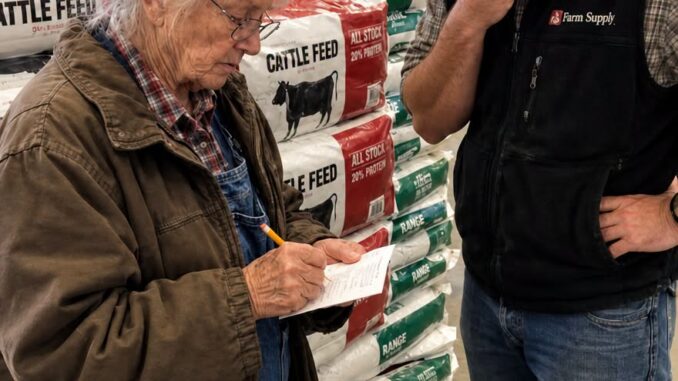
“Hold up.” Caleb paused, a bag of feed half-lifted onto the cart. Travis Dawson walked across the store in our direction. At forty-six, he had grown a bit heavy around the middle, carrying his father’s broad shoulders and his mother’s sharp, narrow features. He wore a crisp button-down shirt paired with a fleece vest bearing the embroidered logo of Dawson Farm Supply, a smartphone clutched in one hand. Ignoring me entirely, he focused his gaze on Mom. “Sorry, Mrs. Carter,” he said. “Those are spoken for.” Mom let out a frown—something she rarely did. When she did, people instinctively stepped back. “Since when?” she asked. “About five minutes ago.” Caleb looked puzzled. “Nobody told me, Travis.” “I’m telling you now. Put them back on the pallet.” “Hold on a second,” I said. “What do you mean, spoken for? They were sitting right out here. No one mentioned anything about them being reserved.” Travis finally flicked his eyes toward me. “Hey, Jess.” “Hey, Travis. What’s going on?” He sighed, acting as though I were being troublesome. “A commercial buyer called a few moments ago,” he said. “They want every single bag of feed I have left in stock. All of it. And they offered a premium.” “How much extra?” I asked. “That’s between me and the buyer.” Mom glanced down at the bags, then back up at him. “But we got here first,” she pointed out. Her tone wasn’t laced with anger; she stated it as plainly as someone pointing out that it was raining. Just a straightforward fact. Travis gave a light shrug. “Business is business, Mrs. Carter.” I felt my jaw clench. Mom needed that feed. Not just wanted it—needed it. We had ninety-seven head of cattle confined to that barn and only a single day’s worth of feed remaining. The nearest alternative supplier sat nearly forty miles away in Perry, and the weather report predicted freezing rain by midday. Before nightfall, every single road in the county would turn into sheet ice. If we left empty-handed today, we might be stranded without feed for days. And Travis Dawson was well aware of that. Mom had been a patron of that store before I was even born—even before Travis was born. She’d purchased her first set of work gloves there back in 1972, a twenty-one-year-old newlywed farm wife who could barely tell a heifer from a steer. Travis knew that history, too. He had sat at our kitchen table eating her homemade peanut butter sandwiches. She had patched up his scraped knee in our driveway after he crashed his bike at age nine. She had delivered a casserole to his family every single week for three months straight in 1993 after his mother passed away. I parted my lips, loaded with plenty of choice words for Travis Dawson. Mom placed her hand gently on my arm. Just a light touch, but enough. I shut my mouth. She stared at Travis for a beat, then gave a slow nod. “Well,” she said, “I understand. You’ve got to earn a living.” Travis smiled, visibly relieved. “Glad you see it that way, Mrs. Carter. I knew you would.” He turned his attention back to Caleb. “Put them back.” Caleb hesitated, glancing at Mom, then at me. Finally, staring down at the floor, he began lifting the feed bags one by one, moving them off the cart and back onto the pallet. Every dull thud of a fifty-pound bag striking the wooden pallet felt like a direct insult. I stood rooted in place, hands balled into tight fists inside my coat pockets. I couldn’t wrap my head around Mom letting this slide—Ellen Carter, the same woman who once chased a dishonest cattle buyer off our land with a broom handle because he tried swindling Dad out of two hundred dollars. Yet she didn’t utter another syllable. She simply walked over and stood quietly beside the counter.
Leave a Reply