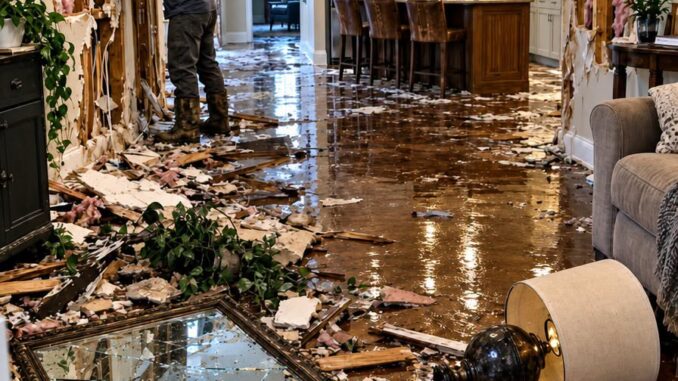
After Eight Months of Dviorce Battles, the Judge Finally Awarded Me Our House. But When I Walked Inside, I Found Holes in the Walls, Every Faucet Running, and My Grandmother’s Precious Antique Mirror Sm3shed Across the Floor. My Ex-Husband Thought He’d Left Me With One Final Cruel Surprise. Then My 68-Year-Old Father Walked Into Court Wearing a Suit—and Revealed Something My Ex Never Expected. The initial sound that greeted me upon unlocking the front entrance was flowing water. Not a gentle dripping. Not a broken pipe. Water cascading at full pressure somewhere inside the residence. I remained on the porch with my key still inside the lock, listening intently. For a brief moment, I wondered if perhaps I had left something running during my previous visit. Then I recalled that I hadn’t stepped inside for months. Brian had been residing there by himself. And his deadline to vacate had passed the day before. My stomach tightened anxiously. Somehow, before I had even crossed the threshold, I sensed that my former husband had left me an unpleasant discovery. My name is Nicole Harmon. I am thirty-seven years old, and I had just endured eight grueling months of divorce proceedings. When the judge finally granted me ownership of the house, I believed the worst was behind me. I could not have been more mistaken.
Over the course of the following days, Claire coordinated repair estimates. A drywall specialist inspected the three structural cavities. A plumber checked out the bathrooms and water heater system. Fortunately, the drains had remained unblocked, averting a catastrophic flood. However, persistent moisture had warped a portion of the upstairs bathroom flooring. Moreover, the water heater had operated continuously. One contractor surveyed the wreckage and shook his head in disbelief. “Someone was harboring severe anger.” I offered a weary smile. “That is certainly one way of phrasing it.” The plumber offered a contrasting observation. “Whoever left those taps running understood how to squander an astronomical volume of water without instantly flooding the dwelling.” That insight stuck with me. Because Brian had always grown eerily quiet whenever fury consumed him. He rarely resorted to shouting. Instead, he turned ice-cold. Controlled. Calculated. And the destruction bore that exact fingerprint. Not a spontaneous emotional outburst. Rather, a premeditated act engineered to inflict maximum distress while remaining difficult to prove.
On Wednesday afternoon, Claire requested my presence at her office. Upon my arrival, she handed over an email forwarded by Brian’s legal counsel. Brian outright denied responsibility for any intentional property damage. He asserted that the holes constituted ordinary wear and tear associated with moving out. He proposed that the running faucets might have been accidentally left open by unknown parties. Furthermore, he maintained absolute ignorance regarding how the mirror came to be broken. I stared blankly at the printed page. “Unknown parties?” Claire let out a heavy sigh. “Nicole—” “Who else could possibly have been residing there?” “I fully comprehend.” “And the mirror simply decided to shatter itself?” She offered a look that conveyed a silent warning against repeating such sarcasm in a court of law. Then she reached for an alternative document. It was a formal motion filed by Brian’s attorney shortly before I stumbled upon the devastation. Brian was petitioning the court to diminish my rightful portion of remaining marital assets. Retirement portfolios. Savings funds. Capital linked to our secondary vehicle. He was demanding that nearly one-third of my remaining share be stripped away. His stated justification was financial distress. I stared incredulously at Claire. “He is actually claiming financial hardship?” “Affirmative.” “Yet he earns considerably more than I do.” “I am well aware.” “He drives a brand-new truck. He put down a hefty deposit on a lakeside condominium.” Claire tapped her pen rhythmically against the desktop. “What ultimately matters is what the court can legally substantiate.” Then her eyes drifted toward the photographs depicting the ruined home. “He filed this particular motion prior to your discovery of the incident.” I caught the full implication of her point. Brian had evidently anticipated positioning himself as a struggling, cash-strapped individual. He had never foreseen the judge viewing tangible evidence that the premises he had just vacated suffered deliberate sabotage. At least, that was my fervent hope.
Brian was already seated beside his legal counsel when we walked into the courtroom. He sported a sharp navy suit and had recently trimmed his hair. He projected an aura of confidence. Relaxed. Almost pleased with his own reflection. Upon spotting me, his expression remained largely unchanged. However, his gaze subsequently shifted toward my father. And an immediate transformation occurred. His shoulders went rigid. His mouth set into a hard line. For a fleeting second, he appeared genuinely terrified. Then he quickly averted his eyes back toward his documentation. I leaned closer to Dad. “Did you catch that reaction?” He kept his eyes fixed upon the magistrate’s dais. “Let Claire manage today’s session.” A heavy knot formed deep within my gut. Judge Alvarez stepped into the room moments later. We rose to our feet. Then the formal hearing commenced. Claire exhibited the photographic evidence of the wreckage. The three drywall breaches. The running water taps. The water meter logs. The saturated flooring. The contractor estimates. The judge scrutinized each piece of documentation meticulously. Next, Brian’s attorney took the floor. He portrayed his client as an individual subjected to immense emotional and financial strain. According to his narrative, vacating the matrimonial home had proved deeply traumatic. Any subsequent property damage could easily have occurred by pure accident. The taps might have been left flowing unintentionally. And the structural holes could have resulted from careless moving logistics. I sat in absolute stillness, absorbing his words. Then he pivoted to the financial settlement proposals. He outlined Brian’s ongoing rent obligations, legal expenses, vehicle payments, and miscellaneous overhead. He petitioned the court to slash my portion of remaining assets on the grounds that Brian was allegedly facing severe monetary distress. As he concluded his arguments, I felt my father’s hand shift beside me on the bench. Dad leaned forward. Then he whispered something quietly into Claire’s ear. I failed to catch the specific wording. Yet I observed her immediate reaction. Her eyes widened in surprise. She whipped her head around toward him. And across the courtroom aisle, Brian abruptly drained of color. My father slowly lifted his hand. “Your Honor?” The judge glanced up from her papers. Throughout eight months of litigation, Dad had never once addressed the bench. “Yes?” “If I may interject,” he stated clearly, “there is a matter I believe the court ought to consider.” Brian’s legal counsel leaped to his feet with an immediate objection. Dad was not an officially registered witness. He was not a named party to the lawsuit. The purported evidence had not been pre-disclosed. The judge listened to the competing arguments. Then she permitted my father to summarize the context, while emphasizing that counsel would subsequently debate admissibility. Dad stood erect. He buttoned the center button of his jacket. Then he faced the magistrate directly. “Your Honor, there exists a fact my daughter remains entirely unaware of.” I stared at him in disbelief. “Dad?” He kept his gaze averted from mine. “Three days prior to the deadline requiring Brian to vacate the premises, he placed a phone call to me.” My mouth instantly went dry. “I neglected to answer,” Dad pursued. “Consequently, he left a recorded voicemail.” Brian’s attorney resumed his frantic objections. The judge instructed my father to outline the background without presuming the recording would gain automatic entry into evidence. Dad gave a single nod. “That message runs for forty-seven seconds.” He paused briefly. “Brian wanted me to pressure Nicole into dropping her fight over the remaining financial settlement.” I stared at my father in shock. “He claimed she would heed my counsel,” Dad continued. “And that I should convince her to fold under his terms.” Then his voice dropped to a somber register. “He additionally remarked that she would deeply regret forcing him out of that house.” The entire courtroom fell into absolute stillness. Brian bolted upright in his chair. “That is not what I implied!” His lawyer instantly clamped a hand onto his arm. The judge leveled a severe gaze at him. “Mr. Lawson, you will communicate exclusively through your legal representation.” Brian slumped back down. Dad pressed on. “He stated that if Nicole desired the house with such fervor, she could inherit it looking precisely how he chose to leave it.” A chilling shiver raced down my spine. The drywall holes. The running taps. The ruined bathroom. My grandmother’s precious mirror. Suddenly, those acts bore no resemblance to the work of a man who simply lost his temper on moving day. They were calculated acts of sabotage. My father lowered his gaze to the floor. “I preserved that voicemail.” With that, he resumed his seat. The opposing attorneys immediately plunged into legal arguments regarding whether the recording met admissibility standards. Brian’s counsel protested lack of prior disclosure. Claire countered by establishing relevance concerning intent and credibility. Judge Alvarez ruled that the audio file be securely preserved, noting she would weigh its evidentiary value alongside existing testimony. She then announced a brief recess.
The moment we stepped out into the corridor, I whipped around to face Dad. You had an inkling he might pull something like this?” “Negative,” he replied. “Dad.” “I figured he would leave the place untidy. Perhaps pocket a few items he had no right taking. I never in my wildest dreams imagined he would smash the walls or your grandmother’s mirror.” “Then why on earth did you withhold this from me?” He looked utterly exhausted. “Because I knew precisely how you would react.” I crossed my arms defensively. “And just how would I have reacted?” “You would have hopped into your car, driven straight over there, and confronted him face-to-face.” I opened my mouth to argue. Then snapped it shut. He was entirely correct. Had he informed me that Brian threatened retribution for keeping the house, I likely would have rushed right over. By myself. While Brian still occupied the interior. Yet that realization failed to soothe the sharp sting of betrayal. “I am thirty-seven years old,” I asserted. “You do not possess the right to harbor secrets from me under the guise of parental protection.” Dad nodded heavily. “I understand.” “You ought to have told me.” “I know, Nicky.” He sank down onto a wooden bench. Then he looked up at me. “Sometimes a father recognizes that his daughter is strong enough to bear the truth, yet he still commits the error of trying to shield her anyway.” I lingered there for a moment in silence. Then sat down beside him. “Is there anything else you are keeping from me?” Dad did not answer instantly. My stomach tightened anew. “Dad?” He glanced toward the heavy courtroom doors. “There was a second call.” I turned sharply toward him. “Another call originating from Brian?” He nodded affirmatively. “What could he possibly want?” Dad lowered his voice to a whisper. “He asked me to commit perjury.” I stared at him, stunned. “Regarding what matter?” “The mirror.” For a span of seconds, speech deserted me entirely. Throughout the divorce proceedings, Brian had insisted Grandma Lena’s mirror constituted a wedding present meant for both of us. My father knew that narrative was a complete fabrication. He had personally gifted it to me prior to my acquaintance with Brian. Yet, apparently, Brian had approached him with a quid pro quo proposition. If Dad agreed to corroborate Brian’s false story, Brian would drop his contests regarding several other marital assets. Furniture. Savings accounts. An automobile. Items we had bickered over for months. In exchange, Dad merely needed to testify that Grandma Lena intended the mirror for shared ownership. “He argued it would streamline things for your benefit,” Dad explained. “So you could secure the remaining property without enduring another grueling battle.” I stared at him in disbelief. “He attempted to bargain with you utilizing my personal heritage?” “Affirmative.” “And you turned him down?” “Naturally.” I swallowed hard. “What transpired next?” Dad’s jaw tightened into a hard knot. “He stated, ‘Then perhaps nobody gets to keep the mirror at all.’” I felt as though the oxygen had been violently knocked from my lungs. Everything suddenly fell into sharp focus. Brian had never fought for the mirror out of affection. He had never intended to sell it. He never believed it rightfully belonged to him. His sole objective was to strip away an irreplaceable piece of my past. And when the court thwarted that effort, he smashed it to pieces. Not because the physical glass carried a $400 market value. But because it embodied memories no amount of currency could ever repurchase. I sat motionless beside my father, tongue-tied. He placed a heavy, reassuring hand between my shoulders. “I am deeply sorry, sweetheart.” “For what?” “For failing to speak up sooner. I keep torturing myself wondering whether I might have intervened at the house and prevented the destruction.” I shook my head slowly. “You possessed no way of predicting what he was capable of.” Yet Dad continued to look unconvinced.
When the session resumed, Claire questioned my father regarding the specifics of those phone communications. Brian’s attorney lodged repeated objections. The judge restricted the inquiry strictly to facts deemed pertinent. Dad answered with absolute composure. He outlined the threatening voicemail. The subsequent conversation. The proposed illicit bargain. His steadfast refusal. And Brian’s parting remark that perhaps nobody would retain the mirror. He refrained from exaggeration. He hurled no insults at Brian. He simply delivered unvarnished truth. Following his testimony, Claire exhibited one final piece of visual evidence. A close-up photograph of my grandmother’s shattered mirror. The fractured walnut frame. The broken carved rose. The glittering glass strewn across the hardwood floor. Judge Alvarez studied the image for an extended duration. Then Claire addressed the defense’s claim of financial hardship. She pointed out that committing deliberate sabotage against property prior to surrender does not demonstrate financial distress. Rather, it demonstrates premeditated malice. Brian’s attorney desperately insisted that no video captured his client inflicting the damage. No eyewitness stepped forward. And my father’s testimony remained a point of contention. The judge posed several pointed inquiries. Had Brian retained exclusive possession of the property right up until the deadline? Yes. Had he kept possession of the secondary key set? Yes. Was anyone alleging that I had engineered the destruction myself? No. Did Brian possess any credible alternative explanation for the ruined drywall, the flowing water, and the demolition of an item he fought tooth and nail over during mediation? His counsel hesitated visibly. Ultimately, he conceded that no coherent alternative narrative existed. Brian leaned over and whispered frantically into his ear. However, his lawyer simply shook his head in defeat. Then the magistrate delivered her formal verdict. Brian’s petition seeking to diminish my share of remaining assets was denied outright. The documented property damage costs were officially factored into the financial accounting. The associated repair expenses were levied directly against his portion of the settlement pool. The house remained unequivocally mine. And all lingering disputes concerning vehicles, savings, furniture, and retirement funds were finally settled. There was no theatrical speechifying. No dramatic slamming of a gavel. She simply articulated her rulings. Affixed her signature to the necessary decrees. And declared the hearing concluded. After eight arduous months, that resolution proved more than sufficient.
As we made our way back through the courthouse corridor, Brian hurried up behind us. “Nicole, hold on a moment.” I stopped in my tracks. perhaps out of sheer ingrained habit. After nine years of marriage, my instincts still conditioned me to turn when he uttered my name. Claire smoothly stepped directly between us. “Brian, any further dialogue must be channeled through legal counsel.” He completely ignored her presence. “You engineered things to make it appear as though I wrecked the entire property.” I stared directly into his eyes. Months prior, tears likely would have sprung forth. I would have argued until my throat went raw. He would have branded me hysterical. And somehow, I would have ended up defending my own emotional validity. Yet on that afternoon, raising my voice proved entirely unnecessary. “You smashed holes through the walls,” I stated plainly. “You possess no proof of that.” “You left every tap running wide open.” “You cannot substantiate—” “And you intentionally shattered my grandmother’s mirror.” His expression faltered. For a fleeting second, I thought I detected a flicker of shame. Then he dropped his tone. “Nicole, it was merely a pane of glass.” My father stepped up right beside me. He offered no threats. He did not raise his voice. He simply positioned himself close enough that our shoulders brushed. Then he remarked, with icy calm: “No. It was the one possession you knew you could never replace.” Brian stared at him. His mouth parted slightly. Then clicked shut. He offered not a single word in response. I turned my back on him. Flanked by my father on one side and Claire on the other, I strode down the hallway without looking back once. Over the ensuing weeks, the residence gradually began to reclaim the feeling of home. Contractors patched the drywall breaches. I took on the interior painting myself. I selected a warm, inviting cream shade designated as Morning Light. I devoted an entire weekend rolling fresh coats across the rooms while classic rock tunes echoed from a vintage radio. I repainted the guest bedroom as well. Those pale-green walls had long absorbed years of painful memories. Upon finishing, I paused in the doorway to survey the space. For the first time, it felt like an ordinary room. Unburdened by past sorrow. Merely a blank canvas awaiting whatever chapter came next. The plumber successfully restored the warped bathroom floor. The water heater proved entirely undamaged. Eventually, the utility statement arrived in the mail. It was staggering. I sat at the kitchen table staring at the figures for a lengthy duration. Yet under the court-mandated financial framework, the cost was debited directly from Brian’s settlement share. I forwarded the bill straight to Claire. And in due course, it was settled. The walls were repaired. The plumbing functioned flawlessly. Yet one single casualty remained beyond restoration. Grandma Lena’s mirror. Or so I firmly believed. Dad eventually tracked down an antique furniture restoration specialist named Abe operating out of a converted barn roughly an hour away. Dad personally transported the carton containing the fractured mirror fragments to his workshop. A week later, Abe placed a call to my phone. “I can salvage the vast majority of the original frame,” he informed me. My spirits lifted instantly. “The corner can be reconstructed. I can match the walnut grain. Even the chipped wooden rose can receive a fresh petal.” “And the glass itself?” A brief pause ensued on the line. “I am afraid the original glass cannot be salvaged.” I closed my eyes tightly. It had been antique glass boasting an aged, subtly distorted reflection. Abe could certainly substitute modern mirror glass. Yet it would lack that authentic historic character. “Will it lose the wavy effect?” I inquired. “Affirmative, honey.” I sat in quiet acceptance. Then I replied, “That is acceptable. Please install the new glass.” Abe retained the mirror for nearly two months. Dad checked in with him regularly regarding restoration progress. Then, on a crisp Sunday afternoon in December, I heard my father’s aging truck rumble up the driveway. Glancing outside, I watched him hoist something large and flat from the truck bed. It was securely wrapped in heavy moving blankets. He carried the piece inside the living room and leaned it gently against the sofa. “Go ahead,” he prompted. I dropped to my knees and unwrapped the protective coverings. And there it rested before me. Grandma Lena’s mirror. The walnut border had been impeccably restored. The damaged corner was smooth to the touch. The carved wooden roses looked stunning once more. The newly fashioned petal exhibited a slightly lighter hue compared to the rest, though discerning it required close inspection. And embedded within the frame was brand-new glass. Immaculately clear. Flawlessly transparent. For the very first time in my existence, my reflection did not appear…
Leave a Reply