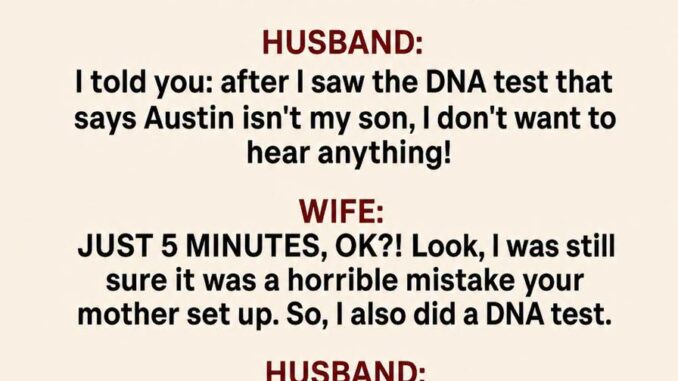
When our son was born, something inside me urged me to demand a paternity test. I couldn’t quite put my finger on why — perhaps doubt, perhaps panic — but I had to know for certain. My wife met my gaze with quiet calm and a slight smirk, asking, “And what if he isn’t?” I answered coldly, “Then I’m walking away. I won’t raise another man’s child.” Weeks later, the envelope arrived: I wasn’t the biological father. My entire universe shattered. Without uttering another word, I gathered my belongings, initiated a divorce, and cut off all communication. I walked away from the little boy I had once called my son. For three agonizing years, I carried pure fury. Anger at her, at myself, at the whole world. Then one afternoon, I bumped into an old friend of my ex-wife — and the truth she revealed completely wrecked me. She explained that my former wife had been devastated ever since the day I walked out. Following the test, she had returned to the facility demanding a recount. It turned out the testing center had made a clerical error. The samples had been accidentally swapped. My son had been mine all along. By the time the reality caught up to me, it was far too late. My ex had relocated, and my young boy barely retained a memory of me. I tried every way I could to reach her, but she ignored every attempt. Now, every single night, I sit staring at faded photographs — his tiny fingers wrapping around mine, his first smile, his first laugh — and I realize I let pride demolish everything that truly mattered. Sometimes the truth hurts more than lies… especially when it comes too late. The revelation could not simply erase those three lost years. I had treated a single piece of data as the final word on my marriage, shutting my ears to any other possibility. By the time I discovered the laboratory blunder, my bitterness had already driven choices that deeply impacted innocent lives with no way to undo them. False certainty made walking out feel simple. Facing what I had actually done was far more painful. I kept circling back to the gap between asking an honest question and deciding you already have the answer. My desire for clarity had twisted into an impulse to punish. I stopped looking at a family and started looking at a trial. In doing so, I left zero room for error in the information I was given. That friend could share what my ex-wife had discovered, but she couldn’t restore the ordinary days I had thrown away. A child’s growth doesn’t pause while grown-ups sort through their assumptions. Three years hold countless fleeting moments that cannot be put on hold until a mistake gets cleared up. That was the reality I could no longer run from. My initial reaction had been to view betrayal strictly as something inflicted upon me. The later revelation forced me to look at the damage caused by my own reaction. Whatever happened from that point on had to start with taking responsibility for that harm, rather than expecting a corrected test result to magically wipe the slate clean. The lab’s data had been flawed. But the choices I made afterward were entirely my own.
Leave a Reply